
Custom Stickers Melbourne
Custom Stickers Melbourne: The Complete 2026 Guide for Victorian Businesses Picture this: it’s a Thursday afternoon in a Brunswick café. The new logo finally landed

Australian educators face unprecedented demands in 2026 classrooms, where personalised learning approaches and positive behavior management systems are more crucial than ever. Personalised teacher stickers have emerged as one of the most versatile and effective tools for classroom management, student motivation, and educational organization. Whether you’re a primary school teacher implementing a new reward system, a high school educator organizing resources, or a teaching assistant supporting diverse learning needs, the right stickers can transform your classroom dynamics.
The modern Australian classroom is a complex ecosystem where teachers juggle differentiated instruction, inclusive education practices, and digital integration while maintaining positive learning environments for increasingly diverse student populations. In this dynamic setting, personalised teacher stickers serve as bridges between traditional recognition methods and contemporary educational psychology, offering immediate, tangible feedback that resonates across age groups and learning styles.
This comprehensive guide explores everything Australian educators need to know about personalised teacher stickers, from educational applications to fast delivery solutions that keep pace with your teaching schedule. We’ll delve into the psychology behind effective reward systems, examine practical applications across different educational contexts, and provide actionable insights for maximizing the impact of your personalized sticker investment.
The landscape of personalised teacher stickers has evolved dramatically to meet the sophisticated demands of contemporary Australian education. Today’s educators require more than basic smiley faces and generic praise phrases—they need strategic tools that align with evidence-based teaching practices while reflecting their unique classroom culture and educational philosophy.
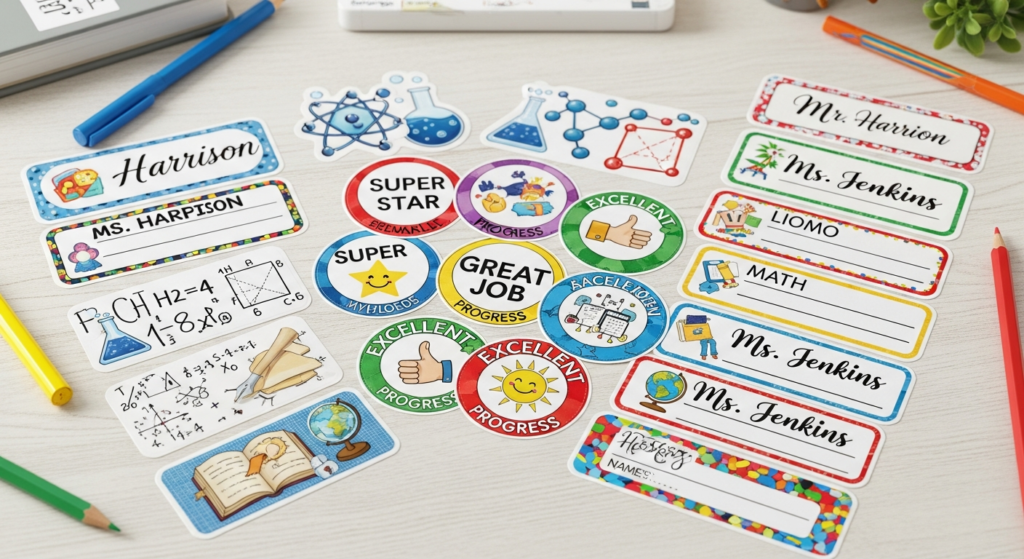
Reward and Achievement Stickers represent the cornerstone of positive reinforcement systems in modern classrooms. These customised recognition tools feature teacher names combined with specific positive messages such as “Excellent Work by Ms. Smith’s Class” or “Outstanding Effort – Mr. Chen’s Mathematics Students.” The personalization aspect creates a direct connection between student achievement and teacher recognition, fostering stronger relationships while building classroom identity.
Contemporary reward stickers have moved beyond simple praise to incorporate growth mindset language, specific skill recognition, and culturally responsive messaging. For instance, teachers working with Aboriginal and Torres Strait Islander students might include culturally appropriate imagery and acknowledgment phrases, while ESL educators can incorporate multilingual elements that celebrate linguistic diversity within their classrooms.
The psychological impact of receiving personalized recognition from a specifically named teacher cannot be overstated. Research in educational psychology consistently demonstrates that students respond more positively to individualized feedback, and personalised stickers create a tangible representation of this personal attention. When a student receives a sticker reading “Creative Thinking Champion – Ms. Wilson’s Innovation Lab,” they’re not just being rewarded for their work—they’re being welcomed into a community of learners with specific values and expectations.
Name and Identification Labels have become essential organizational tools in increasingly resource-rich classrooms where students interact with multiple learning materials throughout the day. These functional stickers feature teacher names, classroom numbers, or specific subject areas, enabling efficient labeling of supplies, books, personal items, and learning stations. The organizational benefits extend beyond simple identification to create visual consistency that supports student autonomy and responsibility.
Modern identification labels serve dual purposes: practical organization and subtle community building. When every item in a classroom bears consistent branding with the teacher’s name and thoughtful design elements, students develop a sense of belonging to something special and organized. This environmental psychology principle supports both classroom management and student engagement by creating visual cues that reinforce expectations and belonging.
Behavioral Management Stickers have evolved into sophisticated tracking tools designed for complex behavior support systems. These stickers integrate with behavior charts, individual behavior plans, and whole-school positive behavior frameworks. Custom designs include teacher names alongside specific behavioral goals relevant to individual classroom management approaches, creating accountability and celebration systems that support both teachers and students.
The effectiveness of behavioral management stickers lies in their ability to provide immediate, visible feedback that bridges the gap between abstract behavioral expectations and concrete recognition. When teachers use stickers labeled “Respectful Communication – Room 12” or “Collaborative Learning – Ms. Patterson’s Class,” they’re reinforcing specific behaviors while maintaining consistent messaging that students can internalize and replicate.
Subject-Specific Educational Stickers address the need for curriculum-aligned recognition tools that celebrate learning within specific academic disciplines. Mathematics teachers might use stickers celebrating “Problem-Solving Excellence – Mr. Rodriguez’s Math Lab,” while science educators could feature “Scientific Inquiry Champion – Dr. Kim’s Discovery Zone.” These targeted recognition tools help students develop subject-specific identity while maintaining connection to their classroom teacher.
The value of subject-specific stickers extends beyond recognition to curriculum support. When teachers consistently use stickers that reference specific skills, concepts, or thinking processes, they reinforce learning objectives through multiple sensory channels. Students begin to associate the visual elements of the stickers with the academic behaviors being celebrated, creating additional memory pathways that support retention and skill development.
Seasonal and Event-Based Stickers maintain engagement throughout the academic year by acknowledging special occasions, school events, and seasonal milestones while preserving teacher branding and classroom consistency. These might include designs for ANZAC Day commemorations, Science Week celebrations, or end-of-term achievements that maintain personal teacher connection while honoring broader educational and cultural contexts.
The strategic use of seasonal stickers helps teachers maintain momentum and excitement across the longer Australian school terms. By incorporating personal branding into celebratory recognition, teachers can participate in school-wide events while maintaining their individual classroom culture. This balance supports both school community building and classroom identity development.
Motivational and Inspirational Labels reflect individual teaching philosophies and encourage student growth through carefully crafted messages that go beyond generic praise. These stickers might feature growth mindset language, social-emotional learning concepts, or values-based messaging that aligns with specific classroom cultures and teaching approaches.
Understanding the popular uses for custom stickers across Australia reveals how educators successfully implement sticker programs across different educational contexts and grade levels, while Queensland Department of Education’s positive behaviour for learning framework provides official guidance on implementing positive behavior support systems that incorporate recognition tools like personalised stickers.
The diversity of personalised teacher sticker options ensures that every educator can find tools that align with their teaching style, student needs, and classroom management approach. This foundation of understanding different sticker types sets the stage for exploring their proven educational benefits and practical implementation strategies that enhance learning outcomes across Australian classrooms.
The integration of personalised teacher stickers into modern classroom practice represents more than a simple reward system—it embodies evidence-based educational psychology principles that support learning, behavior management, and positive teacher-student relationships. Understanding these benefits provides educators with the foundation necessary to implement sticker programs strategically and measure their impact on student outcomes.
Positive Reinforcement Psychology forms the theoretical foundation for effective sticker implementation in educational settings. Research consistently demonstrates that immediate, specific, and personal recognition enhances motivation, increases task engagement, and improves learning retention rates. When teachers use personalised stickers, they activate multiple psychological mechanisms simultaneously: the satisfaction of receiving tangible recognition, the social validation of teacher approval, and the intrinsic motivation that comes from seeing progress acknowledged.
The immediacy of sticker rewards addresses a critical challenge in educational feedback systems. Traditional grading and formal recognition often come days or weeks after student effort, diminishing their motivational impact. Personalised stickers allow teachers to provide instant positive feedback that captures and reinforces the specific moment when students demonstrate desired behaviors or achieve learning milestones.
Neuroscience research in educational settings reveals that positive recognition activates reward pathways in the developing brain, creating neural connections that associate learning behaviors with positive outcomes. When students receive personalised stickers, their brains release dopamine and other neurotransmitters associated with pleasure and motivation, literally rewiring neural pathways to support continued engagement with learning activities.
Classroom Management Enhancement through strategic sticker implementation transforms traditional behavior management from reactive discipline to proactive recognition systems. Teachers who implement comprehensive sticker programs report significant reductions in disruptive behavior, increased student cooperation, and improved classroom atmosphere. The key lies in creating systems that recognize positive behaviors consistently rather than only addressing negative behaviors when they occur.
Effective classroom management through personalised stickers requires systematic implementation that aligns with broader behavior support frameworks. Teachers must establish clear expectations, communicate recognition criteria transparently, and maintain consistency in sticker distribution to ensure equity and effectiveness. When students understand exactly what behaviors earn recognition and see that recognition distributed fairly, they develop intrinsic motivation to engage in positive classroom behaviors.
The predictability of sticker-based recognition systems provides essential structure for students who struggle with traditional classroom expectations. Students with attention difficulties, social anxiety, or processing differences often benefit enormously from clear, immediate feedback that helps them understand whether their behaviors align with classroom expectations. Personalised stickers create visual cues that support self-regulation and social skill development.
Student Engagement and Ownership increases dramatically when recognition comes from specifically named teachers through personalised stickers. The psychological impact of receiving acknowledgment from “Mrs. Thompson’s Reading Champions” versus a generic “Good Work” sticker demonstrates the power of personal connection in educational recognition. Students develop stronger relationships with teachers who take the time to create personalized recognition systems.
This personal connection extends beyond individual teacher-student relationships to encompass classroom community building. When students see consistent branding and messaging through personalised stickers, they develop a sense of belonging to something special and intentional. This classroom identity supports both academic and social-emotional learning by creating shared experiences and common language around achievement and behavior.
Student agency develops naturally within well-designed sticker systems when teachers involve students in setting goals, tracking progress, and celebrating achievements. Rather than passive recipients of teacher recognition, students become active participants in their own learning journey, using sticker accumulation as data for self-reflection and goal setting.
Differentiated Learning Support through personalised stickers addresses the diverse needs present in every Australian classroom. Students with disabilities, language learners, and gifted students all benefit from recognition systems that can be customized to acknowledge different types of achievement and progress. Personalised stickers allow teachers to celebrate effort alongside achievement, recognizing growth rather than just final outcomes.
For students with special needs, personalised stickers provide concrete evidence of progress that supports both student confidence and parent communication. When teachers use stickers to acknowledge specific skill development or behavioral improvement, they create documentation that supports individualized education planning and progress monitoring.
English as a Second Language learners particularly benefit from visual recognition systems that transcend language barriers while building vocabulary through repeated exposure to positive English phrases and terminology. Personalised stickers become language learning tools while providing emotional support for students navigating new linguistic and cultural environments.
Data Tracking and Assessment capabilities inherent in systematic sticker programs provide teachers with valuable information about student progress, behavioral patterns, and program effectiveness. When teachers maintain records of sticker distribution, they gather data that supports instructional decision-making and individual student support planning.
Progressive educators use sticker tracking data to identify students who may need additional support, recognize patterns in whole-class behavior, and adjust instruction based on engagement levels. This data-driven approach transforms stickers from simple rewards into sophisticated assessment tools that support continuous improvement in teaching practice.
Communication with parents and administrators becomes more concrete and positive when teachers can reference specific recognition students have received through personalised sticker programs. Rather than focusing primarily on areas needing improvement, teachers can share evidence of student success and growth that builds positive relationships and supports home-school collaboration.
Building Classroom Community through consistent use of teacher-branded stickers creates shared experiences and common language that unite students around positive learning goals. When every student has opportunities to receive recognition through personalised stickers, classrooms develop inclusive cultures where achievement and effort are celebrated consistently.
The visual consistency of personalised stickers contributes to classroom identity and school spirit in ways that support long-term learning engagement. Students develop pride in their classroom community when they see evidence of thoughtful teacher investment in their recognition and success.
Research from the Victorian Department of Education on positive classroom management strategies supports the integration of recognition tools like personalised stickers into comprehensive behavior support systems, while NSW Department of Education’s guidance on positive behaviour support reinforcement provides evidence-based framework for implementing effective recognition systems in Australian classrooms.
INSERT IMAGE HERE: Australian teacher applying a personalised reward sticker to a smiling student’s work, demonstrating positive reinforcement in action
The comprehensive benefits of personalised teacher stickers extend far beyond simple reward distribution to encompass fundamental improvements in classroom culture, student engagement, and learning outcomes. Understanding these evidence-based benefits provides the foundation for implementing design strategies that maximize educational impact and create lasting positive change in teaching and learning environments.
Creating educationally effective personalised teacher stickers requires more than aesthetic appeal—it demands understanding of visual psychology, developmental appropriateness, and practical classroom functionality. Professional design principles ensure that your investment in personalised stickers generates maximum educational return while reflecting your teaching professionalism and classroom culture.
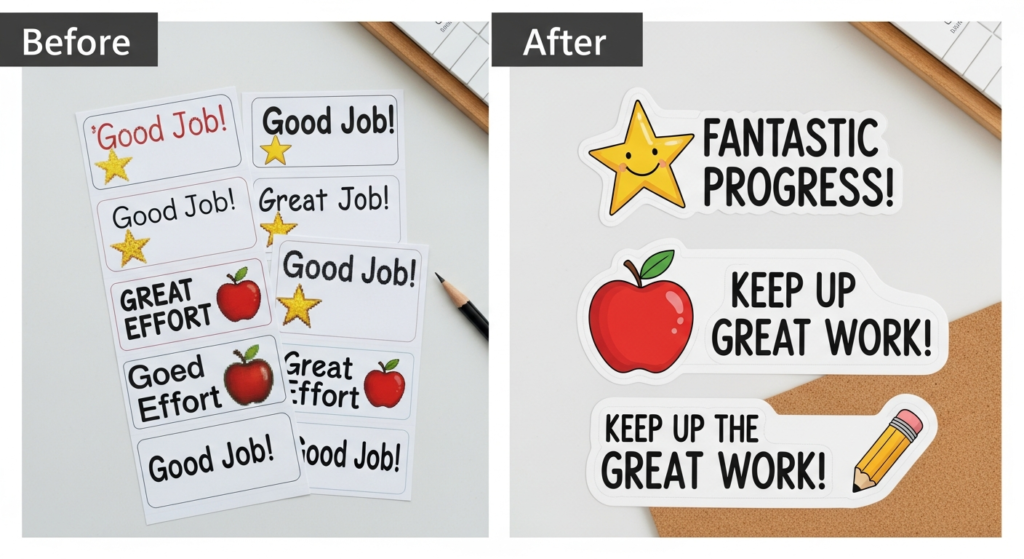
Readability and Clarity form the foundation of effective educational sticker design, particularly in diverse classrooms serving students with varying visual processing abilities and reading levels. Typography selection impacts both immediate recognition and long-term usability, requiring careful consideration of font families that maintain clarity at small sizes while conveying appropriate personality and professionalism.
Sans-serif fonts like Arial, Helvetica, or Calibri provide optimal readability for educational applications, especially when stickers will be viewed from varying distances or by students with visual processing difficulties. These fonts maintain clarity when reproduced at small sizes and photocopy well when teachers need to create supporting materials or documentation.
Font size considerations must account for the intended viewing distance and student age groups. Primary school applications typically require larger text (12-14 point minimum) to support developing reading skills, while secondary applications can utilize smaller fonts (10-12 point) that allow for more detailed messaging and sophisticated design elements.
Contrast requirements extend beyond basic visibility to encompass accessibility standards that ensure all students can engage with sticker-based recognition systems. High contrast combinations like dark text on light backgrounds or light text on dark backgrounds support students with visual impairments, dyslexia, or other learning differences that affect visual processing.
Color selection for text and background elements should consider both aesthetic appeal and practical functionality. Teachers working in classrooms with varied lighting conditions need designs that remain readable under fluorescent lights, natural sunlight, and digital projection systems commonly used in modern educational environments.
Age-Appropriate Visual Design requires understanding of cognitive and emotional development stages that influence how students respond to visual stimuli. Color psychology principles apply differently across age groups, with early childhood students responding positively to bright primary colors that signal excitement and celebration, while adolescent students prefer more sophisticated color palettes that acknowledge their developing maturity.
Elementary school sticker designs benefit from warm, energetic colors like orange, yellow, and bright blue that create immediate positive emotional responses. These colors support the high-energy, enthusiasm-driven learning environments that characterize effective primary education while maintaining visual appeal across diverse cultural backgrounds.
Middle school design considerations must balance childlike enthusiasm with emerging sophisticated preferences. Jewel tones, earth tones, and sophisticated color combinations acknowledge students’ developing aesthetic preferences while maintaining the positive energy necessary for effective recognition systems.
Secondary school applications often require more subtle, professional color schemes that respect adolescent identity development while maintaining educational functionality. Designs that could work in professional settings acknowledge students’ emerging adult identities while supporting continued engagement with recognition systems.
Imagery selection should reflect both cultural inclusivity and educational relevance while avoiding stereotypes or dated references that might alienate students or families. Modern educational sticker design incorporates diverse representation, contemporary imagery, and universal symbols that resonate across cultural backgrounds.
Cultural Sensitivity and Inclusivity considerations are particularly important in Australia’s diverse educational landscape, where classrooms regularly include students from dozens of cultural backgrounds, various socioeconomic circumstances, and different family structures. Inclusive design principles ensure that personalised stickers support all students rather than inadvertently excluding or marginalizing certain groups.
Language choices in personalised stickers should reflect contemporary Australian values while remaining accessible to students with varying English proficiency levels. Simple, clear positive language works effectively across cultural and linguistic barriers while maintaining specificity necessary for effective recognition systems.
Visual imagery must avoid cultural stereotypes while celebrating diversity through inclusive representation. Generic positive symbols, geometric patterns, and nature imagery often work well across cultural boundaries while allowing teachers to maintain personal branding and professional appearance.
Religious considerations may influence design choices in certain educational contexts, particularly regarding holiday-themed stickers or imagery that might conflict with family values. Teachers in diverse communities often benefit from consulting with school administrators and parent communities when developing comprehensive sticker programs.
Durability and Practical Considerations significantly impact design effectiveness, particularly regarding material selection, protective finishes, and size optimization for daily classroom use. Understanding how design choices affect longevity ensures that personalised stickers maintain their visual impact throughout extended use periods.
Material selection influences both appearance and functionality over time. Vinyl materials provide superior durability for high-use applications but may require different design approaches than paper materials to achieve optimal visual impact. Gloss finishes enhance color vibrancy but may create glare issues in certain lighting conditions, while matte finishes reduce reflection but may appear less vibrant.
Weather resistance becomes important for teachers who use stickers in outdoor educational activities, playground behavior systems, or classroom spaces with variable temperature and humidity conditions. Design choices that work well indoors may not translate effectively to outdoor applications without appropriate material selection.
Handling considerations affect both design scale and protective finish selection. Stickers that students will handle frequently require more durable materials and potentially larger design elements that remain recognizable even with minor damage or wear.
Brand Consistency and Teacher Identity integration allows educators to maintain professional appearance while expressing individual teaching style and classroom culture. Effective design balances personal creativity with institutional requirements and professional standards expected in educational environments.
Color scheme coordination with existing classroom décor creates visual harmony while establishing consistent recognition systems that support student learning. Teachers who invest in comprehensive classroom design benefit from sticker designs that complement their broader visual environment.
Logo integration, when appropriate, can include school logos, educational symbols, or personal teaching brands that reflect individual educational philosophy. However, design balance ensures that branding elements support rather than overshadow the primary recognition message.
Professional consistency across different sticker types creates comprehensive recognition systems that support various classroom functions while maintaining visual coherence. Teachers who use multiple sticker types benefit from design families that share color schemes, typography, and visual elements while serving different functional purposes.
Size and Format Optimization requires strategic consideration of intended applications, viewing distances, and practical handling requirements. Different classroom uses demand different size approaches to ensure maximum visibility and impact.
Individual reward stickers typically work best in smaller formats (1-2 inches) that provide sufficient space for meaningful messages while remaining practical for student collections and teacher distribution systems. These sizes work well for daily recognition while remaining cost-effective for regular use.
Larger recognition displays may require bigger formats (2-4 inches) that provide visual impact when posted on classroom walls or bulletin boards. These applications prioritize visibility from distance while potentially incorporating more detailed design elements.
Specialized applications like book labels, supply organization, or equipment identification may require custom sizing that balances functionality with design impact. Teachers benefit from understanding how size choices affect both immediate usability and long-term system effectiveness.
The comprehensive design tips for creating perfect custom stickers guide provides technical design aspects and material considerations specifically for custom sticker creation, while research on positive teacher-student relationships demonstrates how personalised recognition tools strengthen educational relationships.
Professional design principles transform personalised teacher stickers from simple rewards into sophisticated educational tools that support learning, build classroom community, and reflect teaching professionalism. Understanding these design fundamentals guides educators toward material and customization choices that bring creative visions to life with lasting educational impact.
Understanding the technical specifications and customization capabilities available for personalised teacher stickers empowers educators to make informed decisions that align with specific classroom requirements, budget constraints, and long-term educational goals. The material foundation of your sticker investment directly impacts both immediate functionality and sustained educational effectiveness.
Vinyl versus Paper Materials represents the fundamental choice that influences every other aspect of your personalised sticker investment. This decision affects durability, appearance, cost-effectiveness, and environmental considerations that teachers must balance against their specific classroom needs and usage patterns.
Vinyl materials provide superior longevity and weather resistance, making them ideal for classroom applications where stickers will experience frequent handling, exposure to varying temperatures, or potential contact with cleaning products and moisture. Elementary classrooms, outdoor learning environments, and high-traffic educational spaces benefit significantly from vinyl’s enhanced durability. The material’s resistance to fading, tearing, and water damage ensures that teacher investments maintain their visual impact throughout extended use periods.
The cost differential between vinyl and paper materials often balances out over time when considering replacement frequency and sustained visual quality. While vinyl stickers require higher initial investment, their extended lifespan often provides better value for recognition systems intended for long-term use or high-frequency distribution.
Paper materials excel in applications where cost efficiency takes precedence over extreme durability requirements. Teachers implementing temporary behavior tracking systems, seasonal recognition programs, or experimental sticker strategies often find paper materials provide adequate functionality while allowing for affordable testing and iteration.
Environmental considerations increasingly influence material selection as schools prioritize sustainability initiatives. Paper materials offer biodegradable options that align with environmental education goals, while high-quality vinyl materials provide reusability that may offset environmental impact through reduced replacement frequency.
Surface preparation requirements differ between materials, with vinyl applications benefiting from clean, smooth surfaces while paper materials adapt to slightly textured or irregular surfaces more readily. Classroom environments with painted walls, laminated surfaces, or varied textures may influence optimal material selection.
Adhesive Strength Options significantly impact both immediate functionality and long-term classroom management, requiring careful consideration of intended applications and removal requirements. Understanding adhesive technologies ensures that personalised stickers perform optimally without creating maintenance challenges or surface damage.
Removable adhesives provide flexibility for temporary applications, behavior tracking systems, and reusable recognition tools. These formulations maintain sufficient holding power for normal use while allowing clean removal without surface damage or adhesive residue. Teachers implementing experimental programs, seasonal displays, or student-controlled tracking systems benefit from removable options that adapt to changing needs.
The timeline for removability varies among formulations, with some maintaining clean removal for weeks while others provide this capability for months or years. Understanding these timelines helps teachers select appropriate adhesives for their intended use duration and replacement schedules.
Permanent adhesives create lasting bonds suitable for equipment labeling, long-term displays, and recognition systems intended for extended periods. While these applications sacrifice flexibility, they provide security against unauthorized removal and maintain consistent appearance over time.
Repositionable adhesives occupy the middle ground between removable and permanent options, allowing initial adjustment and repositioning while developing stronger bonds over time. These formulations work well for classroom organization systems where initial flexibility supports proper placement while eventual permanence provides long-term stability.
Special application adhesives address unique classroom challenges like textured surfaces, outdoor use, or extreme temperature variations. Teachers working in portable classrooms, outdoor education programs, or facilities with challenging environmental conditions benefit from specialized adhesive formulations designed for these applications.
Finish and Protection Options affect both visual appeal and practical durability, influencing how personalised stickers perform under various classroom conditions while maintaining their intended appearance and recognition value.
Gloss finishes enhance color vibrancy and provide natural protection against moisture, fingerprints, and general handling. The reflective properties create visual appeal that attracts attention while providing easy cleaning for stickers that accumulate dirt or handling marks. However, gloss finishes may create visibility challenges under certain lighting conditions or for students with visual sensitivities.
Matte finishes eliminate glare and reflection while providing sophisticated appearance that works well in professional educational environments. The reduced shine creates comfortable viewing under various lighting conditions while maintaining color accuracy and text readability. Matte finishes often appear more premium and professional, supporting teacher credibility and classroom aesthetics.
Protective lamination adds durability layers that extend sticker lifespan significantly while providing enhanced resistance to scratching, fading, and wear. Laminated stickers maintain visual quality under intensive use conditions while providing smooth surfaces that resist dirt accumulation and clean easily.
UV protection becomes important for stickers displayed near windows, in outdoor applications, or in classrooms with significant natural light exposure. Protected finishes maintain color vibrancy and prevent degradation that could compromise recognition system effectiveness over time.
Scratch-resistant coatings protect against damage from student handling, accidental contact, or cleaning processes common in educational environments. These protective layers maintain design integrity while supporting the active, hands-on learning environments that characterize effective education.
Shape and Size Customization capabilities enable teachers to create distinctive recognition systems that align with educational themes, subject-specific concepts, and memorable visual impact strategies. Custom cutting technologies transform basic circular or rectangular stickers into educational tools that support curriculum objectives.
Die-cut capabilities allow virtually unlimited shape options, from subject-specific symbols like mathematical equations, scientific instruments, or literary devices to fun shapes that appeal to specific age groups while maintaining educational relevance. Science teachers might choose molecule shapes, mathematics educators could select geometric forms, and language arts teachers might opt for speech bubbles or book shapes.
Size optimization requires balancing visual impact with practical considerations including cost, storage requirements, and application methods. Larger stickers create greater visual impact and allow more detailed designs but require more storage space and increase material costs. Smaller stickers provide economical solutions for frequent distribution while requiring simpler designs that maintain clarity at reduced scales.
Custom sizing allows precise matching to specific applications like standard behavior charts, existing recognition displays, or integration with commercial educational materials. Teachers implementing comprehensive behavior management systems benefit from stickers sized specifically for their chosen tracking methods and display materials.
Multi-sticker formats enable teachers to receive several different designs or messages within single orders, providing variety for comprehensive recognition systems while maintaining cost efficiency through bulk production. This approach supports differentiated recognition that acknowledges various student achievements and behaviors within unified design families.
Color and Printing Specifications determine both immediate visual impact and long-term color consistency, requiring understanding of printing technologies and color management systems that ensure professional results matching teacher expectations and classroom needs.
Full-color printing capabilities support sophisticated design approaches including photographic images, complex graphics, and detailed illustrations that create memorable recognition experiences. Modern digital printing technologies reproduce colors accurately while maintaining consistency across large quantities and repeat orders.
Pantone color matching ensures precise color reproduction that maintains consistency with school colors, existing classroom materials, or specific brand requirements. Teachers working within established institutional color schemes benefit from precise matching that maintains visual harmony and professional appearance.
Special finishing options including metallic inks, fluorescent colors, and specialty effects create attention-grabbing designs that stand out in busy classroom environments while maintaining professional appearance. These options work particularly well for special recognition, achievement celebrations, or highlighting exceptional accomplishments.
Color consistency across quantities ensures that bulk orders maintain uniform appearance throughout distribution periods. Professional printing systems maintain color accuracy from first to last sticker, preventing visual inconsistencies that could undermine recognition system effectiveness.
Quantity Considerations require balancing cost efficiency through bulk ordering with practical storage limitations and evolving classroom requirements throughout academic years. Strategic quantity planning supports both immediate needs and long-term recognition program sustainability.
Bulk pricing structures typically provide significant cost savings for larger orders while requiring increased storage capacity and longer-term planning. Teachers implementing comprehensive recognition systems often benefit from larger initial orders that provide cost efficiency while ensuring adequate supplies for extended periods.
Storage considerations include both physical space requirements and organization systems that maintain sticker quality and accessibility. Proper storage prevents adhesive degradation, protects against moisture and temperature fluctuations, and supports efficient distribution during daily classroom activities.
Program evolution considerations acknowledge that recognition needs may change throughout academic years as classroom dynamics develop, student needs evolve, and teaching approaches adapt. Flexible ordering strategies balance cost efficiency with responsiveness to changing requirements.
Collaboration opportunities with other teachers, grade levels, or departments can provide bulk pricing benefits while reducing individual storage requirements. School-wide or department-wide orders often achieve better pricing while distributing storage and planning responsibilities across multiple educators.
Fast Stickers provides comprehensive guidance through detailed customization options covering materials, finishes, and technical specifications, while specialized product lines including premium vinyl stickers for demanding applications and removable stickers for flexible classroom management systems address specific educational needs.

Understanding material options and customization possibilities enables educators to make informed decisions that maximize their personalised sticker investment while ensuring optimal performance in demanding classroom environments. This technical foundation supports appreciation of why delivery speed becomes crucial when teachers need these customized educational tools for immediate implementation.
The demanding pace of Australian educational environments creates unique urgency requirements that standard supply chains often fail to address effectively. Understanding why rapid delivery matters transforms personalised teacher stickers from helpful supplies into essential professional tools that support responsive, adaptive teaching practices.
Term Schedule Pressure creates relentless timelines where delayed materials can derail carefully planned educational initiatives and behavior management implementations. Australian schools operate on compressed term structures where every week contains critical learning milestones, assessment periods, and behavioral development opportunities that cannot be postponed or delayed.
When teachers design behavior management systems or recognition programs to address emerging classroom dynamics, they require immediate implementation to maintain momentum and effectiveness. A delay of even one week can mean missing the optimal intervention window for addressing specific student behaviors or capitalizing on teachable moments that support long-term learning outcomes.
Professional development initiatives often generate immediate needs for customized recognition tools as teachers implement new strategies learned during training sessions. The enthusiasm and commitment generated during professional learning experiences require immediate support through appropriate materials, or risk losing momentum as teachers return to previous practices.
Term planning cycles create concentrated periods where teachers must implement comprehensive classroom management systems, often at the beginning of terms when establishing routines and expectations proves most critical. Delays in recognition material delivery during these crucial establishment periods can compromise entire term success by forcing teachers to use generic, less effective alternatives.
End-of-term recognition events, graduation ceremonies, and achievement celebrations operate on fixed schedules that cannot accommodate supply delays. Teachers planning these important milestone events require certainty that their customized recognition materials will arrive in time to support student success celebrations appropriately.
Budget allocation periods often create narrow windows where teachers must utilize allocated funds before fiscal deadlines. Fast delivery ensures that educators can make purchases confidently, knowing they’ll receive materials within required timeframes rather than risking budget forfeit due to delivery delays.
Immediate Classroom Needs emerge unpredictably as teaching environments respond to student dynamics, unexpected opportunities, and evolving educational requirements that demand instant adaptation and response.
Behavioral intervention requirements often arise suddenly when individual students or entire classes experience challenges that require immediate positive support systems. Teachers cannot schedule these interventions for convenient delivery windows—they must respond immediately to support student success and prevent escalation of difficulties.
Recognition opportunities appear spontaneously when students achieve unexpected breakthroughs, demonstrate exceptional effort, or reach personal milestones that deserve immediate acknowledgment. Generic recognition lacks the impact and meaning that personalised acknowledgment provides, making rapid access to customized materials essential for maximizing these teachable moments.
Supply emergencies occur when existing recognition systems run out unexpectedly due to higher-than-anticipated student success rates, increased classroom enrollment, or expanded program implementation. Teachers cannot suspend positive reinforcement while waiting for supply replenishment—they need immediate replacement to maintain program effectiveness.
Integration opportunities arise when teachers discover new applications for recognition systems, want to expand successful programs, or need to adapt existing approaches to address newly identified student needs. Fast delivery enables responsive teaching that adapts to emerging opportunities rather than being constrained by supply limitations.
Event-Based Urgency characterizes many of the most meaningful educational experiences that require customized recognition but operate on fixed schedules that cannot accommodate standard delivery timelines.
School concerts, drama productions, and artistic showcases create opportunities for subject-specific recognition that celebrates creative achievement while building school community. These events operate on performance schedules that require recognition materials to arrive well before presentation dates to allow proper preparation and distribution.
Sports days, athletics carnivals, and competitive events provide ideal opportunities for recognizing effort, sportsmanship, and achievement through customized stickers that commemorate specific events while maintaining teacher branding. However, these events cannot be rescheduled to accommodate supply delays.
Parent-teacher conferences and family engagement events offer important opportunities to share evidence of student success through tangible recognition that parents can see and celebrate. Teachers need these materials available for scheduled conferences rather than having to make promises about future recognition delivery.
Assessment periods create intense recognition needs as teachers celebrate student achievement and effort during formal evaluation cycles. Recognition during these periods provides emotional support that helps students maintain confidence while demonstrating their learning progress.
Science fairs, art exhibitions, and academic competitions generate specific recognition opportunities that require customized materials reflecting both the achievement and the teacher’s personal investment in student success. Generic recognition undermines the significance of these special accomplishments.
Budget Cycle Considerations create artificial but unavoidable constraints that influence when educators can purchase supplies and how quickly they need delivery to ensure successful utilization of allocated resources.
End-of-financial-year purchasing deadlines force teachers to make supply decisions quickly while ensuring delivery before budget expiration. Standard delivery timelines often conflict with these administrative requirements, forcing educators to choose between desired materials and budget compliance.
Grant funding opportunities frequently come with rapid implementation requirements where teachers must demonstrate immediate program deployment to maintain funding eligibility. Fast delivery enables teachers to pursue funding opportunities confidently, knowing they can meet implementation deadlines.
Department budget allocations may specify timeframes for educational supply purchases that require rapid turnaround from selection to delivery. Teachers working within these constraints need supply partners who understand educational budget cycles and can accommodate administrative requirements.
Professional development funding often includes material purchase components that must be utilized within specific timeframes following training completion. Rapid delivery ensures teachers can implement learned strategies immediately while training content remains fresh and enthusiasm levels stay high.
Professional Flexibility enables educators to respond spontaneously to teaching opportunities, adapt to unexpected challenges, and maintain momentum in dynamic classroom environments where rigid supply schedules constrain educational effectiveness.
Responsive classroom management allows teachers to adjust recognition systems based on observed student responses, emerging behavioral patterns, or evolving classroom dynamics. This responsive approach requires supply flexibility that standard delivery schedules often cannot accommodate.
Spontaneous teaching opportunities arise when current events, student interests, or unexpected learning moments create chances to enhance education through immediate recognition and celebration. Teachers cannot schedule these opportunities—they must be prepared to respond immediately when they occur.
Adaptive educational strategies require materials that support flexible implementation rather than forcing teachers to conform to supply availability. Professional educators need partners who understand that effective teaching often requires immediate adaptation and response.
Collaborative planning with colleagues may generate shared recognition initiatives that require rapid implementation to maintain group momentum and enthusiasm. Standard delivery schedules can disrupt these collaborative efforts by forcing artificial delays in program implementation.
Competitive Advantage comparison with standard education supply industry practices reveals how Fast Stickers’ 2-3 business day turnaround with free express shipping across Australia transforms educational planning and implementation possibilities.
Traditional educational suppliers often require 2-3 weeks for custom products, forcing teachers to plan far in advance and limiting their ability to respond to immediate needs or emerging opportunities. This constraint reduces teaching effectiveness by preventing responsive, adaptive practice.
Standard shipping costs for expedited delivery often exceed reasonable educational budgets, forcing teachers to choose between rapid access and cost efficiency. Fast Stickers’ inclusion of express shipping eliminates this artificial constraint on educational effectiveness.
Quality control processes in traditional supply chains often extend delivery times unnecessarily while failing to provide meaningful quality improvements. Streamlined production and quality systems enable both speed and quality without forcing artificial trade-offs.
Customer service responsiveness varies dramatically across suppliers, with educational customers often receiving lower priority than commercial clients. Education-focused suppliers understand the unique urgency that characterizes effective teaching and prioritize accordingly.
The Fast Stickers contact page provides information about urgent order processing and same-day service options for critical educational needs, while Victorian Department of Education guidance on positive classroom management strategies provides context for why rapid implementation of positive behavior systems supports effective classroom management.

Understanding the critical importance of delivery speed reveals how Fast Stickers transforms the relationship between planning and implementation in educational settings, enabling responsive teaching that adapts to student needs rather than being constrained by supply limitations. This foundation supports appreciation of the streamlined ordering process that makes rapid, professional results accessible to every Australian educator.
Navigating the process of ordering personalised teacher stickers should enhance rather than complicate your educational planning and classroom management efforts. Understanding each step of the ordering workflow ensures successful outcomes while minimizing the administrative burden on busy educators who need professional results without extensive time investment.
Pre-Order Preparation establishes the foundation for successful personalised sticker implementation by addressing essential planning considerations that influence design choices, quantity requirements, and timeline management throughout the ordering process.
Quantity estimation requires understanding both immediate needs and long-term usage patterns to balance cost efficiency with practical storage and distribution requirements. Elementary teachers implementing comprehensive behavior management systems typically distribute 10-20 stickers per student per week, requiring calculations that account for class size, program duration, and potential expansion to other classroom applications.
Secondary educators often use stickers more selectively for special recognition, subject-specific achievements, or event-based celebrations, requiring different quantity calculations that prioritize impact over frequency. Understanding your intended usage pattern ensures appropriate quantity selection that provides adequate supplies without excessive storage requirements.
Budget planning should account for both initial sticker costs and potential expansion opportunities as successful programs generate demand for additional designs, sizes, or applications. Comprehensive budgeting includes consideration of storage supplies, application tools, and potential collaboration with other educators who might benefit from shared ordering arrangements.
Design concept development begins with identifying your core educational message, visual preferences, and practical requirements that will guide professional design creation or template selection. Effective concept development considers color psychology appropriate for your student age group, messaging that aligns with your teaching philosophy, and visual elements that complement your existing classroom environment.
Timeline planning must account for design development time, production schedules, and delivery requirements while building in appropriate buffers for approval processes and potential revisions. Realistic timeline planning prevents last-minute urgency while ensuring materials arrive when needed for optimal educational impact.
Collaboration opportunities with colleagues, grade-level teams, or subject departments can provide cost efficiency through bulk ordering while sharing planning responsibilities and storage requirements. Successful collaboration requires early communication about shared design elements, quantity distributions, and timeline coordination.
Design Submission Options provide multiple pathways for creating professional personalised stickers regardless of your design experience, technical skills, or available time for creative development.
Professional design services offer comprehensive solutions where experienced designers translate your educational concepts into polished, effective visual communications. This option works particularly well for educators who have clear ideas about desired outcomes but lack time or technical skills for design implementation. Professional designers understand both educational psychology and visual design principles that ensure optimal classroom impact.
The collaborative design process typically begins with consultation where you communicate your educational goals, aesthetic preferences, and practical requirements to experienced designers who translate these concepts into visual proposals. Multiple revision cycles ensure final designs meet your expectations while incorporating professional insights about educational effectiveness and visual appeal.
Template selection provides efficient solutions for educators who prefer structured design options while maintaining personalization capabilities. High-quality templates incorporate proven design principles while allowing customization of text, colors, and specific visual elements that reflect your individual teaching style and classroom culture.
Template customization typically includes modification of teacher names, classroom identifiers, educational messages, color schemes, and sometimes imagery selection from approved libraries. This approach balances efficiency with personalization while ensuring professional visual quality through tested design frameworks.
Artwork upload procedures accommodate educators who have existing designs, school-provided graphics, or specific imagery requirements that need professional reproduction on quality sticker materials. Clear guidelines about file formats, resolution requirements, and design specifications ensure optimal reproduction quality while preventing production delays.
Design collaboration tools enable iteration and refinement through digital proofing systems that allow review, revision requests, and approval confirmation before production begins. These systems provide confidence that final products will meet expectations while documenting the approval process for quality assurance.
Proof Review Process ensures complete satisfaction with design, messaging, and technical specifications before production begins, preventing disappointment and ensuring successful educational implementation.
Digital proof review allows detailed examination of design elements including color accuracy, text readability, proportional relationships, and overall visual impact. High-resolution proofs enable evaluation of how designs will appear at actual sticker sizes while providing opportunities to request modifications before production begins.
Revision procedures provide structured processes for requesting changes to design elements, messaging, or technical specifications based on proof review findings. Clear communication channels and revision tracking ensure efficient modification cycles that maintain project timelines while achieving desired outcomes.
Technical specification confirmation includes verification of materials, sizes, quantities, adhesive types, and finishing options that ensure final products meet classroom requirements and usage expectations. This confirmation prevents misunderstandings about product characteristics that could affect educational effectiveness.
Approval documentation provides written confirmation that designs and specifications meet requirements before production begins. This documentation protects both educators and suppliers by ensuring clear agreement about expected outcomes while providing reference materials for potential future orders.
Timeline implications of revision requests require understanding how design changes affect production and delivery schedules. Transparent communication about timeline impacts enables informed decision-making about revision priorities and helps maintain delivery deadlines when timing is critical.
Quality assurance measures throughout the proof review process include verification of text accuracy, color reproduction, proportional scaling, and technical specification compliance that prevents production errors and ensures professional results.
Production and Delivery Timeline provides realistic expectations for the complete process from order placement through classroom delivery, including understanding of factors that influence timing and options for expedited processing when urgent needs arise.
Standard production schedules typically require 1-2 business days for design development and approval cycles, followed by 1-2 business days for production, plus delivery time based on location within Australia. Understanding these standard timelines enables appropriate planning for non-urgent orders.
Rush order procedures accommodate educators with urgent needs through expedited processing that prioritizes critical orders while maintaining quality standards. Rush orders may include same-day design services, overnight production, or expedited shipping arrangements that ensure delivery within required timeframes.
Quality control processes during production include verification of design accuracy, color consistency, material specifications, and cutting precision that ensures professional results worthy of classroom use. These processes maintain quality standards while supporting efficient production schedules.
Delivery tracking systems provide real-time visibility into order progress from production completion through final delivery, enabling educators to plan classroom implementation activities with confidence about material arrival timing.
Geographic considerations affect delivery timing within Australia, with metropolitan areas typically receiving faster service than remote locations. Understanding these geographic factors supports realistic planning while enabling optimization of delivery arrangements when timing is critical.
Communication protocols ensure educators receive updates about order progress, any production challenges, and delivery confirmations that support classroom planning and implementation activities.
Quality Assurance and Support systems provide confidence that educational sticker investments will meet professional standards while offering ongoing support for successful classroom implementation and problem resolution.
Quality guarantee policies protect educator investments through clear commitments to product quality, accurate reproduction, and educational suitability. Understanding these guarantees provides confidence in ordering decisions while establishing clear recourse options if products fail to meet expectations.
Customer service resources include knowledgeable support staff who understand educational applications and can provide guidance about design optimization, material selection, and implementation strategies. Educational expertise among support staff ensures relevant assistance that addresses classroom-specific needs and challenges.
Post-delivery support includes follow-up communication to ensure satisfaction, assistance with implementation questions, and resolution of any quality concerns that emerge during initial classroom use. Ongoing support relationships build confidence in supply partnerships while providing resources for maximizing educational effectiveness.
Return and replacement policies provide clear procedures for addressing quality issues, shipping damage, or products that fail to meet specifications. Understanding these policies reduces risk in ordering decisions while ensuring protection for educational investments.
Technical support for design and implementation questions enables educators to optimize sticker usage for maximum educational impact while troubleshooting any challenges that arise during classroom implementation.
Ongoing Relationship Management establishes long-term partnerships that support sustained educational excellence through efficient reordering, program expansion, and strategic planning for evolving classroom needs.
Reorder procedures provide streamlined processes for reproducing successful designs while enabling modifications for program evolution or expanded applications. Efficient reordering supports program sustainability while maintaining cost efficiency through established relationships.
Design archive access enables educators to reference previous orders, modify successful designs for new applications, or coordinate related materials that maintain visual consistency across comprehensive classroom management systems.
Seasonal planning strategies help educators anticipate material needs for special events, term beginnings, or academic year transitions while taking advantage of optimal ordering timing and bulk pricing opportunities.
Program expansion support includes consultation about extending successful sticker programs to additional applications, collaborating with other educators, or scaling recognition systems to meet growing classroom needs.
Educational consultation services provide ongoing guidance about maximizing sticker program effectiveness, implementing best practices from other educational settings, and adapting programs based on observed student responses and educational outcomes.
The Fast Stickers shop provides direct access to online ordering systems with educational-specific options and bulk pricing for schools, while the custom quote system accommodates complex educational orders requiring special specifications or bulk educational discounts.
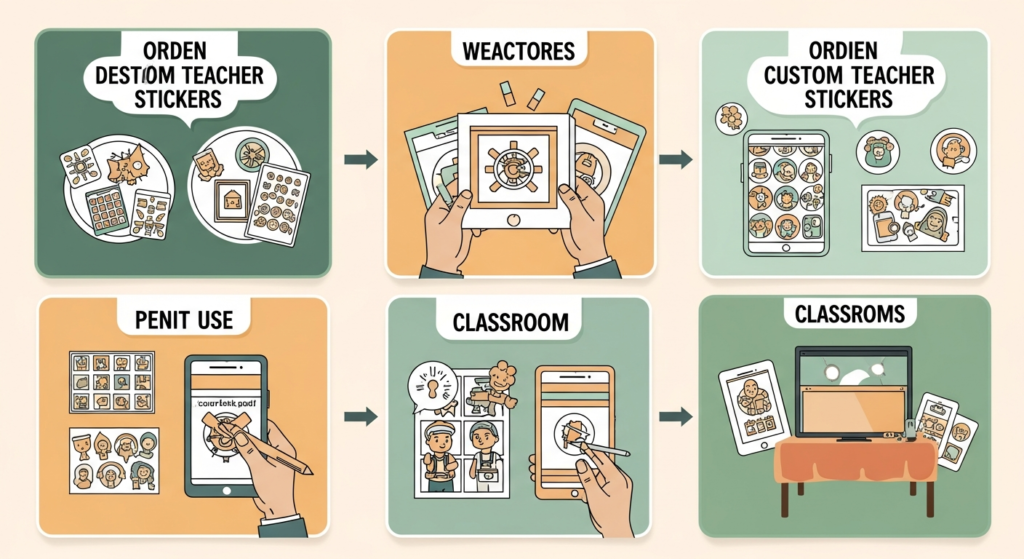
Understanding the complete ordering workflow transforms personalised teacher sticker acquisition from potential administrative burden into streamlined professional development that enhances educational effectiveness. This comprehensive knowledge empowers educators to implement sophisticated recognition systems that support student success while reflecting teaching professionalism and classroom culture.
INSERT IMAGE HERE: Happy Australian teacher showing off a variety of personalised stickers while students work enthusiastically in the background
Personalised teacher stickers represent far more than simple classroom supplies—they embody a comprehensive approach to educational excellence that recognizes the profound impact of individualized recognition on student motivation, classroom culture, and long-term learning outcomes. Throughout Australia’s diverse educational landscape, forward-thinking educators are discovering how strategic implementation of customized recognition tools transforms teaching effectiveness while building stronger connections with students, families, and school communities.
The evidence-based benefits of personalised recognition extend beyond immediate classroom management to encompass fundamental improvements in educational relationships, student engagement, and academic achievement. When teachers invest in recognition systems that reflect their individual teaching philosophy and classroom culture, they create learning environments where every student feels valued, acknowledged, and motivated to continue growing.
The strategic integration of high-quality, rapidly delivered personalised stickers enables responsive teaching that adapts to emerging opportunities rather than being constrained by supply limitations or administrative delays. Fast Stickers’ commitment to 2-3 business day turnaround with free express shipping across Australia eliminates traditional barriers that have prevented educators from implementing immediate, effective recognition systems when students need them most.
Quality customization options ensure that every educator can create recognition tools that align perfectly with their teaching style, student needs, and classroom environment while maintaining the professional appearance that supports credibility and effectiveness. From material selection through design optimization, comprehensive customization capabilities enable true personalization that enhances rather than complicates educational practice.
The streamlined ordering process transforms potentially complex supply management into straightforward professional development that supports rather than burdens busy educators. Clear workflows, responsive customer service, and educational expertise throughout the supply chain ensure that teachers can focus on teaching while confident that their recognition material needs are handled professionally and efficiently.
Most importantly, personalised teacher stickers serve as tangible representations of the caring, thoughtful, professional approach that characterizes excellent education. When students receive recognition that bears their teacher’s name and reflects specific achievement or effort, they experience the profound impact of personalized attention that builds confidence, motivation, and lifelong learning habits.
The opportunity to enhance your educational impact through professional, personalised recognition tools is immediately available through Fast Stickers’ comprehensive ordering system designed specifically for Australian educators. Don’t let another term pass without the customized recognition tools your students deserve and your teaching effectiveness demands.
Immediate Action Steps for Maximum Educational Impact:
Quick Orders for Busy Educators: Browse Fast Stickers’ education-friendly template collection and customize with your name, classroom identifier, and personalized educational messages. These tested designs incorporate proven educational psychology principles while allowing rapid personalization that gets professional recognition tools into your classroom within days rather than weeks.
Custom Design Collaboration: Partner with Fast Stickers’ experienced design team to create unique stickers that perfectly reflect your teaching philosophy, classroom culture, and student recognition goals. Professional designers understand both educational psychology and visual communication principles that ensure maximum impact while maintaining professional appearance that enhances your credibility and effectiveness.
Bulk Pricing for Schools and Departments: Contact Fast Stickers’ education specialists for special pricing on larger orders that serve entire schools, grade levels, or subject departments. Collaborative ordering provides cost efficiency while ensuring consistent recognition systems that support school-wide positive behavior initiatives and community building efforts.
Urgent Order Processing for Immediate Needs: When classroom situations require immediate recognition tool deployment, Fast Stickers provides expedited processing that can deliver professional results within 24-48 hours across major Australian metropolitan areas. Emergency support ensures that urgent student recognition needs don’t wait for standard delivery schedules.
Professional Consultation for Program Development: Access educational expertise that helps optimize sticker program effectiveness, implement best practices from successful classroom applications, and design comprehensive recognition systems that support long-term educational goals while maintaining practical classroom functionality.
Direct Contact Options for Immediate Support:
Join the Growing Community of Australian Educators who have discovered how Fast Stickers transforms recognition system effectiveness while supporting professional teaching practice. Thousands of teachers across Australia trust Fast Stickers for classroom recognition and organizational needs because of consistent quality, educational expertise, and reliable delivery that keeps pace with demanding educational schedules.
Your students are achieving, growing, and demonstrating effort that deserves meaningful recognition right now. Their next breakthrough, behavioral improvement, or learning milestone shouldn’t wait for generic supplies or delayed delivery. Professional, personalised teacher stickers create recognition moments that students remember for years while building classroom communities that support continued growth and achievement.
Make the investment in educational excellence that your teaching effectiveness and student success deserve. Contact Fast Stickers today to transform your classroom recognition systems with personalised stickers delivered at lightning speed across Australia.
Custom Stickers Melbourne: The Complete 2026 Guide for Victorian Businesses Picture this: it’s a Thursday afternoon in a Brunswick café. The new logo finally landed

Picture this: it’s 9pm on a Tuesday in a spare room in Bendigo, and you’re sitting cross-legged on the floor because the table ran out

Picture this. It’s Friday night in a suburban Australian street — the kind where the smell of melted cheese and wood-fired dough drifts through open

The Complete Australian Guide for Beekeepers and Honey Producers Picture this: it’s a warm December morning in the Yarra Valley. The flow has been extraordinary

Picture this: it’s 6am on the Saturday before Mother’s Day, and a florist in Melbourne’s inner north is already three hours deep into the morning.