

Custom Stickers Melbourne
Custom Stickers Melbourne: The Complete 2026 Guide for Victorian Businesses Picture this: it’s a Thursday afternoon in a Brunswick café. The new logo finally landed
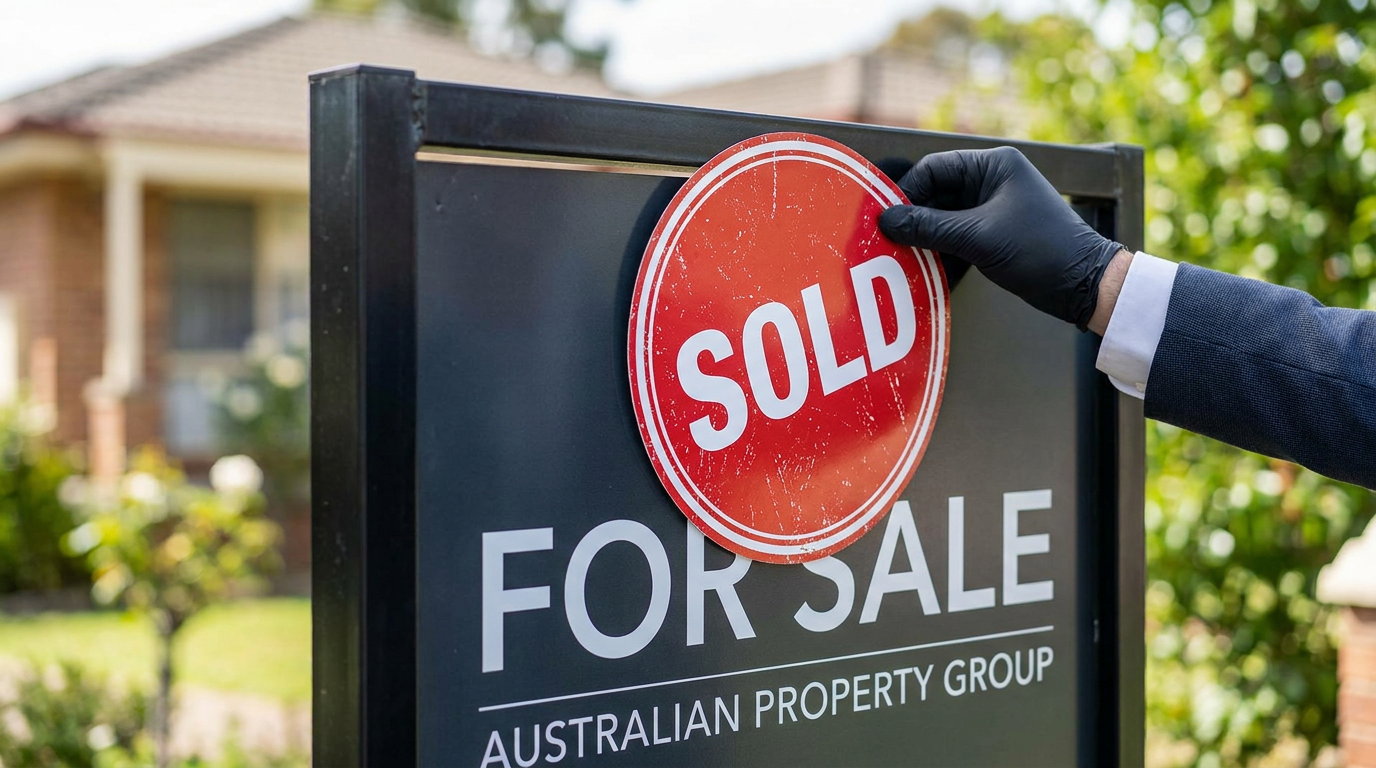
Picture this: It’s a Saturday afternoon in a quiet suburban street somewhere in Melbourne’s outer east. The open homes are done, the negotiations are over, and an agent — laptop bag slung over one shoulder — peels the backing off a bold, agency-branded SOLD sticker and smooths it firmly across the corflute board standing out the front of number 14. She steps back. She straightens it slightly. And before she’s even unlocked her car, the neighbour two doors down has her phone out, photographing the board for her own shortlist of agents to call about an upcoming appraisal.
That sticker cost less than a few dollars. It just did more targeted, street-level marketing work than a $500 social media boost — without an algorithm, without a click-through rate, without a campaign brief. It simply stood there, bold and branded, doing exactly what great marketing should do: communicating success to the right audience at the perfect moment.
Real estate sold stickers are one of the highest-ROI marketing tools available to Australian agents. And yet, they’re often treated as an afterthought — a compliance checkbox at the end of a campaign rather than the brand-building asset they genuinely are. This guide changes that thinking entirely.
Whether you’re a solo agent with a handful of listings or an agency principal managing a team across multiple offices, this is your complete reference for everything related to real estate sold stickers in Australia: materials, sizes, types (SOLD, Under Offer, Auction, For Lease), custom branding, correct application, and how to order smarter. The team at FastStickers.com.au has been printing premium stickers for Australian businesses for over 15 years — and real estate agencies are among their most loyal customers, for good reason.
Let’s get into it.
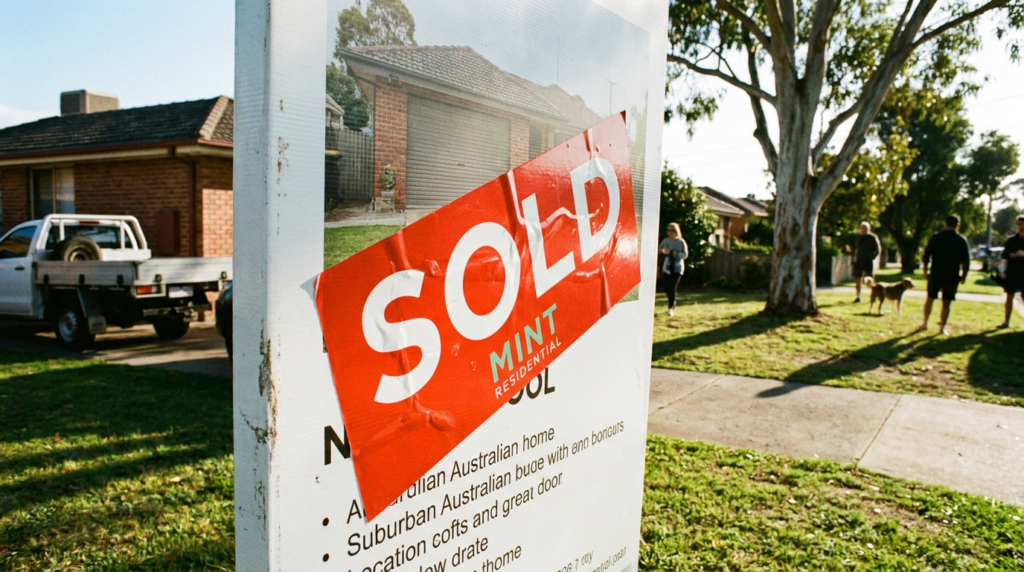
There’s a reason the most successful real estate agencies in Australia take their sticker game seriously. It’s not vanity. It’s not tradition. It’s pure, measurable marketing logic — and once you see the sticker not as a compliance step but as a branding instrument, everything about how you order, design, and deploy them changes.
Consider the audience. When a SOLD sticker goes up on a board in a residential street, who sees it? Not strangers passing through. Not people who have no connection to the area. The people who slow down, look twice, and pull out their phones are the neighbours — the exact demographic that statistically represents your most likely future vendors. They live in the same street. They own property at comparable values. They’ve been quietly watching the market. And right now, at the moment that sticker goes up, they are forming an impression of which agent just delivered a result.
This is what makes the SOLD sticker categorically different from almost any other marketing channel. The audience self-selects. The timing is perfect — social proof is being demonstrated at the exact moment a potential vendor is most receptive. And the cost is negligible relative to the impression being made.
The effect compounds when multiple listings in the same street or suburb carry the same agency’s branding. A street with three boards bearing the same logo, the same colours, the same bold SOLD treatment creates something rare and powerful in marketing: dominant presence. It signals to every owner on that street that this agency is active here, winning here, and trusted here. That kind of local saturation is something no digital campaign can replicate at the same cost per impression.
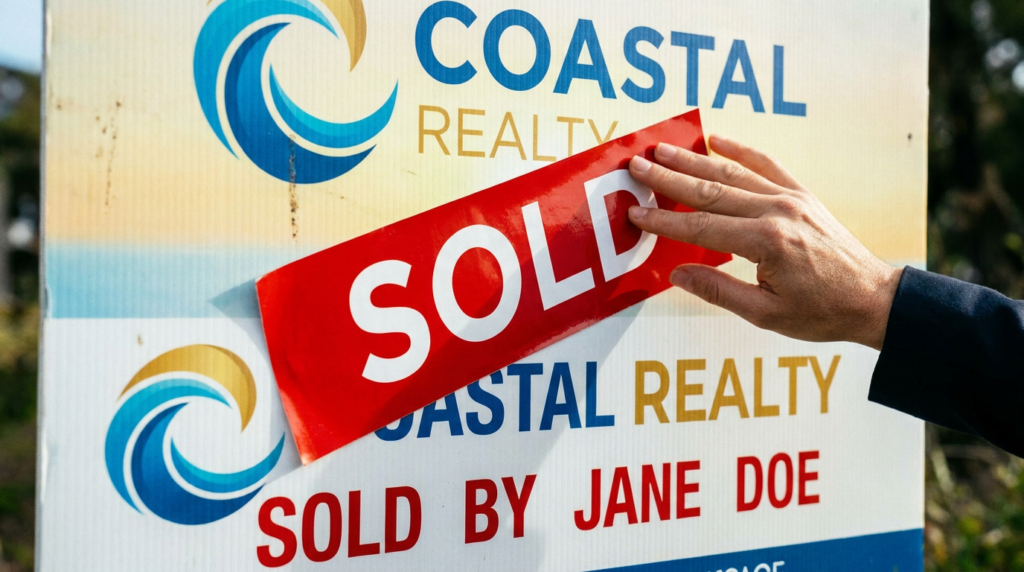
The social media dimension adds another layer of reach that costs nothing extra. SOLD stickers photograph well. Agents regularly capture that “board shot” for Instagram and Facebook — a quick post that extends the sticker’s visual impact from the street to hundreds or thousands of followers. The sticker becomes a content asset as well as a physical one, doubling its marketing utility without any additional spend.
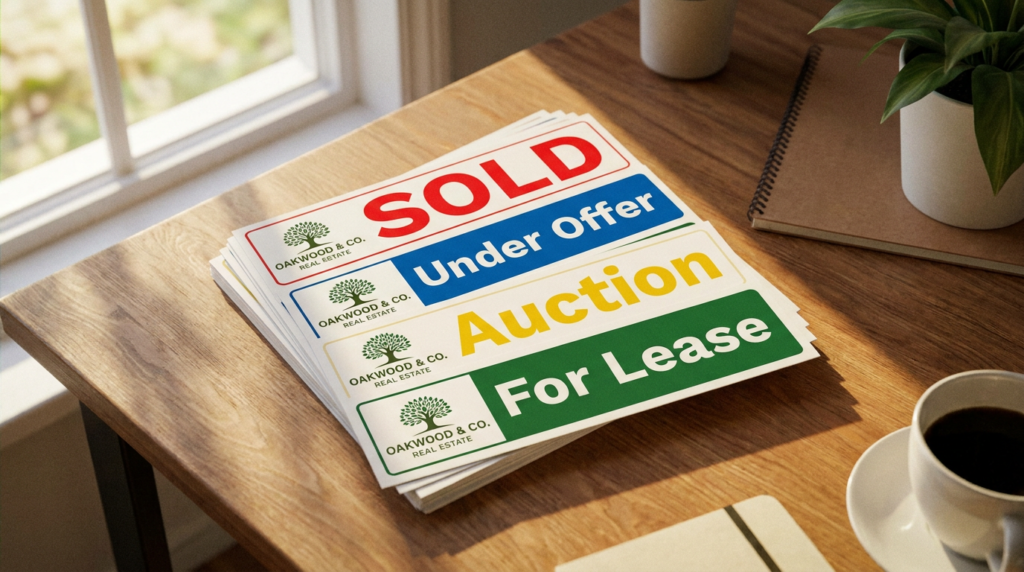
And the story doesn’t end with SOLD. Under Offer and Auction stickers build momentum and urgency during a campaign, communicating to competing buyers that time is running out and other parties are moving. For property management arms of agencies, For Lease and Leased stickers extend the same brand-building logic into the rental market — maintaining professional consistency across every board, every listing, every suburb the agency operates in.
The scale of opportunity here is significant. CoreLogic RP Data, Australia’s leading property data platform, records over 600,000 residential property transactions in Australia annually. Every single one of those sales represents a moment where a SOLD sticker could be doing branding work on a board in front of a property. For agencies that understand this, sticker procurement isn’t a minor operational task — it’s a marketing decision.
The ROI argument is almost embarrassingly straightforward. A custom-branded SOLD sticker from FastStickers.com.au costs a fraction of any other marketing format available to an agent. The commission earned on even a modest suburban sale is typically measured in the thousands. The sticker that helped build the brand that won the next appraisal? That cost a few dollars and was seen by everyone who lives within eyeline of the board.
With the why firmly established, it’s time to move into the what — because not all real estate stickers are the same, and understanding the full range of types and their distinct communication roles is the foundation of a smart sticker strategy.
Most agents think “sold stickers” and picture one thing: a bold red label slapped across a corflute board after exchange. And while that image is accurate, it’s only one piece of a much broader sticker vocabulary that professional real estate agencies use across the full lifecycle of every listing. Understanding each type — and what it communicates — is what separates agencies that treat stickers strategically from those that treat them as an afterthought.
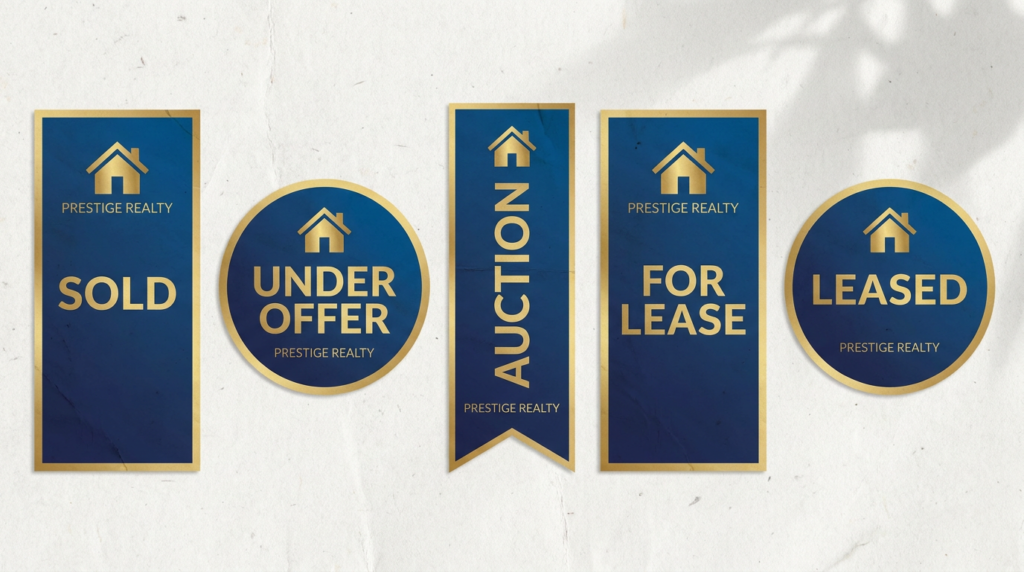
The SOLD sticker is the most recognised and most powerful in the range. Applied post-exchange, it signals a definitive outcome — the property has sold, the agent delivered, the campaign was a success. Bold typography, high-contrast colour, and agency branding make it the most photographed sticker type on any given street. It’s the one neighbours share on community Facebook pages. It’s the one that ends up in the agent’s social media feed. Design it well, and it earns attention long after the sale is settled.
These stickers occupy a critical phase of a campaign — after an offer has been received but before unconditional exchange. They serve a dual purpose: reassuring the vendor that the agent’s strategy is working, and creating urgency for any remaining interested buyers who haven’t yet moved. The terminology varies by state, which is an important distinction for agencies operating across borders. Under Offer is the more common terminology in Victoria and Western Australia, while Under Contract is typically used in Queensland and New South Wales. Agencies should align their sticker wording with the conventions of their state to maintain professionalism and avoid buyer confusion.
Auction stickers are campaign tools as much as status markers. They’re typically applied to boards in the weeks leading up to auction day, often featuring the date and time of the auction itself — “Auction Sat 12 Noon” is a classic format. They generate street-level urgency that no digital medium replicates quite as effectively. When a buyer drives past a property with a clear auction date on the board, the deadline becomes real and physical. For agencies that rely heavily on the auction method, these stickers are a non-negotiable part of the campaign toolkit.
Property management teams often operate as a separate division within an agency, but the brand standards should be identical. For Lease stickers maintain visual consistency across the rentals portfolio — same logo, same fonts, same colour palette — while distinguishing the board type from sales listings, typically through a different colour (blue and green are common for rental boards versus the red and black often used for sales). Every For Lease board in a suburb is a brand impression for the agency’s property management arm, and it deserves the same design rigour as any sales board.
Just as SOLD demonstrates sales success, Leased stickers demonstrate property management success. They signal to landlords in the area that this agency finds tenants quickly and manages properties professionally. In competitive rental markets — which have characterised most of Australia’s major cities in recent years — a Leased sticker going up quickly after a For Lease board appears is a powerful, visible indicator of agency performance.
“The agencies that run out of SOLD stickers are the ones winning the most listings — but they’re also the ones scrambling at the worst moments. The smartest agencies order by the kit, not the sticker.”
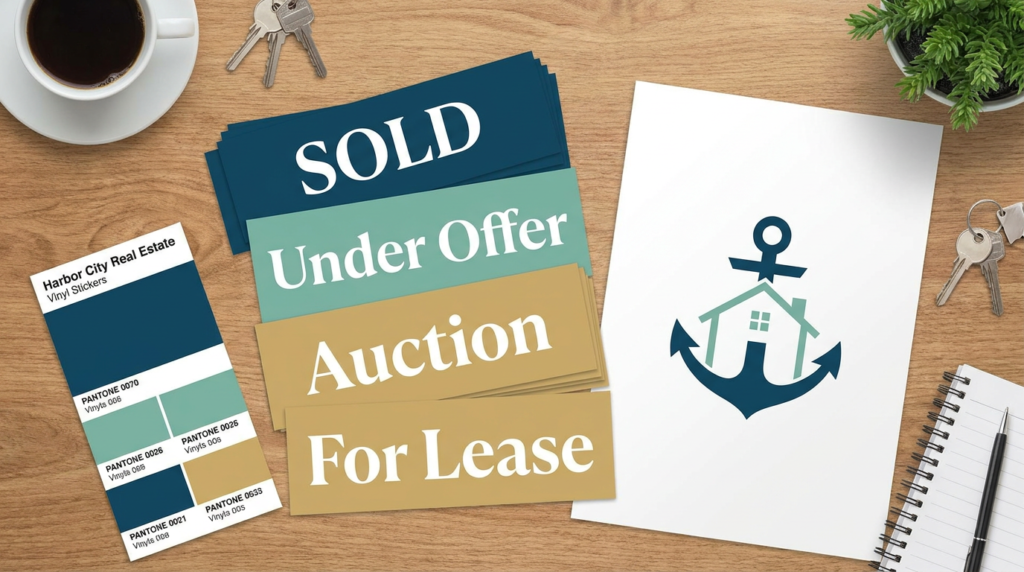
The most efficient approach is for agencies to order all sticker types together as a branded set — rather than reordering ad hoc after every sale or lease. Browse the full range at the FastStickers.com.au Shop to see the complete product offering, and consider die-cut sticker options if your agency uses custom-shaped signage that goes beyond the standard rectangular rider format.
Now that the full range is clear, the next critical decision — and one that significantly affects how well your stickers perform in Australian outdoor conditions — is material choice. Vinyl, removable, or high-tack: here’s what each one means and when each one is the right call.
This is where most agents get vague, and where most ordering mistakes happen. Sticker material isn’t a technical detail to leave to the printer — it’s a purchasing decision that directly affects how your sticker performs on a corflute board in the Australian climate, and whether your board comes out clean when the campaign is over. Get it right, and your stickers look sharp for as long as needed and come off cleanly when they should. Get it wrong, and you’ve either got a sticker lifting in the coastal wind or a corflute board ruined by adhesive residue.
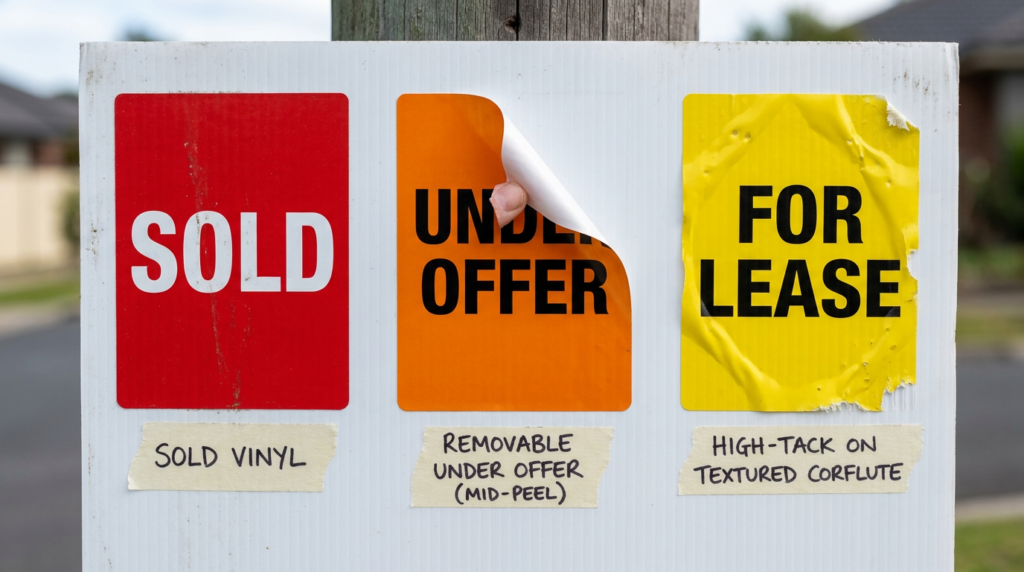
Standard vinyl stickers are the workhorse of the real estate sticker world, and for good reason. They’re durable, UV-resistant, and weather-resistant — designed to stay firmly in place and retain vibrant colour through weeks of Australian sun, rain, and wind. For SOLD stickers, Auction stickers, and any application where the sticker is going on and staying on until the board comes down, standard vinyl is almost always the right choice.
The UV-resistance factor is particularly important in Australia. In Queensland, Western Australia, and the Northern Territory, direct sun exposure can degrade inferior adhesive stickers within days — causing fading, lifting corners, and a decidedly unprofessional appearance on a board that’s supposed to be projecting success. Premium vinyl with UV-resistant inks and a laminated finish holds its colour and adhesion for four to eight weeks of outdoor exposure without issue.
Removable stickers use a low-tack adhesive specifically engineered to bond well enough to stay in place during a campaign, but release cleanly from the corflute surface without leaving residue or causing surface damage when peeled. This is the right choice for:
The clean removal capability is the key feature. Corflute boards represent a meaningful asset cost, especially for agencies managing dozens of listings simultaneously. Removable stickers protect that investment by allowing the board to be refreshed and redeployed rather than discarded when a sticker leaves adhesive residue or tears the surface on removal.
High-tack stickers use an aggressive adhesive formulation designed for surfaces that standard vinyl might not grip reliably. In real estate applications, this matters in specific scenarios:
For a deeper look at how UV exposure specifically affects outdoor sticker performance across Australia’s climates, the FastStickers UV Bumper Stickers guide is worth reading — it covers the science of UV-resistant inks and lamination in accessible, practical terms that apply equally to real estate sticker applications.
Beyond adhesive type, the finish choice has a real-world impact on readability. Gloss finishes produce vivid, saturated colour and are the standard for most real estate sticker applications — they’re high-impact and photograph beautifully. Matte finishes offer a premium, more understated aesthetic and reduce glare in direct sunlight, which can be a genuine readability advantage in sun-drenched locations. In practice, most agents in northern states lean toward matte for SOLD riders where sun angle creates glare; southern state agents tend to opt for gloss across all sticker types.
Here’s a quick breakdown of when to choose each material:
With the right material locked in, the next question every agent faces is sizing — specifically, how to size a SOLD sticker so it sits cleanly and professionally on the standard Australian corflute board formats used across every state.
Size is where guesswork is most expensive. A SOLD sticker that’s slightly too small looks underwhelming and amateurish. One that’s slightly too large creates overhang, lifting edges, and misalignment. Getting the dimensions right before you order — and understanding how rider stickers relate to the standard board formats used across Australia — saves time, money, and professional reputation.
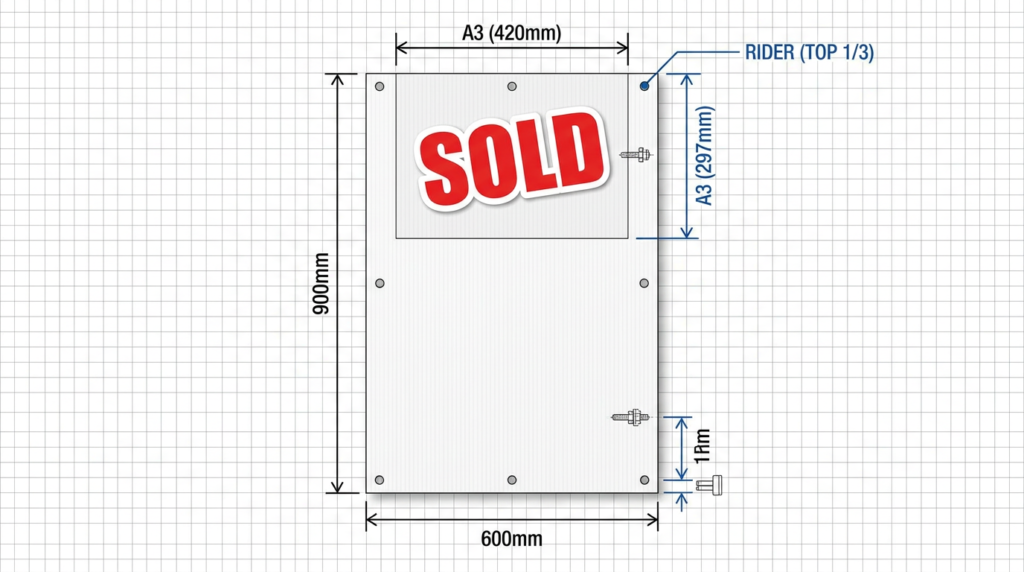
The residential listing board standard across Australia is a 600×900mm corflute board — portrait orientation, mounted on a single post or H-frame. This is the universal format you’ll encounter from Cairns to Hobart, from Perth to Sydney. Every sizing decision for real estate stickers starts with this reference point.
The most common SOLD sticker format is the rider — a sticker sized to overlay the top portion of an existing listing board, typically covering the “For Sale” heading and replacing it with the SOLD treatment. For a 600×900mm board, the two standard rider sizes are:
Some agencies prefer a full-board SOLD sticker — a single sticker that covers the entire face of the corflute board with a post-sale branded design. The correct dimension for a standard 600×900mm board is approximately 590×890mm, allowing a small margin to avoid the sticker overhanging the board edges. This format gives maximum visual impact and is often used by agencies that want a complete, redesigned board face rather than an overlay.
Premium listings and high-traffic locations often use larger 900×1200mm boards. For these, the rider sticker scales accordingly:
Not every agency uses the universal standard. Some use custom post systems, branded frames, or non-standard corflute dimensions. For these, FastStickers.com.au offers a custom quote service — simply supply the exact board dimensions and the team will confirm the right sticker size before production. This is always worth doing before placing a first order with any new board format.
Before preparing artwork at any of these sizes, the Artwork & Print Quality guide on the FastStickers blog is essential reading — it covers bleed allowances, safe zones, and resolution requirements that apply directly to setting up artwork at A3, A2, and custom real estate sticker dimensions.
The sizing reference in brief, for quick ordering:
With the size confirmed, the next layer that transforms a correctly-sized sticker into a genuine brand asset is the design itself — and the choices made here are what separate agencies whose boards are remembered from those whose boards are merely seen.
A SOLD sticker with your agency’s logo, colours, agent name, and contact number isn’t just a status update on a board. It’s a miniature billboard, a social media content asset, and a future vendor acquisition tool — all at once. The design decisions you make determine which of those things it actually becomes. Get the design right, and every sticker in every street is working for your brand. Get it wrong — or worse, use a generic sticker with no agency identity — and you’ve handed that marketing moment to nobody.
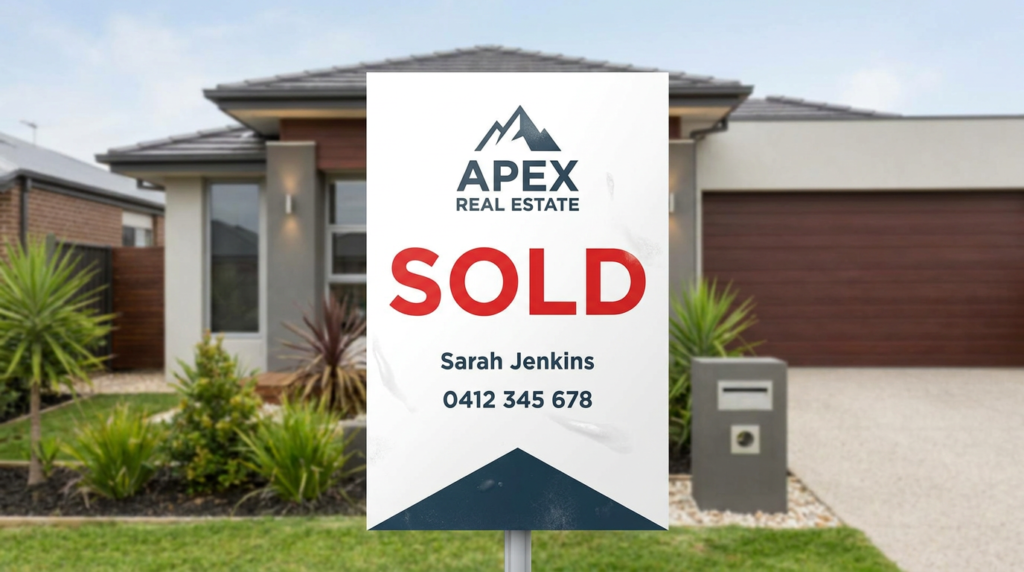
The single most important principle in real estate sticker design is consistency. Your SOLD sticker should be visually indistinguishable in brand language from your listing boards, your window cards, your social media templates, and your digital advertising. The same logo. The same typeface. The same colour values. The same proportional relationships between elements.
Why? Because brand recognition is built through repetition and consistency across touchpoints. If your SOLD sticker uses a slightly different shade of your brand blue than your listing board, the two don’t read as the same brand to the casual observer — and that undermines the cumulative impression you’re trying to build in a suburb. Brand drift, even subtle brand drift, erodes professional credibility.
Every well-designed real estate SOLD sticker should include:
For agencies working with an in-house designer or external studio:
For agencies with questions about technical file requirements, the FastStickers FAQ covers the most common artwork and ordering questions in plain English.
Not every agency has an in-house designer, and not every solo agent has a relationship with a design studio. FastStickers.com.au includes a free artwork design service for exactly this scenario. Provide your agency logo and brand colours, and the team will build a print-ready SOLD sticker design for your approval before anything goes to print. The Get a Quote page is the starting point for this service, and it’s straightforward — no design brief required, just your brand assets.
For agencies with an existing print-ready template, ordering is as simple as uploading the file, selecting the size and material, and confirming the quantity. Every file is reviewed by the FastStickers team before production — a quality check that catches sizing errors, low-resolution artwork, and colour mode issues before they become a problem on the printed sticker.
A perfectly designed sticker, however, still depends on correct application to deliver the professional result it promises. The next section covers exactly how to get that right in the field — and how to remove stickers cleanly when the time comes.
A premium branded SOLD sticker, misapplied, still looks amateur. Bubbles, crooked alignment, lifting corners — these are the kinds of small details that subtly undermine the professional image the sticker is supposed to project. The good news is that correct application is straightforward when you know the method. Here’s the field-guide version: everything you need to apply and remove real estate stickers properly, in the order you need to know it.
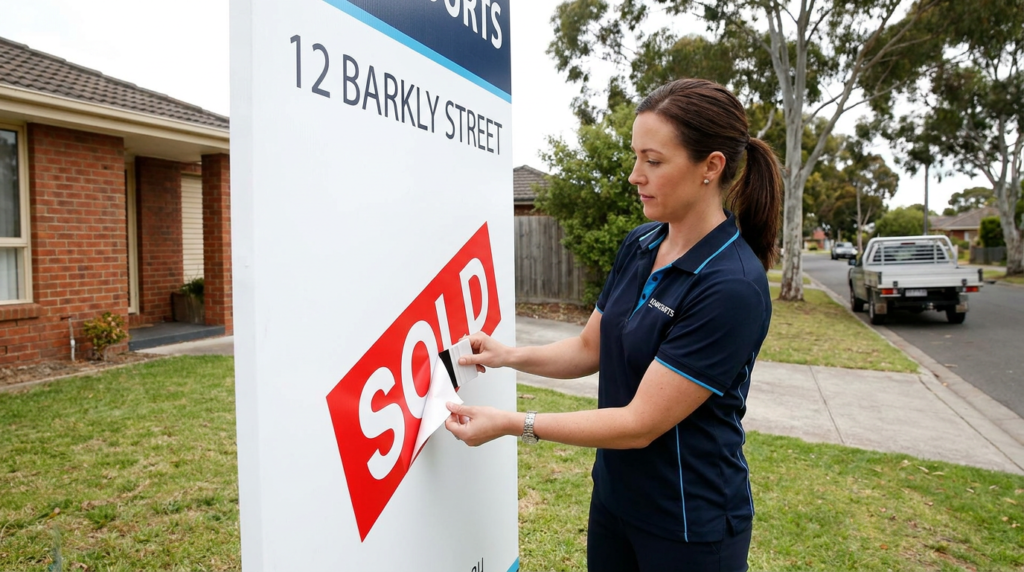
1. Clean the surface.
Wipe the corflute board with a dry or slightly damp cloth before applying any sticker. Dust, dirt, dried mud, or old adhesive residue all reduce initial bond strength and can cause lifting within days. Take thirty seconds to clean the surface; it’s worth it.
2. Check the temperature.
Apply stickers in moderate conditions — ideally between 10°C and 30°C. A board that has been baking in direct Queensland sun will have a surface temperature well above 30°C, which causes adhesive to set too quickly and can create bubbles that you cannot smooth out afterward. If the board is hot to the touch, move it into shade for a few minutes before applying. Conversely, cold conditions (below 10°C) reduce initial tack and can cause the sticker to fail to bond properly at the edges.
3. Lay the board flat if possible.
Applying a large A2 sticker to a board that’s upright and wobbling in the wind is a two-person job that often ends in misalignment. Wherever practical, lay the board flat on the tailgate of a ute or the ground to get a controlled, aligned application.
Step 1: Peel the backing from one corner or one short edge only — do not remove the entire backing at once. This creates a “hinge” that lets you position the sticker accurately before committing the full adhesive to the surface.
Step 2: Position the peeled corner against the board, align the sticker to your reference edges (board border, existing text, or a straight edge), and then slowly peel the remaining backing while smoothing the sticker down progressively.
Step 3: Use a squeegee, a credit card, or a firm cloth to smooth from the centre of the sticker outward toward the edges. Never smooth inward — you’ll trap air bubbles that have no exit path. Work in one direction, systematically moving toward each edge.
Step 4: Pay particular attention to the corners and edges after the main field is smooth. Press them firmly with a fingernail or the edge of the squeegee to ensure the adhesive has fully contacted the board surface.
Step 5: For large stickers (A2 or full-board), having a second person to hold one end while you peel and smooth from the other is genuinely useful — it’s not overkill, it’s precision.
Allow at least 24 hours for the adhesive to fully cure before the sticker is exposed to heavy rain, high wind, or extreme temperature. Inspect the edges the following day — press down any corners that haven’t fully bonded. Once fully cured, a quality vinyl sticker should stay firmly in place for its full rated outdoor lifespan.
For removable stickers, the removal process is straightforward when done correctly:
Real estate signage is subject to local government area (LGA) regulations across Australia, and the rules vary meaningfully from council to council — covering permitted board sizes, the duration for which boards can remain in place, and in some cases requiring permits for boards on public land. Agents should familiarise themselves with the rules in every LGA they operate in. The REIQ’s guidance on local council requirements for real estate signage is one of the most useful published references on this topic, particularly for Queensland agents — but the principle of checking LGA requirements applies equally in every state.
With application and compliance covered, the final piece of a smart sticker strategy is the ordering process itself — how to buy smarter, stock consistently, and get stickers fast when time is working against you.
Real estate moves fast. A property can go from listed to under offer to exchanged in a matter of days. An auction can sell under the hammer on a Saturday morning, and the agent will want that SOLD sticker on the board before she drives home. This is the reality of the industry — and it means the ordering strategy for real estate stickers needs to be built around speed, consistency, and smart stock management rather than reactive, last-minute orders.
The per-unit cost of stickers decreases meaningfully with volume — this is true of virtually all print products, and stickers are no exception. But the cost argument isn’t even the most compelling reason to order in bulk for real estate agencies. Brand consistency is.
When stickers are ordered ad hoc — one here, five there, a rush order after a big auction weekend — there’s a real risk of minor inconsistencies between print runs: slight colour shifts, different finishes, marginal differences in size. These are invisible in isolation but visible when boards from different print runs appear side by side in the same street. Bulk ordering from the same print run eliminates this problem entirely. Every sticker matches exactly, because they all came from the same production batch.
A team of five agents running concurrent listings at any given time needs a meaningful supply on hand: SOLD riders, Under Offer stickers, Auction stickers, For Lease and Leased stickers — all in the agency’s brand colours, all ready to deploy without a two-day wait. Pre-stocking these as a branded set isn’t extravagant; it’s operationally smart.
The smartest agencies don’t order stickers reactively. They maintain a standard stock kit that covers every sticker type they routinely deploy, ready on the shelf. A practical agency sticker kit includes:
For generic stock stickers — the ones you keep pre-printed and ready to go — leave address-specific information off the design. Keep the agency logo, brand colours, “SOLD” (or relevant label), agent name, and mobile number. These remain accurate across every listing without any customisation needed.
FastStickers.com.au operates on a 2–3 business day production turnaround for standard orders, followed by free express shipping across Australia — metro and regional. For most agencies, this means total order-to-delivery time of three to five business days depending on location.
For urgent orders, the right move is to call the FastStickers team directly and identify the order as urgent — the team will do everything operationally possible to prioritise production. Don’t place an urgent sticker order online and hope for the best; make the call.
For first-time orders, allow extra time for the design approval process. If you’re using the free design service, the team needs to create artwork from your brand assets, present a proof for approval, and incorporate any revisions before going to print. This step is worth doing properly on the first order, because every repeat order using the same approved file is significantly faster — often same-day production queue entry once the file is confirmed.
FastStickers.com.au has no minimum order quantity, which means smaller agencies and solo agents can order the number they actually need rather than being forced into large quantities they’ll sit on for months. Bulk pricing scales as quantities increase, so the cost per unit decreases naturally as you order more — but the flexibility to start small is available.
If you’re deciding between clear and white vinyl as a base for your sticker design, the FastStickers comparison guide on clear vs white stickers is a quick, useful read that covers when each substrate works best — a relevant consideration if your agency is experimenting with a more contemporary board design.
Real estate sold stickers are not administrative paperwork in sticker form. They are street-level brand communications — small in physical size, significant in commercial impact — that work for your agency every hour they’re on a board, in front of neighbours who are your next vendors, in streets that your competitors are also trying to dominate.
The agencies that understand this get more from every sticker they deploy. They choose the right material — standard vinyl for durability on permanent applications, removable for boards that get reused, high-tack for coastal and challenging surface conditions. They size their stickers correctly for the 600×900mm Australian standard board format, using A3 or A2 riders for clean overlay placement or full-board stickers for maximum post-sale impact. They design with brand discipline — consistent CMYK colours, correct logo treatment, agent name and number included — turning every sticker into a personal brand asset on every street it appears in. They apply with technique, not just enthusiasm, using the hinge method and a squeegee to get bubble-free, aligned results every time. And they order smart — in bulk, as a complete sticker kit, ahead of need rather than in the scramble after a big Saturday.
FastStickers.com.au has been helping Australian businesses get this right for over 15 years, printing from Gippsland, Victoria, and shipping express across the country — free. The 2–3 business day turnaround, free design service, and no minimum order quantity make them the natural partner for real estate agencies of every size, from the solo agent building a street presence to the multi-office principal standardising brand assets across a team of twenty.
In a market where every competitive edge matters and attention is hard-won, a bold, well-designed, correctly applied SOLD sticker is still one of the most powerful moves on the board.
Ready to order your custom real estate SOLD stickers? Get your branded stickers designed, printed, and express-shipped across Australia — fast.
Order Online → — For agents ready to upload artwork and order now.
Get a Custom Quote → — For agencies wanting bulk pricing, custom sizes, or a full agency sticker kit with free design service included.
Contact the Team → — For urgent orders or bespoke agency requirements.
⚡ 2–3 business day production turnaround
🚚 Free express shipping across Australia
🎨 Free artwork design service included
🇦🇺 Australian-made, printed in Gippsland, Victoria
💬 Urgent? Call us and mention “URGENT” — we’ll do our best to help
Custom Stickers Melbourne: The Complete 2026 Guide for Victorian Businesses Picture this: it’s a Thursday afternoon in a Brunswick café. The new logo finally landed

Picture this: it’s 9pm on a Tuesday in a spare room in Bendigo, and you’re sitting cross-legged on the floor because the table ran out
Picture this. It’s Friday night in a suburban Australian street — the kind where the smell of melted cheese and wood-fired dough drifts through open

The Complete Australian Guide for Beekeepers and Honey Producers Picture this: it’s a warm December morning in the Yarra Valley. The flow has been extraordinary

Picture this: it’s 6am on the Saturday before Mother’s Day, and a florist in Melbourne’s inner north is already three hours deep into the morning.