
Custom Stickers Melbourne
Custom Stickers Melbourne: The Complete 2026 Guide for Victorian Businesses Picture this: it’s a Thursday afternoon in a Brunswick café. The new logo finally landed
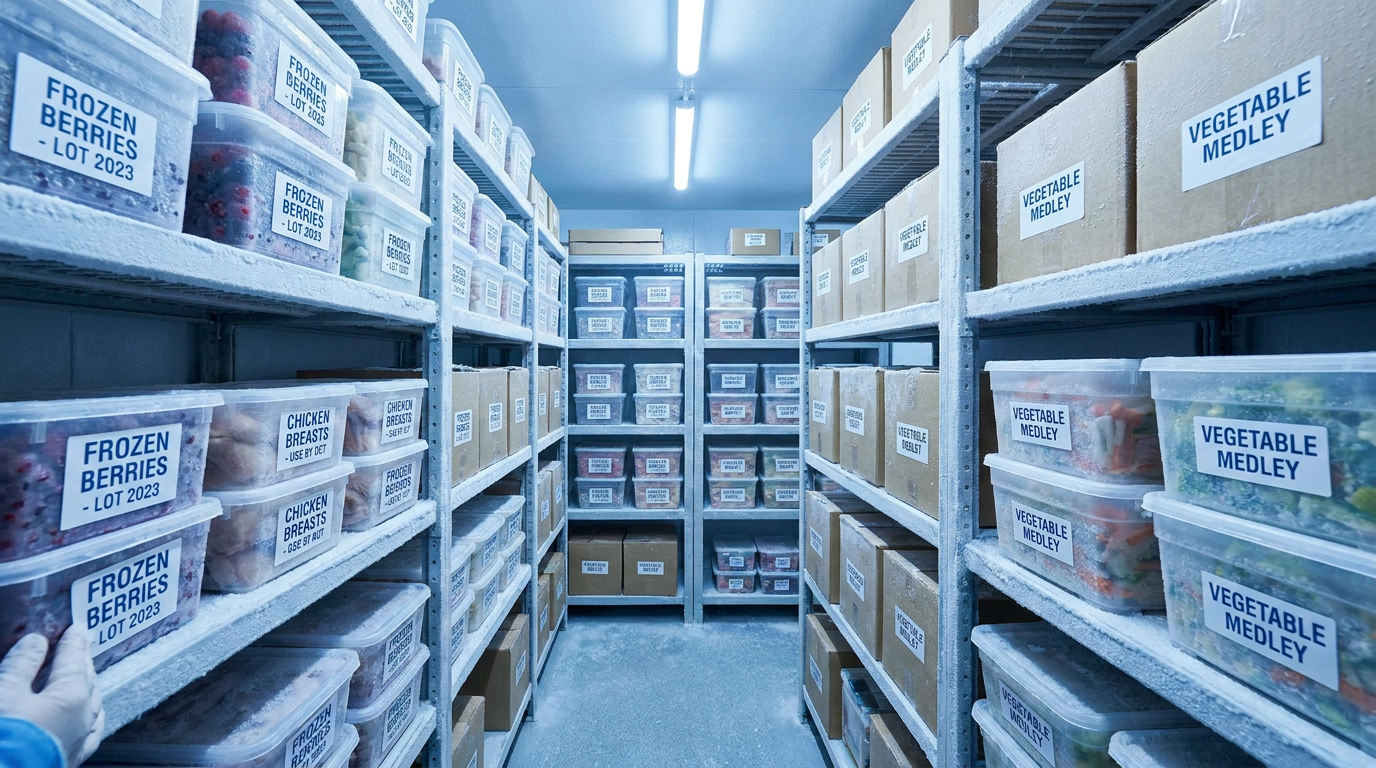
Picture this: It’s a Monday morning in a busy commercial kitchen in Melbourne. The head chef opens the walk-in freezer to pull stock for the week ahead and discovers a problem — the labels on a dozen containers of house-made stock, portioned sauces, and prepped proteins have simply vanished. Some have peeled clean off. Others are soggy, illegible blobs clinging by a corner. A few have fallen entirely to the freezer floor, leaving behind nothing but a ghost of adhesive residue and a serious compliance question: what is in each container, when was it made, and is it safe to use?
It’s not a dramatic food safety crisis, but it is exactly the kind of preventable operational chaos that costs businesses time, money, and peace of mind every single week across Australia. The culprit isn’t the chef, the containers, or even the freezer. It’s the labels — standard, off-the-shelf stickers that were never engineered to survive sub-zero conditions.
This is the core problem that freezer stickers — also called freezer-grade labels or cold-storage labels — exist to solve. These aren’t just “stickers that go in the freezer.” They are precision-engineered pressure-sensitive labels, designed from the adhesive layer up to maintain their grip, legibility, and structural integrity in some of the most punishing environments any label can face.
This complete guide covers everything you need to know about freezer stickers: what makes them different from standard labels, the science behind the materials and adhesives that keep them stuck, the industries and everyday situations that depend on them, how to choose the right one for your specific application, what Australian law requires of your freezer labelling, and how Fast Stickers — with over 15 years of custom label experience based right here in Gippsland, Victoria — can help you get it right, fast.
Whether you’re a meal prep enthusiast labelling glass containers at home, a café operator managing FIFO rotation in a busy kitchen, a food manufacturer running a full cold chain operation, or a pharmaceutical business storing temperature-sensitive medications, this guide is for you.
So, what exactly makes a sticker a freezer sticker?
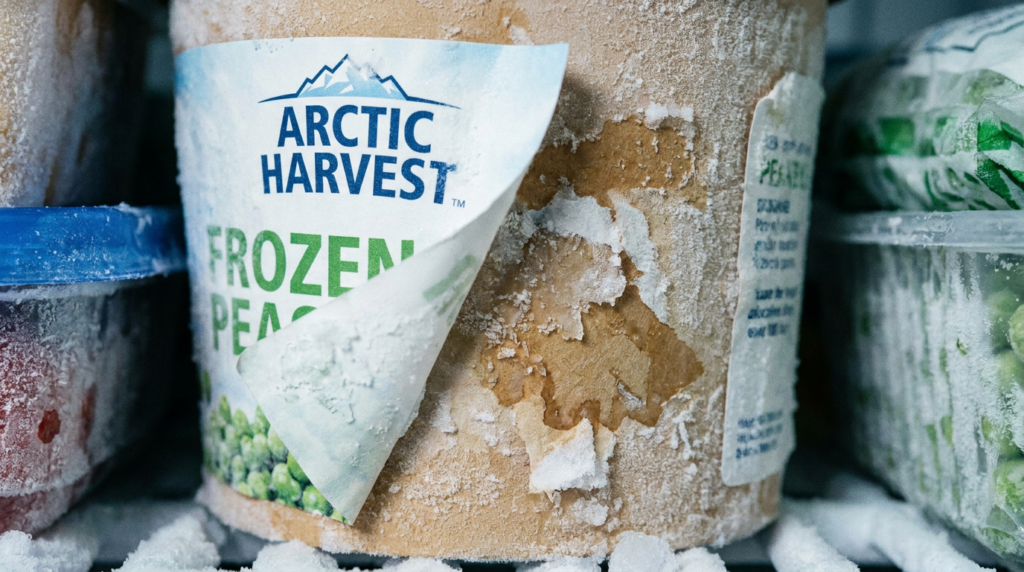
Walk into any office supply store or online marketplace and you’ll find hundreds of “label” products marketed for general use. Pick one up, print on it, slap it on a container, and drop it in the freezer — and within days, or even hours, you’ll understand exactly why that approach fails. The label will lift at the corners. The ink will smear. The paper will absorb condensation and swell into a soft, illegible mess. Eventually, it peels away entirely, taking your date code, product name, and compliance information with it.
Standard labels simply were not engineered for the freezer environment. To understand why freezer-grade labels are different, it helps to understand precisely what they’re up against.
Freezer stickers — sometimes referred to as freezer-grade labels, cold-storage labels, or cryogenic labels in more extreme applications — are pressure-sensitive labels specifically engineered to maintain adhesion, legibility, and physical integrity at sub-zero temperatures. Every layer of their construction, from the facestock material you write or print on, to the adhesive that bonds the label to the surface, has been formulated to perform where standard products catastrophically fail.
At the core of the problem is what cold temperatures do to adhesives. Standard adhesives rely on a degree of molecular flexibility to maintain their grip on a surface. As temperature drops, polymers stiffen. At refrigerator temperatures (around 0–5°C), standard adhesives begin to lose tack. Push below -10°C into genuine freezer territory, and many standard adhesives become brittle — literally losing the ability to conform to surface irregularities and maintain their bond. The result is a label that feels like it’s stuck, right up until it isn’t.
Then there’s the question of the facestock — the label surface itself. Paper-based facestocks, which dominate the general-purpose label market, are fundamentally unsuitable for cold storage. Paper is hygroscopic: it absorbs moisture from the air. In a freezer environment, particularly one where products cycle between frozen and ambient temperatures, paper labels absorb condensation and swell, warp, and degrade. The print smears. The paper tears. The label becomes structurally compromised. For a deeper look at why paper stickers aren’t suited to demanding environments, the difference in materials is significant and well worth understanding before you commit to a labelling solution.
It’s also critical to distinguish between two different temperature environments that are often conflated: refrigerator conditions and freezer conditions. A label rated for refrigerator use (0–5°C) is an entirely different product from one rated for freezer use (-18°C and below). Many businesses make the mistake of using a refrigerator-grade label in a freezer application — the result is predictable and expensive.
Two technical concepts matter enormously when evaluating any freezer label:
Application temperature is the minimum temperature at which a label can be successfully applied to a surface. Some freezer-grade labels must be applied to ambient-temperature product before freezing. Others — designed for in-freezer application on production lines — are formulated to bond at temperatures as low as -20°C or below.
Service temperature is the range of temperatures the label can endure once applied. A quality freezer-grade label should maintain full adhesion and legibility throughout the product’s entire frozen life — often months to years at -18°C for commercial food products, or as low as -40°C for deep-freeze or cold chain applications. Our high-tack stickers with a temperature range of -40°C to +150°C are a strong example of what genuinely engineered cold-performance adhesion looks like in practice.
One of the most underappreciated threats to freezer labels isn’t the cold itself — it’s condensation. When a frozen product is briefly removed from storage, brought to a loading dock or kitchen bench at ambient temperature, and then returned to the freezer, moisture condenses on the product surface. This moisture can migrate beneath the label edge, weakening the adhesive bond and initiating the peeling process. Freezer-grade labels use synthetic facestocks and properly formulated adhesives that resist this moisture ingress — protecting the label even through repeated freeze-thaw cycles.
The solution, as we’ll explore in the next section, lies in engineering every layer of the label for cold-environment performance — from the facestock material through to the adhesive chemistry itself.
There’s a reason professional label engineers get deeply specific about materials. In a freezer environment, the wrong material choice doesn’t just underperform — it fails completely, often at the worst possible moment. Understanding the science behind freezer-grade labels equips you to make smarter purchasing decisions and to have better conversations with your label supplier about what you actually need.
Every pressure-sensitive label has three fundamental layers: the facestock (the material you see and print on), the adhesive (the bond layer), and the liner (the backing sheet you peel away before application). In freezer applications, the facestock and adhesive are where all the engineering action happens.
Biaxially Oriented Polypropylene (BOPP) is one of the most widely used synthetic facestocks in commercial food labelling, and for good reason. It is dimensionally stable, moisture-resistant, scuff-resistant, and maintains its structural integrity at sub-zero temperatures. BOPP is rigid enough to run efficiently through high-speed dispensing equipment, and its smooth surface delivers crisp, legible print — including barcodes and fine text. For frozen food products that need to look sharp on a retail shelf, BOPP is a workhorse.
Polyethylene (PE) takes a different approach. Where BOPP is rigid, PE is flexible and conformable — making it ideal for squeezable containers, pouches, and irregularly shaped packaging that flexes when frozen. A rigid label on a flexible container creates a stress point that accelerates peeling; a PE label flexes with the container, maintaining its bond through temperature changes and physical handling.
Vinyl (PVC) is the material of choice for extreme cold applications. Vinyl’s inherent flexibility and waterproof properties make it a trusted facestock for deep-freeze environments where temperatures push to -40°C and below. Unlike materials that become brittle at extreme cold, vinyl retains its flexibility, resisting cracking and maintaining the integrity of the adhesive layer underneath. Vinyl is also widely used in cryogenic laboratory applications where labels must survive liquid nitrogen temperatures.
Why NOT paper: Paper absorbs moisture — full stop. In a freezer environment, this means paper labels will swell, warp, tear, and ultimately fail. The adhesive system beneath a paper facestock is also compromised by moisture migration, leading to accelerated bond failure. Paper may be fine for a label on the pantry shelf, but in the freezer it is categorically the wrong material.
The adhesive layer is arguably the most critical engineering element in a freezer-grade label. It is invisible in use, but its performance — or failure — determines everything.
Acrylic-based adhesives are the dominant chemistry in commercial cold-storage labelling. Acrylic adhesives maintain their flexibility and tack at low temperatures, often performing reliably to -40°C. They are chemically stable, resistant to plasticiser migration (important when bonding to plastic packaging), and available in formulations calibrated for different application and service temperatures. For the vast majority of Australian food businesses — from meal prep operations to commercial food manufacturers — an acrylic-based freezer adhesive is the right foundation. Our high-tack formulations use a high-performance acrylic adhesive system rated across extreme temperature ranges, including the demanding conditions of commercial freezer applications.
Rubber-based (hot melt) adhesives offer exceptionally high initial tack — meaning they bond aggressively on contact, even to difficult low-energy surfaces like polystyrene, polyethylene packaging, and corrugated cartons. Hot melt adhesive formulations for freezer use can be rated to -54°C (-65°F) and below, making them the right choice for deep-freeze cold chain operations and polystyrene foam packaging (a notoriously difficult surface for adhesive bonding). The trade-off is that hot melt adhesives can be less resistant to UV and certain chemicals than acrylics, but in a sealed freezer environment this is rarely a concern.
This distinction trips up many buyers. A label might be rated to survive at -40°C in service — but if its application temperature requires a minimum of +10°C, you cannot apply it to a frozen product on a production line. Always confirm both ratings with your supplier before ordering.
Labels applied to ambient-temperature products before freezing benefit from maximum adhesive wet-out — the process by which the adhesive fully contacts and conforms to the substrate surface. This is the ideal application scenario and produces the strongest long-term bond. Labels applied to frozen surfaces are fighting an uphill battle against surface moisture, low substrate temperature, and reduced adhesive flow — which is why deep-freeze-rated application adhesives require specialist formulation.
Just as rubber becomes brittle in the cold, standard adhesives lose their grip when repeatedly exposed to moisture cycling. A product that moves from a -20°C deep freeze to a +25°C loading dock and back again will experience repeated condensation events on its surface. Only synthetic facestocks with properly formulated adhesive systems survive this cycle intact.
A freezer label is only as good as its ability to remain legible. Barcodes, date codes, allergen information, and lot numbers must all remain scannable and readable throughout the product’s entire cold storage life. Thermal transfer printing — which uses heat to transfer resin or wax-based ink onto the facestock — is generally the most durable print method for cold environments, producing sharp, smear-resistant print that survives moisture and temperature extremes. Standard inkjet printing, while convenient, is significantly more vulnerable to smearing and fading in freezer conditions.
With the material science established, it’s time to look at the diverse range of people and businesses who depend on freezer-grade labels every day.
Freezer stickers aren’t a niche product for a narrow slice of industry. They serve an enormous and diverse range of applications — from the domestic freezer in a suburban home to the industrial cold store of a national food manufacturer. Understanding where freezer labels are needed helps every reader recognise their own situation and requirements.
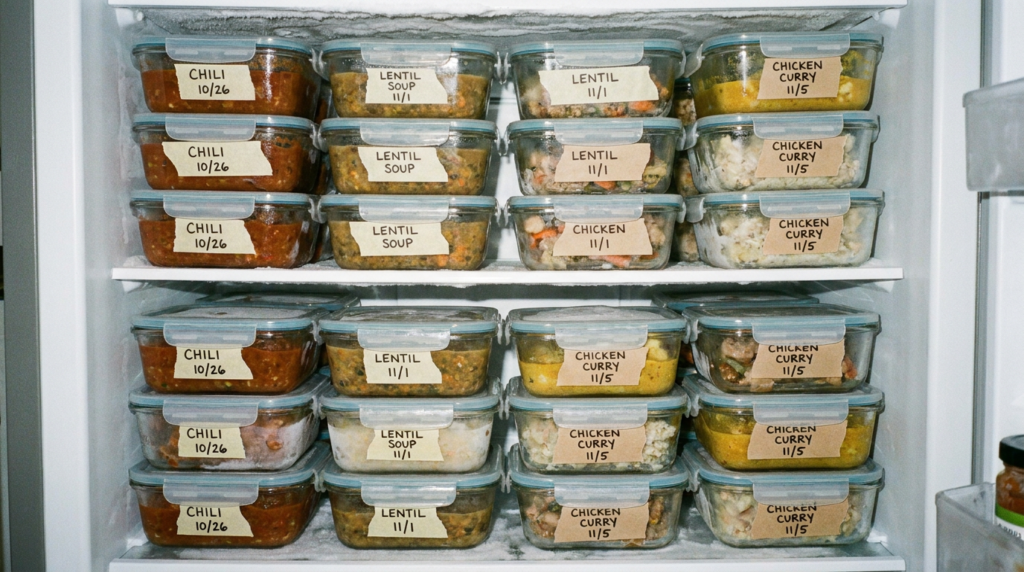
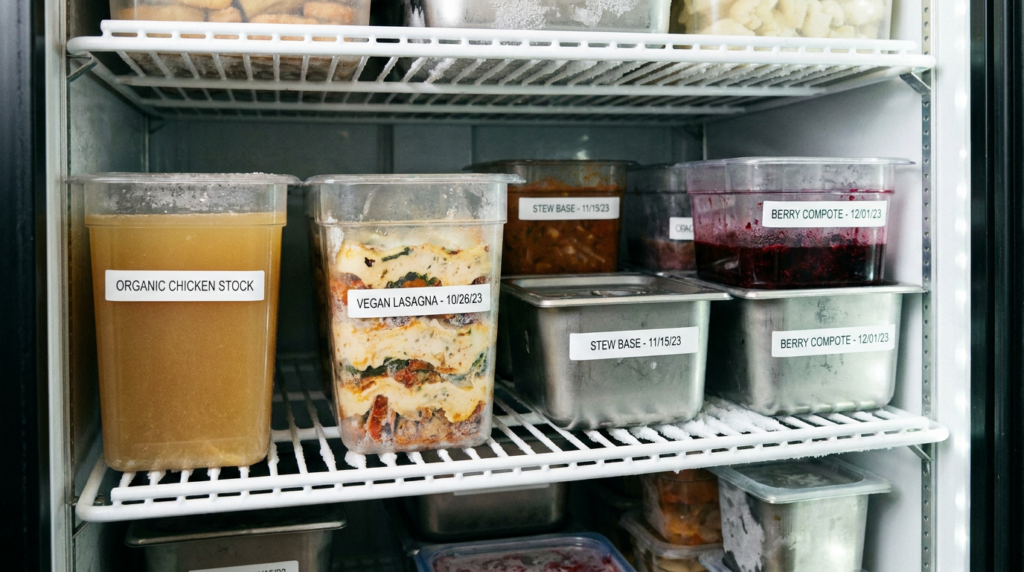
The meal prep movement has made freezer labelling a household concern. Batch cooking on Sundays, portioning meals for the week ahead, freezing seasonal produce — all of these practices depend on clear, durable labelling to keep the freezer organised and prevent food waste. A label that peels off a glass container after two weeks in the freezer is more than an inconvenience; it’s a trigger for the frustrating freezer archaeology of sniffing and guessing that nobody wants to do.
For home use, a removable freezer-grade label is often ideal — it allows clean removal without residue when the container is washed and reused. At minimum, a home label needs to survive weeks to months at -18°C and remain legible through the condensation cycle of regular freezer access.
In the professional kitchen, freezer labelling is not optional — it is a food safety standard. FIFO (First In, First Out) rotation management requires clear, accurate date labelling on every item in cold storage. Day-dot labels, allergen indicators, content descriptions, and use-by dates are applied under time pressure in busy prep environments, which means labels need to go on fast, stay on reliably, and remain legible throughout the product’s storage life.
Café operators, restaurant kitchens, caterers, and food service businesses across Australia also need to comply with food safety regulations that govern the handling and storage of prepared food. A label that falls off or becomes unreadable in the freezer isn’t just an inconvenience — it’s a food safety incident.
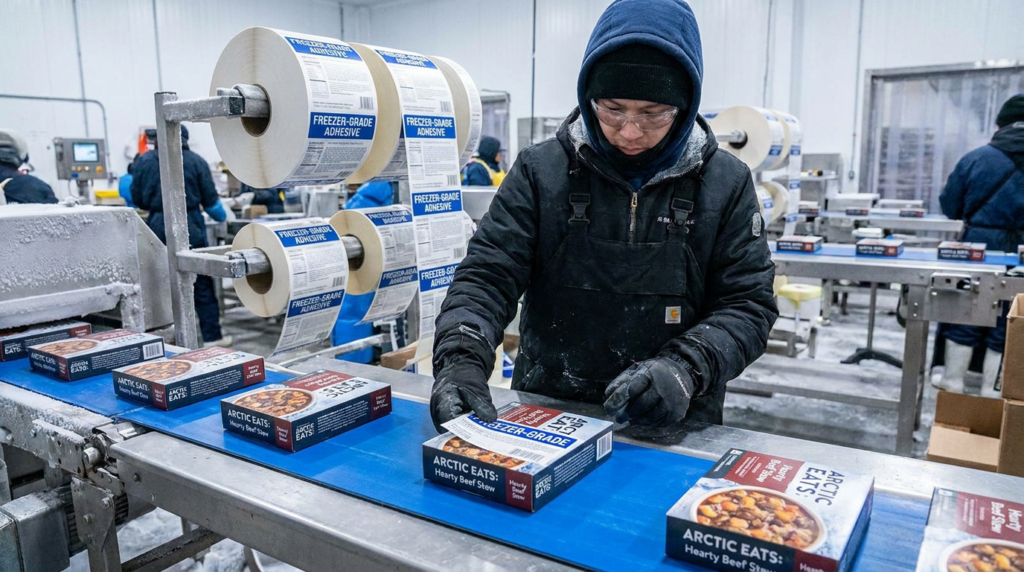
For food manufacturers, the label is the product’s identity through the entire cold chain. From the moment it leaves the production line to the moment it arrives in a consumer’s home freezer, the label must survive refrigerated transport, cold store warehousing, retail freezer cases, and everything in between.
Manufacturer labels carry barcodes for retail scanning, nutritional information panels, use-by or best-before dates, allergen declarations, batch codes, and country-of-origin information — all of which must remain fully legible and scannable throughout the product’s frozen shelf life. FSANZ requires packaged foods with a shelf life of two years or less to carry a date mark, making label durability not just a practical concern but a legal one.
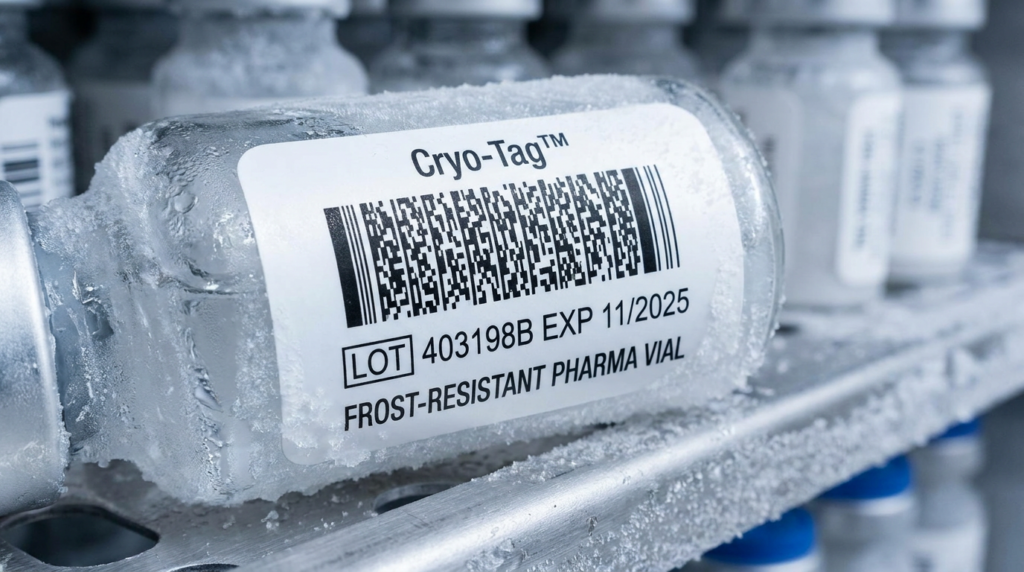
Cold chain labelling in the pharmaceutical and healthcare sector operates under some of the most rigorous standards of any industry. Cold-stored medications, vaccines, blood products, biological samples, and laboratory specimens require cryogenic-grade labelling that remains fully attached and legible through extreme freeze-thaw cycles. Label rolls are ideal for high-volume labelling operations in clinical and laboratory environments where throughput and consistency are essential.
Chain of custody, traceability, and patient safety all depend entirely on label integrity. A detached or illegible label on a pharmaceutical vial or a blood sample is not merely an administrative problem — it can have life-or-death consequences. Labels in these applications must often comply with additional regulatory requirements around legibility, permanence, and resistance to the chemicals and cleaning agents used in healthcare environments.
The Australian cold chain — the network of refrigerated transport, cold store warehouses, and temperature-controlled distribution facilities that keeps frozen and refrigerated food safe from producer to consumer — places extraordinary demands on labels. Pallet labels, carton labels, and individual product labels must survive refrigerated trucks, loading dock temperature swings, and cold store environments that can reach -25°C or below.
For logistics operators, barcode scan-ability is mission-critical. A smeared, detached, or frost-obscured barcode label doesn’t just slow down a warehouse — it can halt a shipment, trigger a compliance investigation, and cause cascading disruption through an entire supply chain. The Australian Cold Chain Guidelines set the operational standards for this industry, and labelling integrity underpins compliance at every step.
Understanding who needs freezer labels naturally leads to the next question: what specifically separates a great freezer label from an inadequate one?
Not all products marketed as “freezer labels” are created equal. The gap between a quality freezer-grade label and a cheap imitation can mean the difference between a product that lasts six months in a deep freeze and one that peels off in three days. Here’s the practical quality framework every buyer should apply.
1. Sub-Zero Adhesive Performance
The most fundamental requirement. Does the adhesive maintain its tack at the lowest temperature your product will experience? For household freezers, a minimum rating of -18°C is the baseline. For commercial deep-freeze environments or cold chain applications, look for labels rated to -40°C or below. Always confirm the adhesive temperature rating — not just a general marketing claim — before ordering. A quality supplier will provide this data clearly and without hesitation.
2. Moisture and Condensation Resistance
The facestock must not absorb water. Full stop. Synthetic films — BOPP, PE, and vinyl — pass this test; paper fails it. But moisture resistance isn’t just about the facestock. The adhesive system must also resist moisture migrating between the label and the substrate surface through repeated freeze-thaw cycles. If a label can’t survive condensation, it can’t survive the real world.
3. Facestock Durability
In a freezer environment, labels are handled, stacked, scraped, and dragged across surfaces regularly. The facestock must resist tearing, scuffing, and abrasion during normal freezer handling. Laminated finishes add an additional protective barrier, extending both the physical durability of the label face and the longevity of the print beneath.
4. Print Legibility and Scan-Ability
A freezer label that protects a barcode that can no longer be scanned has failed its primary purpose. Barcodes, QR codes, lot numbers, and date codes must remain clear, undamaged, and fully scannable throughout the product’s freezer life — which for many products means six to twenty-four months. Thermal transfer printing is the gold standard for durability in cold environments. For ensuring your artwork is print-ready and optimised for maximum legibility, working with a knowledgeable printer from the outset saves significant cost and frustration.
5. Application Flexibility
Can the label be applied at ambient temperature before freezing, or does it need to be applied to an already-frozen product? This distinction matters enormously for production workflows. If your process requires labelling frozen product on a packing line at -15°C, you need a label whose application temperature rating matches that condition. Using a label outside its application temperature range will result in poor initial bond formation and premature failure.
6. Compliance-Ready Design
Does the label provide sufficient space for all mandatory information — use-by or best-before date, storage instructions, allergen declarations, batch codes, and any other regulatory requirements applicable to your product? Is the print food-safe? A compliance-ready design is not just about meeting the law — it’s about ensuring that the label functions as the complete, trustworthy product record it needs to be throughout the cold chain.
Bonus Consideration: Permanent vs. Removable Adhesive
For reusable containers — meal prep boxes, commercial prep bowls, glass storage jars — a removable freezer-grade sticker that peels away cleanly without adhesive residue is the right choice. For permanent product identification on food packaging, pharmaceutical vials, or logistics cartons, a permanent bond is essential. Getting this choice right prevents both the frustration of labels that won’t come off and labels that won’t stay on.
One final note on cost: cheap paper “freezer labels” from generic suppliers often fail within days — meaning the cost of reprinting, relabelling, and managing the compliance risk of unlabelled product far exceeds any savings on the label itself. Investing in quality synthetic freezer labels is nearly always the more economical decision across a product’s full lifecycle.
With the quality checklist established, there’s a critical dimension of freezer labelling in Australia that every food and pharmaceutical business must understand: the regulatory framework.
In Australia, freezer labelling is not purely a practical consideration — for food businesses, pharmaceutical operators, and cold chain logistics providers, it carries significant regulatory weight. Getting your labels wrong doesn’t just cost you operationally; it can cost you legally.
“Under the Australia New Zealand Food Standards Code, it is illegal to sell food past its ‘use by’ date — and your freezer label is the document that proves compliance.”
Under FSANZ date marking requirements set out in Standard 1.2.5 of the Australia New Zealand Food Standards Code, packaged foods with a shelf life of two years or less must carry a date mark. This date mark takes one of two forms:
A “use by” date indicates a safety deadline. Food must not be consumed after this date, and — critically — it is illegal in Australia to sell food past its use-by date. Use-by dates apply to foods that may pose a health or safety risk if consumed after a certain point: fresh and frozen meat, dairy products, and many ready-to-eat prepared foods.
A “best before” date indicates quality retention. Food may still be safely consumed after the best-before date if it is otherwise fit for human consumption, and it may legally be sold after this date provided it meets that standard. Best-before dates apply to most other packaged foods.
If specific storage conditions are necessary to keep a food safe until its date mark — such as “keep frozen at -18°C” or “store below -15°C” — those storage instructions are mandatory on the label. For frozen food products, this means your freezer label must carry both the date mark and the required storage instruction, and both must remain legible for the entire duration of the product’s frozen shelf life. A label that becomes unreadable after two months on a product with an eighteen-month frozen shelf life is a compliance failure, not just an operational inconvenience.
Foods with a shelf life of two years or more — some canned goods, for example — are exempt from mandatory date marking. However, most frozen food products fall well within the two-year threshold, meaning date marking is a non-negotiable requirement for the overwhelming majority of commercial frozen food producers.
The Australian Cold Chain Guidelines (2017) establish the operational standards for the handling, storage, and transport of refrigerated and frozen food across Australia’s supply chain. These guidelines underpin the expectation that labels at every point in the cold chain — on pallets, cartons, and individual consumer units — remain legible, scannable, and physically intact from the production facility to the point of sale.
Label failure at any point in the cold chain can trigger product recalls, food safety investigations, and significant financial and reputational consequences. A detached pallet label in a cold store warehouse can mean an entire pallet of product becomes unidentifiable — creating write-off risk and potentially triggering a regulatory investigation. A smeared barcode on a retail freezer product causes point-of-sale scanning failure and supply chain disruption.
For food manufacturers and logistics operators, barcodes on frozen food products must comply with GS1 scan-ability standards. GS1 barcodes — the EAN-13 barcodes used on retail consumer products, and the GS1-128 barcodes used in logistics — must achieve minimum scan-ability grades that are measured against defined contrast and print quality standards. A freezer label that degrades the contrast or sharpness of a barcode through moisture absorption, fading, or physical damage creates a non-compliant product and supply chain disruption.
For pharmaceutical operators, the Therapeutic Goods Administration (TGA) requires that all medications and therapeutic goods carry permanent, legible labelling throughout their shelf life. Cold-stored medications — including vaccines, biologics, and cold-chain-sensitive prescription drugs — are subject to strict labelling integrity standards. Labels on these products must survive the entire cold chain without degradation, and must remain legible and identifiable through any number of freeze-thaw cycles the product may experience during storage and transport.
Wherever possible, apply freezer labels to product at ambient temperature before freezing. This maximises adhesive wet-out — the process by which the adhesive fully conforms to the substrate surface — and produces the strongest, most durable bond. Always test your chosen label in real use conditions (your actual product, your actual freezer, your actual handling process) before committing to a full production run. A label that performs perfectly in a test at room temperature may behave very differently on a product surface that has already been through two freeze-thaw cycles.
With the regulatory landscape clear, the final practical question is: how do you actually choose the right freezer label for your specific application?
Armed with an understanding of materials, adhesives, use cases, and regulatory requirements, you’re now in a position to make a genuinely informed decision about which freezer label is right for your application. Here’s a structured decision guide to cut through the complexity.
Your storage temperature is the foundational variable that determines the adhesive and facestock you need.
Household freezer (-15°C to -20°C): A standard freezer-grade acrylic adhesive on a BOPP or vinyl facestock is entirely sufficient for home use. Most quality freezer-grade labels on the market will perform reliably at this temperature range.
Commercial blast freezer or deep freeze (-30°C to -40°C): You need a deep-freeze rated adhesive — either an acrylic formulation specified for this range, or a hot melt rubber-based adhesive — paired with a flexible synthetic facestock (vinyl or PE). Don’t use a standard refrigerator or mild-freeze label in a blast freezer environment.
Cold chain and refrigerated transport (variable temperatures including ambient loading dock conditions): All-temperature adhesives are the right choice here — formulations designed to perform reliably across the full swing from ambient (+25°C) to deep freeze (-40°C). These labels handle the repeated temperature cycling of the cold chain without losing adhesion.
What the label is sticking to matters as much as the temperature it’s sticking in.
Smooth HDPE or PET plastic containers: Standard freezer-grade acrylic adhesive bonds well to these smooth, relatively high-energy surfaces.
Polypropylene or polyethylene packaging (low-energy surfaces): These are notoriously difficult surfaces for adhesive bonding. For polypropylene or polyethylene packaging, our high-tack stickers deliver the aggressive adhesion needed in cold environments — standard adhesives will simply not achieve the required bond on these low-energy surfaces.
Corrugated cardboard cartons: The uneven surface of corrugated carton requires a high-tack or hot melt adhesive that can penetrate the texture and achieve sufficient contact area for a reliable bond.
Glass vials or jars: Acrylic adhesive on a vinyl facestock provides excellent glass adhesion in cold environments — vinyl’s conformability and acrylic’s chemical compatibility with glass make this a reliable pairing.
This decision should be driven by how the labelled item is used, not by preference alone.
Permanent freezer-grade adhesive is the right choice for food production packaging, pharmaceutical identification, logistics tracking, and any application where label removal would indicate tampering or create compliance risk. Once applied, these labels stay — through the cold chain, on the shelf, in the consumer’s freezer.
Our removable stickers are a popular choice for meal prep businesses and commercial kitchens using reusable containers — where clean removal without adhesive residue is needed to allow the container to be washed and relabelled through many cycles. A good removable freezer label should release cleanly at freezer temperatures without tearing or leaving ghost residue.
Apply to ambient-temperature product before freezing wherever your process allows — this guarantees maximum adhesive bond formation and the strongest possible long-term adhesion. If your production process requires labelling already-frozen product, confirm explicitly with your supplier that the label’s application temperature rating covers your product’s surface temperature at the point of labelling.
For low-volume or intermittent use — home meal prep, small café operations, or batch labelling in a boutique food business — sheet labels or small rolls offer the most practical format. Labels can be printed as needed, applied individually, and stored without specialist equipment.
For high-volume production environments and automated labelling lines, vinyl sticker rolls are the ideal format for production line labelling at scale. Roll labels are compatible with standard thermal transfer printers and automated label applicators, enabling fast, consistent, and efficient labelling at production speeds.
For a deeper look at why synthetic materials consistently outperform paper in demanding label applications, our full guide to vinyl vs. paper stickers walks through the material differences in practical detail.
With the decision framework complete, let’s bring it all together and talk about where to get your freezer labels — fast, from an Australian team that knows exactly what you need.
After six sections of technical depth, practical guidance, and regulatory context, one thing should be clear: getting freezer labels right requires real expertise, quality materials, and a supplier who understands your environment and your compliance obligations. That’s exactly what Fast Stickers delivers.
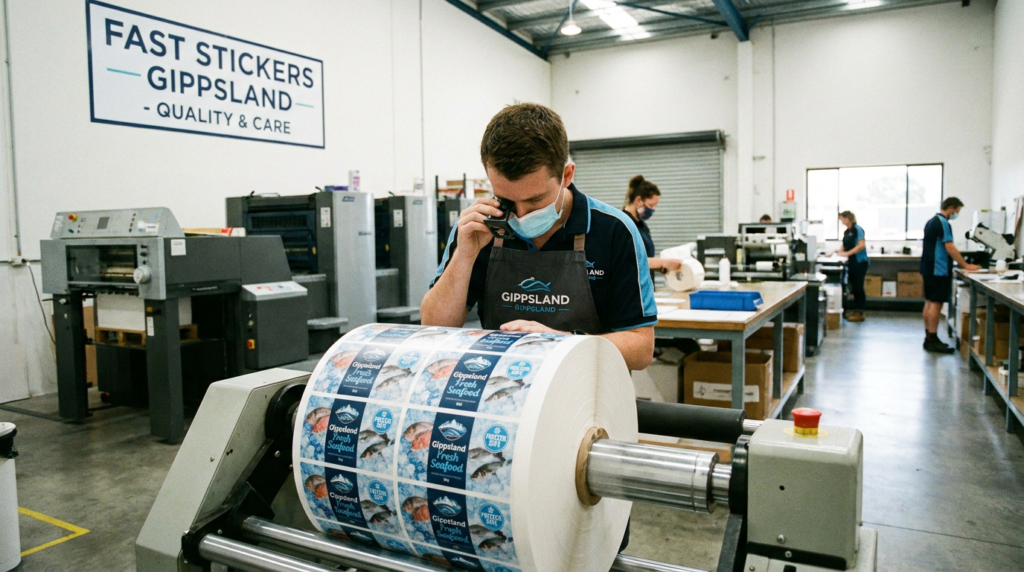
Fast Stickers is a family-run business based in Gippsland, Victoria — an Australian operation with over 15 years of experience producing high-performance custom stickers and labels for businesses across the country. We’re not a faceless overseas label factory or a generic print-on-demand platform. We are a local team that understands Australian climate conditions, Australian cold chain realities, and the regulatory environment that Australian food and pharmaceutical businesses operate in.
Our product range is built for performance, not just aesthetics. For freezer and cold-storage applications, we offer:
High-tack stickers with a high-performance acrylic adhesive system rated from -40°C to +150°C, with a 90-degree peel strength of 12+ N/25mm — more than double standard adhesive peel strength. These labels bond aggressively to difficult surfaces including low-energy polypropylene and polyethylene packaging, rough corrugated cartons, and textured containers.
Vinyl sticker rolls for production line and commercial kitchen applications — the ideal format for high-volume freezer labelling where consistency and speed are essential.
Removable stickers in freezer-compatible formulations for meal prep businesses, commercial kitchens, and anyone using reusable containers who needs clean, residue-free label removal.
Clear freezer labels for a no-label look — ideal for premium frozen food products where a clean, direct-print aesthetic matters, while still delivering cold-temperature performance.
Custom sizes, shapes, and finishes are all available — because your freezer labelling requirements are specific to your products, your packaging, and your brand.
Don’t have artwork ready? No problem. Fast Stickers’ in-house design team can create a compliant, print-ready freezer label design for you — with mandatory information such as date format, storage instructions, allergen boxes, and batch code fields laid out correctly from the start. Getting the design right before print saves time, money, and the headache of relabelling a product run because a compliance field was missed.
In the food and pharmaceutical world, waiting three weeks for labels is simply not an option. Compliance deadlines, product launches, and production schedules don’t accommodate slow suppliers. Fast Stickers delivers most orders within 2–3 business days, with free express shipping to businesses across Australia. From Gippsland to Perth, Darwin to Hobart — your labels arrive fast, on time, and ready to use.
Every label that leaves our Gippsland facility is backed by our quality commitment. If your freezer labels don’t perform to specification, we’ll make it right. That’s what 15+ years of reputation in Australian label printing means in practice.
To learn more about our Gippsland-based team and our history of printing expertise, or to browse our full sticker shop, the Fast Stickers website has everything you need to start your order.
Freezer stickers occupy a small corner of the packaging world — but they carry an outsized responsibility. They are the proof of identity, the compliance record, the traceability anchor, and the consumer-facing communication tool for every frozen product they’re attached to. When they work, they’re invisible. When they fail, the consequences can range from kitchen chaos to regulatory investigation.
The core message of this guide is simple: not all labels are created equal, and the wrong choice in a sub-zero environment leads to real consequences — product confusion, food waste, compliance failures, and damaged credibility. The right freezer-grade label, by contrast, works silently and reliably for the entire life of the product, asking for nothing beyond the right material selection and correct application.
The three pillars of a great freezer label are now clear. First, the right facestock material — synthetic films like BOPP, PE, or vinyl that resist moisture, maintain structural integrity at low temperatures, and provide a durable print surface. Second, the right adhesive for the temperature and substrate — whether that’s a deep-freeze acrylic formulation, a high-tack hot melt adhesive, or a removable system for reusable containers. Third, the right print method for long-term legibility — typically thermal transfer printing that resists the smearing and fading that cold and moisture inflict on inferior inks.
These requirements apply across every segment of the audience this guide has addressed — from the home cook batch-prepping for the week ahead, to the commercial kitchen managing FIFO compliance, to the food manufacturer navigating the full demands of the Australian cold chain. The scale changes. The regulatory complexity varies. But the fundamental requirement — a label that stays on, stays legible, and tells the truth about what’s inside — remains constant.
As Australia’s food safety regulations continue to evolve and the cold chain grows in scale and sophistication, the expectation placed on freezer labels will only increase. Investing in the right solution now is not just about avoiding problems today — it’s about building the operational and compliance foundation that supports growth tomorrow.
Whether you need freezer-grade labels for a commercial kitchen, a food production line, pharmaceutical cold storage, or your home meal prep routine, Fast Stickers has the materials, expertise, and turnaround time to deliver. We’re based in Gippsland, Victoria — a proudly Australian, family-run business serving customers across the country with quality labels that perform where it matters most.
Not sure which freezer label is right for your specific application? Our team is happy to help — describe your product, your packaging, your storage environment, and your volume, and we’ll recommend the right material, adhesive, and format for your exact needs.
Fast Stickers — Gippsland, Victoria. Custom labels for Australian businesses, delivered fast.
Custom Stickers Melbourne: The Complete 2026 Guide for Victorian Businesses Picture this: it’s a Thursday afternoon in a Brunswick café. The new logo finally landed
Picture this: it’s 9pm on a Tuesday in a spare room in Bendigo, and you’re sitting cross-legged on the floor because the table ran out
Picture this. It’s Friday night in a suburban Australian street — the kind where the smell of melted cheese and wood-fired dough drifts through open

The Complete Australian Guide for Beekeepers and Honey Producers Picture this: it’s a warm December morning in the Yarra Valley. The flow has been extraordinary

Picture this: it’s 6am on the Saturday before Mother’s Day, and a florist in Melbourne’s inner north is already three hours deep into the morning.