
Custom Stickers Melbourne
Custom Stickers Melbourne: The Complete 2026 Guide for Victorian Businesses Picture this: it’s a Thursday afternoon in a Brunswick café. The new logo finally landed
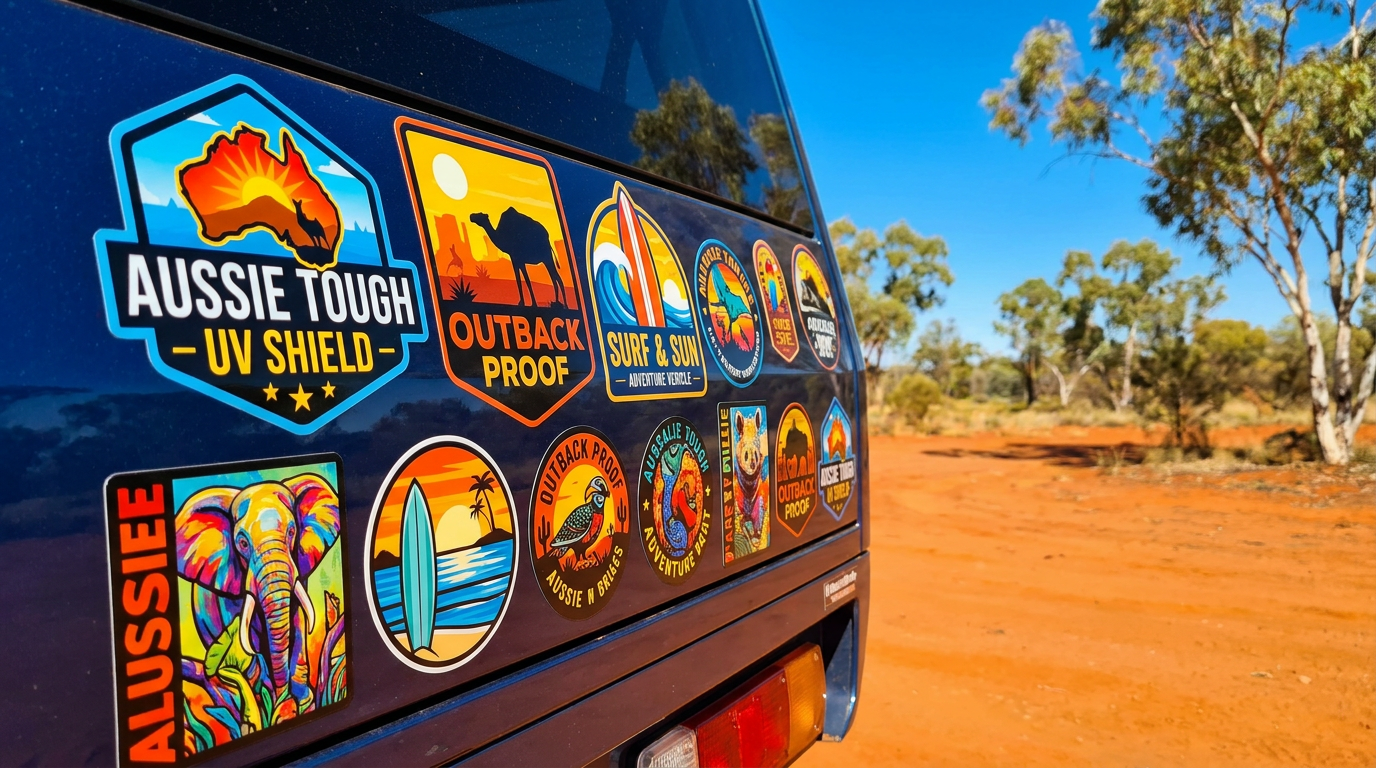
Picture this: a tradie in Townsville slaps a brand-new sticker on his ute on a bright January morning. The logo looks incredible — crisp lines, vivid colour, the kind of first impression that makes a business look professional. Six months later, he reverses into a car park and catches a glimpse of the rear bumper in the reflection of a shopfront window. His business logo is barely recognisable. The colours have bleached to a chalky ghost of themselves, the edges are peeling back, and the whole thing looks like it’s been through a decade of hard living rather than half an Australian summer. He peels it off, embarrassed.
Now contrast that with the ute parked beside his. Same year, same model, same brutal North Queensland sun. But this one is wearing a premium UV-resistant vinyl bumper sticker — and three years later, it still looks the day it was applied. Sharp. Vibrant. Doing its job.
That contrast — months versus years, embarrassment versus confidence — is the entire argument for this guide.
Australia is not a forgiving environment for outdoor materials. Our UV radiation is among the most intense on Earth, not as an occasional spike but as a sustained seasonal assault that no standard paper or budget vinyl sticker is built to withstand. If you’re putting a sticker on a vehicle, a trailer, a fleet, or any outdoor surface in this country, understanding UV bumper stickers and what makes them genuinely sun-proof isn’t just useful information — it’s the difference between a sticker that works for you and one that works against you.
In this guide, we’ll cover everything you need to know: the science behind UV damage, the materials that resist it, the role of protective laminates, realistic lifespan expectations for Australian conditions, and the practical tips that get every possible kilometre out of your investment. And we’ll show you exactly why UV-resistant bumper stickers in Australia need to be built differently from anything designed for a European or North American market.
To understand why UV resistance matters — and how to get it right — we need to start with the sun itself.
Most people know Australia has intense sun. What most people don’t fully appreciate is just how categorically different Australian UV levels are from the rest of the developed world — and what that means for anything designed to live outdoors here.
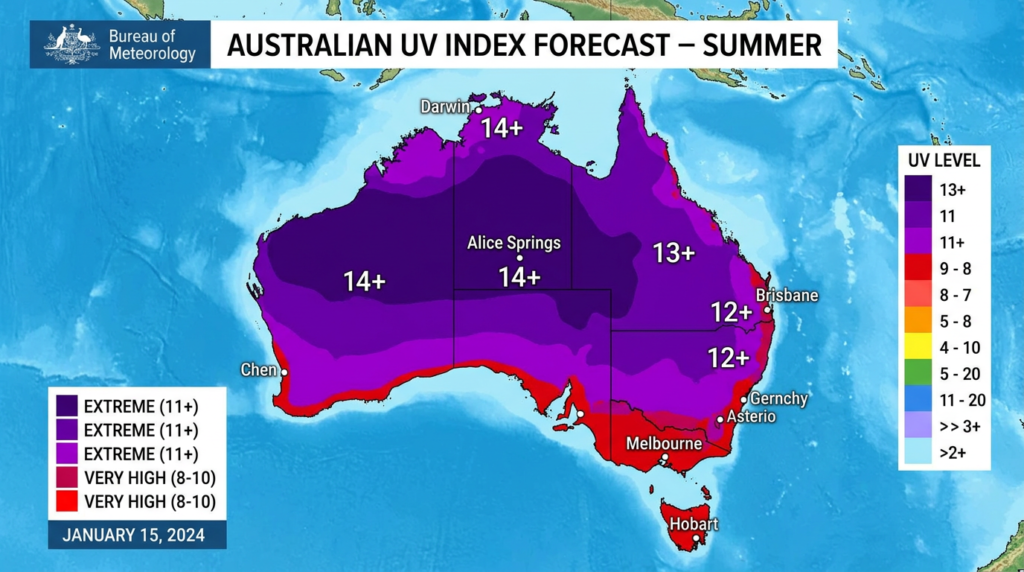
The Bureau of Meteorology’s UV Index maps paint a striking picture. Across Queensland, the Northern Territory, Western Australia, and South Australia during summer, the UV Index regularly climbs into the range of 11 to 14. According to the BoM, anything above 11 is classified as Extreme — the highest category on the global scale, with no upper limit. This isn’t a brief midday peak. In Darwin, Cairns, Townsville, Broome, and Alice Springs, UV Index values at this level are sustained for the majority of daylight hours throughout summer, and Darwin’s year-round average UV Index sits at a remarkable 11.85 — the highest of any major city in the country.
Even in supposedly “milder” southern cities, the numbers are confronting. Melbourne, Sydney, and Adelaide regularly hit UV Index 10–12 on clear summer days. Cancer Council Australia notes that Australia has some of the highest levels of UV radiation in the world — and even in winter, most of the country sits at UV Index 3 or above, the threshold at which sun protection is medically recommended. For context, large parts of Northern Europe spend months below UV Index 1 in winter. The sun simply doesn’t work the same way here.
Why does this matter so much for bumper stickers? It comes down to a process called photodegradation. UV radiation — particularly the UVA and UVB wavelengths — carries enough energy to trigger chemical reactions in the materials it strikes. When UV energy hits an organic pigment molecule (the compounds that give inks their colour), it can break the molecular bonds that hold the pigment structure together. The pigment molecule changes shape or breaks down entirely. The colour you see shifts, fades, or disappears. This isn’t a slow, gentle process under Australian conditions — it’s an accelerated chemical breakdown driven by sustained UV intensity that would shock materials engineers designing for milder climates.
But UV isn’t the only weapon the Australian sun deploys against your sticker. Heat compounds the problem dramatically. A car bumper sitting in direct Australian summer sun isn’t just experiencing UV radiation — it’s baking. Dark-coloured bumper surfaces can reach surface temperatures of 60 to 70 degrees Celsius on a 35°C day, turning the sticker beneath into a thermal stress experiment. Adhesive layers soften, flow, and lose their grip. Vinyl substrates that aren’t specifically formulated for temperature cycling can become brittle in cold overnight temperatures, then expand and contract under daytime heat — eventually cracking, bubbling, or delaminating entirely.
This dual assault — intense UV radiation and extreme thermal stress — is precisely why Australian conditions demand a different standard of sticker. The “3 to 5 year outdoor lifespan” figures commonly cited on international product specifications are typically derived from testing in European or North American climates where UV Index values of 8 are considered a hot summer day, not a baseline. Those figures simply don’t translate directly to Australian use, and buyers who rely on them without understanding the context end up with that Townsville tradie’s outcome: a washed-out sticker and a diminished brand impression.
Regional variation across Australia matters, too. The gradient between Darwin’s year-round extreme UV and Hobart’s more seasonal patterns is significant — but even Hobart can surprise you with UV Index values of 10 or higher on clear summer days. Wherever your vehicle operates in this country, UV protection in your bumper sticker isn’t a premium optional extra. It’s the absolute baseline.
Now that we understand what we’re up against, let’s look at exactly how UV radiation attacks a bumper sticker — and what makes some stickers fight back.
There’s a lot of marketing language thrown around in the sticker and printing industry — “UV resistant,” “weatherproof,” “outdoor rated” — without much explanation of what any of it actually means. Understanding the genuine science behind UV-resistant bumper stickers turns you from a passive buyer into an informed one, capable of recognising the difference between a product that’s built to last and one that merely claims to be.
At the core of UV damage is a photochemical process. When UV radiation — specifically wavelengths in the 280–400 nanometre range covering UVB and UVA — strikes the surface of a printed sticker, the energy is absorbed by molecules in the ink, the substrate, and the adhesive. In an ordinary pigment molecule, this absorbed energy is sufficient to break chemical bonds, particularly the carbon-carbon and carbon-hydrogen bonds that form the backbone of organic dye structures. The molecule’s electronic configuration changes. Its ability to absorb and reflect light in the same way shifts. The colour you see fades, yellows, or disappears. This is photodegradation — and in the Australian summer, it happens with brutal speed on unprotected materials.
UV-stabilised inks are specifically formulated to resist this process. They achieve it through two primary mechanisms. First, they incorporate UV absorbers — molecules that are specifically designed to absorb incoming UV energy and convert it to harmless heat before it can reach the pigment molecules beneath. Second, they include compounds known as HALS (Hindered Amine Light Stabilisers) — these are free-radical scavengers that intercept and neutralise the reactive molecular fragments generated when UV energy does cause some bond-breaking. The HALS essentially mop up the chemical damage before it cascades into visible colour loss. The combination of UV absorbers and HALS is what separates professional-grade UV-resistant inks from the standard inks used in indoor or short-run applications.
Automotive-grade pigments add another layer of protection. Not all pigments are equal — the same colour can be produced using a cheap organic pigment that’s highly susceptible to UV, or using an inorganic or high-performance organic pigment that’s specifically rated for prolonged outdoor exposure. Vehicle manufacturers spend enormous resources qualifying pigments for automotive applications precisely because those pigments need to survive years of sustained sun exposure and still look acceptable when the car is traded in. Premium bumper sticker printers apply the same standard.
Think of the laminate like sunscreen for your sticker — it takes the UV hit so the colours underneath don’t have to.
The substrate — the material the ink is printed onto — plays an equally critical role that’s often overlooked. Even the best UV-resistant ink can’t compensate for a substrate that degrades under UV exposure, because structural failure of the substrate (cracking, embrittlement, yellowing) will destroy the sticker regardless of how well the colours hold. Outdoor-rated vinyl substrates are formulated with UV stabilisers incorporated directly into the polymer matrix of the material itself, giving the entire sticker body inherent resistance to photodegradation.
The final and arguably most important layer of UV defence is the UV-protective laminate. Applied over the printed surface, a UV-protective laminate film is loaded with UV absorbers that intercept incoming radiation before it even reaches the ink layer beneath. The sacrificial nature of this protection is worth understanding: over years of exposure, the UV absorbers in the laminate are gradually consumed as they perform their function. The laminate is, in effect, sacrificing itself to protect the print. This is by design — it’s why a laminated sticker can outlast an unlaminated one by two or three years, even when both use identical inks and substrates.
The result of deploying all three layers — UV-stabilised substrate + UV-resistant inks + UV-protective laminate — is a bumper sticker that doesn’t simply claim to be sun-proof. It is sun-proof, through multiple independent protective mechanisms working in concert. Remove any one of the layers and you weaken the system. Use cheap versions of any one of them, and the chain fails at that link.
Understanding how UV protection works leads naturally to the most important material question: what should a UV-resistant bumper sticker actually be made of?
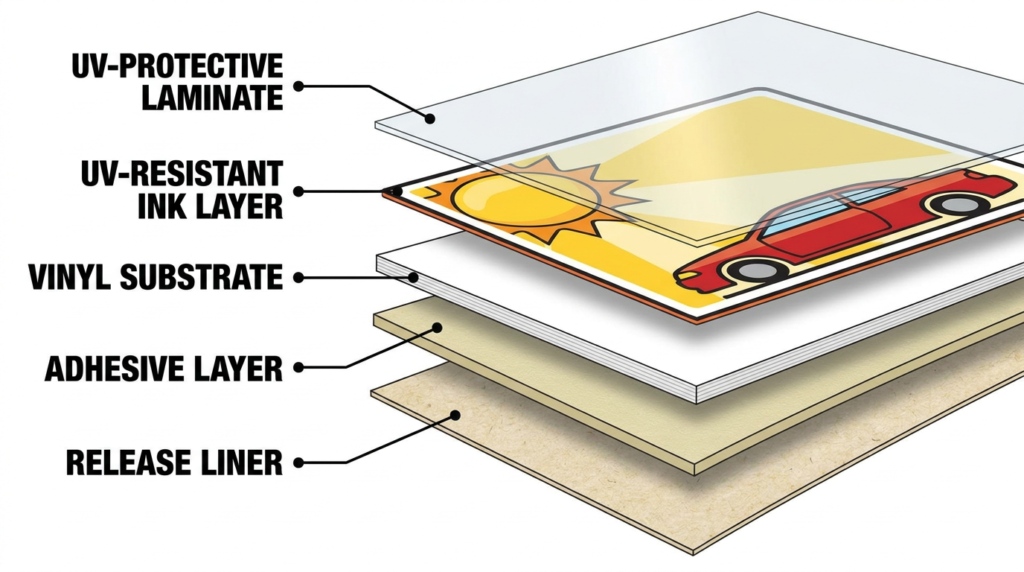
With the science established, the material choice becomes straightforward — but it’s worth walking through each option clearly, because the market is full of stickers at very different price points claiming suitability for outdoor use. Not all of them are telling the full story.
Automotive-grade vinyl (PVC) is the gold standard for outdoor bumper stickers, and has been for good reason. Polyvinyl chloride vinyl engineered for outdoor vehicle applications is a remarkably capable material. It’s inherently waterproof, flexible across a wide temperature range — critical for surviving both a Townsville January and a Canberra July — and formulated with UV stabilisers integrated into the material itself. Properly manufactured outdoor vinyl won’t crack in cold overnight temperatures, won’t become soft and unstable in intense heat, and flexes with the natural movement of vehicle surfaces rather than resisting and delaminating. It also adheres reliably to the curved geometry of modern bumpers, which present more application challenge than a simple flat panel.
Within the vinyl category, there’s an important distinction worth understanding: cast vinyl versus calendered vinyl. The manufacturing process for each produces a film with different characteristics. Cast vinyl is produced by casting liquid PVC onto a casting sheet and allowing it to cure, resulting in a very thin, dimensionally stable, highly conformable film. It’s the premium choice for vehicle graphics precisely because it conforms readily to curves and compound surfaces without the memory and stress that causes cheaper films to lift. Calendered vinyl — produced by pressing and rolling PVC compound — is thicker, less conformable, and better suited to flat surfaces or shorter-term applications. For a bumper sticker on a modern vehicle with curved surfaces, cast vinyl is the correct specification. It’s not a minor upgrade — it’s a meaningful difference in real-world durability.
Polypropylene (PP) deserves an honest mention as a secondary outdoor-capable material. It’s water-resistant, has reasonable UV resistance as an inherent property of the polymer, and is commonly used in label applications for outdoor goods and equipment. For many sticker formats it performs adequately. However, it’s less conformable than cast vinyl, generally less available in the premium outdoor-specification grades that automotive bumper stickers demand, and not the first-choice recommendation for a vehicle application where flexibility and long-term adhesion under thermal cycling are priorities.
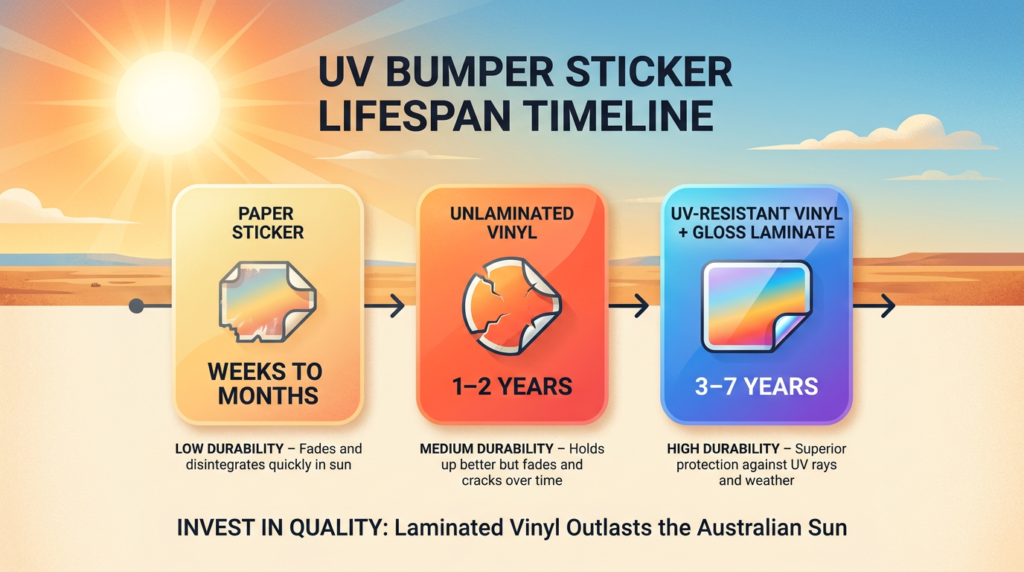
And then there’s paper. If you’ve taken anything from the previous two sections, you’ll already know where this is going. Paper has no meaningful UV resistance, no moisture resistance, no temperature stability, and no business being on the exterior of a vehicle in Australian conditions. Full stop. As our comparison of vinyl vs paper stickers makes clear, the performance gap between these materials outdoors isn’t marginal — it’s categorical. A paper-based bumper sticker in sustained UV Index 12+ with summer surface temperatures reaching 60°C can begin discolouring and bubbling within weeks. It will be embarrassing within months. It is simply not an outdoor material.
The adhesive layer deserves more attention than it usually gets in sticker buying decisions. The adhesive is what keeps everything attached — and under Australian conditions, it faces the same UV + thermal stress as the sticker surface above it. Cheap adhesives yellow visibly (ruining the sticker’s appearance from the inside), lose their tack at high temperatures causing lifting, and leave aggressive residue on removal that can damage paint surfaces. Automotive-grade adhesives are specifically engineered for the thermal cycling, UV exposure, and mechanical stress that a vehicle bumper experiences in day-to-day use. For applications requiring particularly strong adhesion — fleet vehicles, trade equipment, surfaces with challenging textures — high-tack adhesive formulations provide an extra margin of bonding confidence.
The takeaway is simple: for any outdoor Australian bumper sticker application, the material specification must be automotive-grade outdoor vinyl with UV-stabilised inks and an automotive-grade adhesive. Anything less is a compromise that the Australian sun will expose — usually faster than you’d expect.
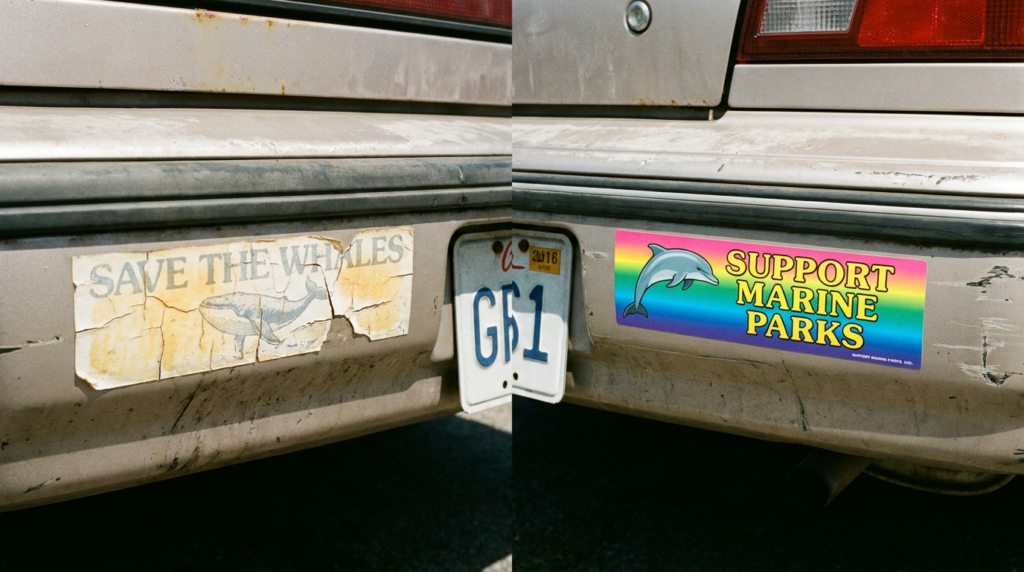
Once you’ve got the right material underneath, the next decision is what goes on top — and that’s where UV-protective laminates and finishes do some very heavy lifting.
The laminate is the layer most buyers never think about — and yet it’s the one doing some of the most critical work in protecting your bumper sticker’s appearance over its lifetime. Understanding what a laminate is, how it functions, and which finish is right for your application will help you make a genuinely informed buying decision rather than defaulting to whatever comes standard.
A UV-protective laminate is a thin, transparent film applied over the printed surface of the sticker after printing. It serves two distinct functions simultaneously. Physically, it provides a tough protective barrier against abrasion, road debris, car washing, and the minor mechanical impacts that a bumper sticker routinely experiences on a working vehicle. Optically, it’s loaded with UV absorbers that intercept incoming UV radiation before it reaches the printed ink beneath. The laminate is, in effect, wearing the UV damage so the ink doesn’t have to — a sacrificial layer that extends colour life dramatically.
This is the sunscreen analogy made concrete: just as sunscreen on your skin absorbs and neutralises UV energy before it can damage the cells beneath, a UV-protective laminate absorbs UV energy before it can trigger photodegradation in the ink layer. And just as sunscreen wears off through use, the UV absorbers in a laminate are gradually consumed over years of exposure. The good news is that “gradually” really does mean gradually — a quality UV-protective laminate maintains its protective function for years before meaningful depletion, which is precisely why laminated outdoor vinyl stickers can achieve the 3–7 year lifespans that the best premium products are rated for.
The gloss UV laminate finish is the most common choice for outdoor bumper stickers, and it earns that status on merit. A gloss laminate creates a shiny, polished surface that intensifies colour saturation and contrast — your reds become deeper, your blues more vivid, your greens richer. This effect is particularly valuable for colourful logo designs, photographic imagery, and any sticker where maximum visual impact at distance is the priority. On a vehicle bumper doing 110 km/h down the highway, that extra pop of colour can be the difference between a message that registers and one that blurs into the background.
Gloss laminates are also practical in a maintenance sense: the smooth, hard surface repels dirt and grime and is easy to clean with a soft cloth and mild soapy water. Road film, bird droppings, and insect impacts wipe away without much effort. For trade vehicles, fleet cars, and business bumper stickers, this ease of maintenance has real daily value.
The matte UV laminate finish achieves its non-reflective, flat aesthetic through a surface texture that scatters rather than reflects light. The result is a sophisticated, premium visual quality that many design-conscious brands — particularly in professional services, hospitality, and lifestyle industries — find more aligned with their identity than the polished look of gloss.
There’s a practical advantage to matte in Australian conditions that’s often overlooked: reduced glare. In the intense Australian sun, a gloss surface can create strong specular reflections that actually interfere with readability from certain angles. A matte surface eliminates this problem entirely, which can make text and logos more legible in bright outdoor conditions — something worth considering if your sticker carries important information rather than purely a brand impression.
In terms of UV protection, matte laminates perform comparably to their gloss counterparts. The UV absorbers in the laminate function regardless of the surface texture applied to the outer face. The choice between gloss and matte is an aesthetic and strategic one, not a UV protection one.
It’s technically possible to produce an outdoor vinyl sticker without any laminate — relying entirely on UV-resistant inks and the UV stabilisers in the substrate to do the protective work. Under moderate outdoor conditions, this can be acceptable for shorter-term applications. But in Australian conditions — particularly northern Queensland, the NT, and WA — skipping the laminate is accepting a meaningful reduction in lifespan. The laminate adds not only UV protection but also physical protection against the abrasion and mechanical stress that a bumper sticker faces on any working vehicle. Removing it is removing a critical layer of your sticker’s defence system.
For most outdoor bumper sticker applications in Australia, the recommendation is clear: gloss UV laminate for maximum colour vibrancy and impact, matte UV laminate for premium brands or design-driven aesthetics. UV-protective laminate is standard on Fast Stickers’ bumper sticker range — it’s not an optional add-on, it’s part of what makes the product genuinely sun-proof. And if your application calls for a custom-shaped sticker rather than a rectangular format, the same UV laminate protection extends across die-cut sticker formats and even clear vinyl sticker options where UV protection is equally important despite the transparent base.
With the right materials and the right laminate in place, the next logical question is: how long will your UV-resistant bumper sticker actually last before it needs replacing?
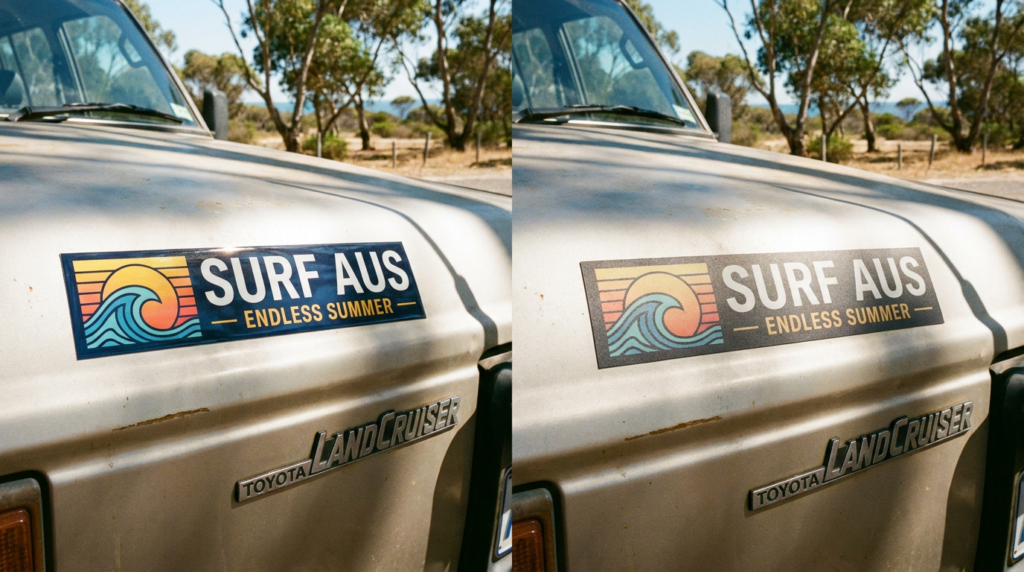
This is the question every business owner, fleet manager, and tradie eventually asks — and it deserves an honest, nuanced answer rather than a marketing claim. The short version is: premium UV-resistant vinyl bumper stickers with UV-protective laminate can last 3 to 7 years in outdoor Australian conditions. The longer version requires understanding the variables that move that number toward the high end or the low end of that range.
“In Australian conditions, a UV-resistant vinyl bumper sticker with protective lamination can last three to seven years while maintaining its colour and impact — that’s thousands of kilometres of mobile advertising at a fraction of a cent per impression.”
The 3–7 year benchmark is a well-established figure across the outdoor vinyl industry, supported by accelerated weathering tests and real-world performance data. It assumes premium-grade cast vinyl, UV-resistant inks, and a UV-protective laminate — all three layers of the defence system working together. Research across outdoor vinyl applications consistently supports this range, and it represents a realistic expectation for a quality product applied correctly to a vehicle bumper.
Remove the laminate, and expect 2–4 years in Australian conditions — potentially less in the north. Use cheap inks without UV stabilisers, and you’re likely looking at months before visible fading becomes embarrassing. These aren’t hypothetical degradations; they’re what the Australian sun does to materials not built to handle it.
Geographic location is the single biggest variable. A bumper sticker on a vehicle operating in Darwin or Cairns — where UV Index 11+ is essentially the year-round norm — faces a more demanding environment than one in Melbourne or Hobart, where UV intensity is more seasonal. Realistically, in the Top End and Far North Queensland, deducting 20–30% from the expected lifespan compared to southern Australian conditions is sensible forward planning.
Surface orientation has a significant and underappreciated impact. A sticker placed on a horizontal surface — the boot lid, the roof, a flat rear panel — receives direct, perpendicular UV radiation at the sun’s peak intensity. A sticker on a vertical surface — the rear bumper itself, a tailgate, the side of a van — receives UV at an angle throughout most of the day, substantially reducing total UV dose. All else being equal, a horizontal sticker will degrade measurably faster than a vertical one on the same vehicle.
Vehicle colour matters more than most people realise. A dark bumper — black, navy, deep red — absorbs solar radiation far more efficiently than a white or silver one. The surface temperature differential can easily reach 20°C between a black and white bumper on the same day. Higher surface temperatures mean greater thermal stress on the adhesive and substrate, accelerating the material fatigue that eventually leads to edge lifting and delamination. If your vehicle is dark-coloured and you operate in northern Australia, that’s the combination that pushes you toward the lower end of the lifespan range.
Car washing habits affect longevity in ways that are easy to control. Automated car washes — particularly high-pressure brushless systems — direct sustained water pressure and friction at sticker surfaces in ways that progressively degrade laminate edges. Hand washing with mild soap and a soft cloth is gentler, extends sticker life, and costs nothing extra if you’re already washing the vehicle. If you regularly use an automated wash, angling the pressure away from sticker edges where possible is a small habit with meaningful impact on longevity.
Application quality is the final major variable, and it’s one entirely within your control. A sticker applied to a contaminated or waxed surface will have compromised initial adhesion; once edge lifting begins, moisture and debris work their way beneath the sticker and accelerate degradation from the inside out. A perfectly applied sticker — on a clean, dry, degreased surface — starts with maximum adhesion and maintains it far longer.
Well-made UV-resistant stickers don’t fail suddenly. They age gracefully — gradually losing some colour vibrancy at the edges first (particularly yellows and reds, which are the most susceptible pigments even in UV-resistant inks), then showing slight contrast reduction across the full design, and eventually beginning to show edge lifting as the adhesive approaches the end of its useful life. This is normal product aging over a multi-year lifespan, not a manufacturing defect. If you’re noticing significant fading before the 2-year mark on a premium sticker, something went wrong in the specification, application, or care of the product — not in the lifespan expectations themselves.
Understanding why vinyl is a genuine game-changer for outdoor branding is especially relevant when you calculate the cost per impression of a bumper sticker with a 5-year outdoor lifespan. For business owners thinking about custom sticker ROI for small businesses, a UV-resistant bumper sticker generating brand impressions every single day for three to seven years represents one of the highest-value marketing assets available at the price point.
Of course, how long your sticker lasts isn’t just about what it’s made of — it’s also about how it’s applied, where it’s placed, and how you care for it. Here’s how to get every possible year out of your UV-resistant bumper sticker.
Even the best UV-resistant bumper sticker money can buy will underperform if it’s applied incorrectly, positioned carelessly, or neglected over time. The good news is that getting every possible year out of your sticker requires no specialised tools, no elaborate maintenance routine, and no significant investment of time. It just requires doing a few things right — and knowing what to avoid.
The single most impactful thing you can do for your sticker’s longevity happens before the sticker even touches the bumper. Surface preparation is everything. Start by washing the application area thoroughly with warm soapy water to remove surface dirt, road grime, and loose contamination. Then, critically, wipe the surface down with isopropyl alcohol — this step removes the invisible wax residues, silicone polishes, and greasy films that vehicle surfaces accumulate from regular washing and detailing. Even a microscopic layer of wax between the adhesive and the painted surface dramatically reduces bond strength from the first moment.
Never apply a sticker to a vehicle that’s been sitting in direct Australian sun. Surface temperatures on a sun-baked bumper can reach 50–60°C — at these temperatures, the adhesive activates and sets almost instantly on contact, before you’ve had any chance to position or adjust the sticker. You get one shot, and the heat takes that shot away from you. Apply in shade, in mild ambient temperatures (ideally between 15–25°C), and in calm, dry conditions. If you’re in Queensland in February, this probably means applying the sticker in the early morning or in a shaded garage.
Use a squeegee — or even a firm flat card like a credit card — to apply firm, even pressure across the sticker surface as you apply it, working from the centre outward to push any trapped air toward the edges. This step prevents air bubbles that, if left untreated, become weak points where UV and moisture can begin to attack the adhesive bond. After application, resist the urge to immediately test the sticker’s resilience. Give the adhesive at least 24 hours to fully cure and achieve maximum bond strength before washing the vehicle or exposing it to rain. The adhesive needs time to flow into the microscopic texture of the painted surface and establish its full grip.
Vertical surfaces — the rear bumper, the tailgate, the side panels — are always preferable to horizontal ones for maximum sticker lifespan. On a horizontal surface like a boot lid, your sticker receives direct overhead solar radiation at maximum intensity throughout peak UV hours. On a vertical rear bumper, UV strikes at an angle and the total dose over a day is meaningfully lower. The difference accumulates significantly over months and years.
Avoid placing stickers near exhaust outlets, where sustained heat and carbon deposits will attack the adhesive and laminate far faster than ambient sun exposure would. Similarly, avoid areas that regularly come into physical contact with other objects — towbar hardware contact points, areas that brush against loading dock edges, or surfaces close to door hinges or handles that experience regular mechanical contact. Your sticker should live in a calm, stable zone of the vehicle surface.
If you have the flexibility, placement in a partially shaded zone — such as beneath a rear spoiler or under a tray edge on a ute — can add meaningful months to its lifespan. Yes, this trades some visibility for longevity. Whether that trade-off makes sense depends entirely on your use case: for pure branding purposes where visibility is the whole point, prioritise visual exposure. For long-term compliance or identification stickers, consider the shaded option.
Once applied, your UV bumper sticker requires very little active maintenance — but a few smart habits make a measurable difference.
One tip that’s specific to the Australian context: where you park your vehicle matters more than most people think. A vehicle regularly parked in a covered car park, under a carport, or in a shaded area every afternoon can add a year or more to a sticker’s effective lifespan — simply by reducing total UV dose accumulated over years. You’re not changing anything about the sticker; you’re just reducing how hard it has to work. In Darwin, Cairns, Broome, and the Kimberley, where year-round extreme UV is the reality, this kind of passive protection is worth genuinely considering.
For the full picture on bumper sticker application, positioning, and best practices for Australian vehicles, our comprehensive car bumper sticker guide goes into even greater depth on techniques and considerations. And if you’re operating leased vehicles or a fleet that undergoes periodic rebrand, removable vinyl sticker options offer UV-resistant outdoor performance with the ability to remove cleanly without paint damage — a consideration worth knowing about before you commit to a permanent adhesive.
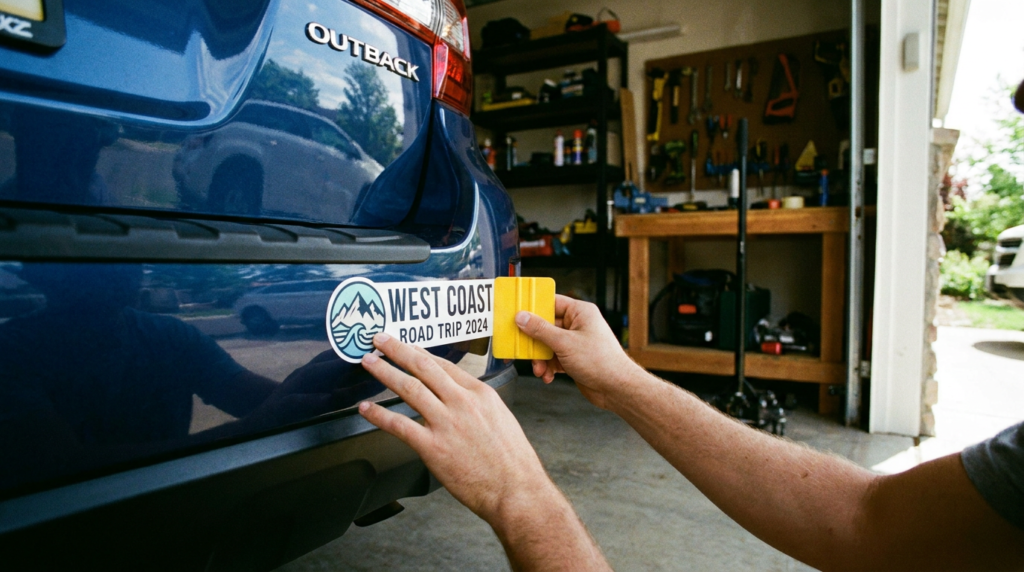
With the right sticker, applied correctly and cared for properly, your UV bumper sticker will keep your message on the road for years to come. The final piece of the puzzle is choosing the right Australian supplier — one that genuinely understands what our conditions demand.
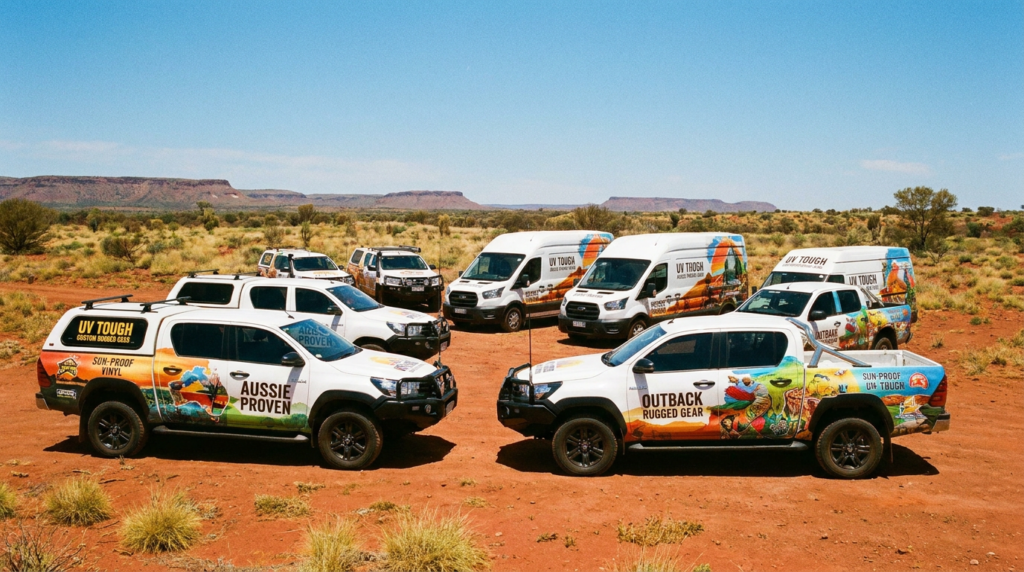
There’s a quiet irony in the sticker industry: a product can be specified and manufactured to genuinely premium standards using all the right materials, yet still underperform if the person making it doesn’t understand the conditions it will face. UV resistance isn’t a box to tick on a product spec sheet — it’s a design philosophy that has to run through every decision in the production process, from material sourcing to ink selection to laminate grade to print settings.
Australia’s UV conditions are genuinely unique at a global scale. A supplier who has spent years, or decades, producing outdoor stickers for Australian vehicles, businesses, and trade applications has a qualitatively different understanding of what “outdoor-rated” actually means in this country. They’ve seen what happens when materials that pass international outdoor testing standards fail six months into an Australian summer. They know which ink formulations hold their vibrancy through a Pilbara summer and which ones bleed out before Christmas. They understand that “outdoor rated” means something very different when the outdoor in question is Townsville rather than Stuttgart.
This is the context in which Fast Stickers’ bumper stickers are produced. Based in Gippsland, Victoria, Fast Stickers is an Australian family business with over 15 years of specialist sticker expertise — including the hard-won understanding of what Australian outdoor conditions demand of a sticker’s materials, construction, and print quality. Every bumper sticker produced uses premium automotive-grade vinyl with UV-resistant inks and UV-protective laminate as standard — not as premium options, but as the baseline specification, because Australian conditions don’t leave room for a lower standard.
The combination matters: a UV-stabilised cast vinyl substrate provides the structural foundation and temperature resilience. UV-resistant inks with automotive-grade pigments maintain colour vibrancy under sustained UV radiation. A UV-protective gloss or matte laminate acts as the final shield — absorbing UV energy before it reaches the ink, and providing a tough physical barrier against the mechanical wear of everyday vehicle use. Together, these three layers deliver a bumper sticker genuinely capable of lasting 3 to 7 years even under Australia’s most challenging sun.
Beyond the materials, the production process matters too. Every order includes a free artwork design service — Fast Stickers’ experienced design team will work with your concept, brief, or rough idea and produce a professional artwork file ready for print. A full-colour digital proof is provided before anything goes to print, and nothing proceeds without your explicit approval. The 100% satisfaction guarantee backs up the quality commitment with real accountability. And once the sticker is approved and printed, most orders are completed within 2–3 business days and dispatched with free express shipping across Australia — so your sticker is on your bumper, not waiting in a queue.
For Australian businesses thinking about vehicle branding, trade identification, fleet livery, promotional campaigns, or any outdoor application where sun-proofness is the non-negotiable requirement, the argument is straightforward: get a UV-resistant bumper sticker that’s actually built for Australia, applied correctly, and cared for sensibly — and it will work for you every single day for years, delivering brand impressions at a cost per contact that no other marketing medium can touch.
Australia’s sun is extreme, unrelenting, and utterly indifferent to the lifespan guarantees printed on spec sheets designed for milder climates. But it’s also the backdrop against which a genuinely high-quality UV-resistant bumper sticker — the right vinyl, the right inks, the right laminate — will simply shine.
Fast Stickers is Australia’s go-to specialist for UV-resistant bumper stickers — printed locally in Gippsland, Victoria, using premium automotive-grade vinyl and UV-protective laminates designed to meet the genuine demands of Australian outdoor conditions. Not European conditions. Not North American conditions. Australian ones.
Whether you need a single custom design for your ute, bulk stickers for a commercial fleet, branded stickers for a product launch, or promotional stickers for an event or campaign, Fast Stickers delivers vibrant, sun-proof results with fast turnaround and free express shipping to every corner of the country.
Don’t have a design ready? That’s not a problem. A free artwork design service is included with every order — Fast Stickers’ experienced designers will bring your idea to life, you review and approve a full digital proof, and nothing goes to print until you’re completely satisfied. The 100% satisfaction guarantee means your investment is protected every step of the way.
Order Your UV Bumper Stickers Online — browse the range and place your order directly.
Get a Free Quote — for bulk orders, fleet stickers, or custom enquiries requiring a tailored price.
Explore the Full Bumper Sticker Range — if you’re still comparing options and want to see everything available before deciding.
Your sticker will face the full force of the Australian sun. Make sure it’s built for it.
Custom Stickers Melbourne: The Complete 2026 Guide for Victorian Businesses Picture this: it’s a Thursday afternoon in a Brunswick café. The new logo finally landed

Picture this: it’s 9pm on a Tuesday in a spare room in Bendigo, and you’re sitting cross-legged on the floor because the table ran out

Picture this. It’s Friday night in a suburban Australian street — the kind where the smell of melted cheese and wood-fired dough drifts through open

The Complete Australian Guide for Beekeepers and Honey Producers Picture this: it’s a warm December morning in the Yarra Valley. The flow has been extraordinary

Picture this: it’s 6am on the Saturday before Mother’s Day, and a florist in Melbourne’s inner north is already three hours deep into the morning.