
Custom Stickers Melbourne
Custom Stickers Melbourne: The Complete 2026 Guide for Victorian Businesses Picture this: it’s a Thursday afternoon in a Brunswick café. The new logo finally landed
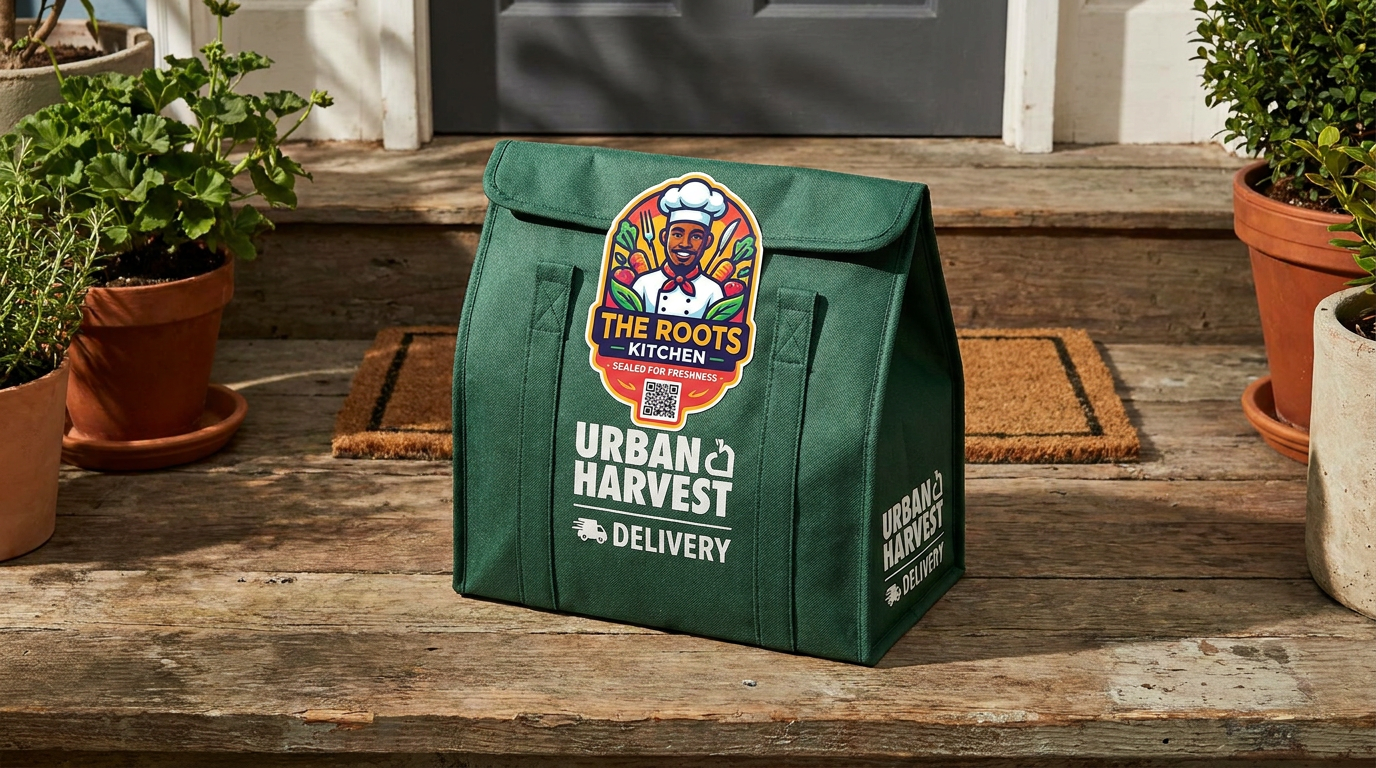
Picture this. It’s a Friday night. A hungry customer opens their front door, reaches down, and picks up a plain brown paper bag. No logo. No colour. No name. Just a generic bag and a receipt stapled to the side. The food inside might be extraordinary — slow-braised, perfectly seasoned, the kind of meal worth driving across the city for — but in this moment, the restaurant behind it is completely invisible. Forgotten before the first bite.
Now picture a different version of the same scene. Same doorstep. Same Friday night. But this time, the kraft paper bag is sealed with a bold, beautifully printed custom die-cut logo sticker in the restaurant’s brand colours. The customer sees it immediately. They recognise it. It feels considered. It feels professional. Before they’ve even opened the bag, they already feel good about the decision they made.
That’s the power of branded food delivery packaging — and it costs far less than most restaurant owners imagine.
Australia’s food delivery market was valued at AUD $20.92 billion in 2025 and is projected to reach AUD $43.12 billion by 2034, growing at a compound annual growth rate of 7.5%. This is not a niche channel. It is not a passing trend. It is a primary revenue stream for restaurants across the country — from hole-in-the-wall burger joints in Fitzroy to sushi chains across Sydney’s CBD. And in a market that competitive, brand visibility at the point of delivery is one of the most powerful advantages a restaurant can claim.
The question every restaurant owner should be asking right now isn’t whether to brand their delivery packaging. It’s whether their packaging is doing enough. If the dining room is the stage, then delivery packaging is the curtain call. Is yours worth remembering?
In this guide, we’ll walk through everything you need to know: the state of Australia’s food delivery market, why custom logo stickers are the smartest and most cost-effective branding tool available, exactly where to place them on your packaging, the psychology behind why branded unboxing experiences build customer loyalty, practical design and material guidance, and how FastStickers can help you get professional results — fast.
The numbers don’t lie, and right now, they’re telling every restaurant owner in Australia the same thing: delivery is no longer a side hustle. It is the business.
Australia’s food delivery market is on track to double by 2034, rising from AUD $20.92 billion in 2025 to an estimated AUD $43.12 billion — a trajectory driven by convenience-hungry consumers, increasingly sophisticated delivery platforms, and a generational shift in how Australians relate to eating out. Almost half of all Australians — 48% — were ordering food delivery at least once a week as of 2025, with Gen Z leading the charge at 67% weekly ordering rates, followed closely by parents at 53%. About 27% of respondents reported ordering delivery three or more times within a single 24-hour period. These aren’t occasional indulgences. They’re habits.
At the same time, dine-in revenues have declined as more Australians order delivery, with the dine-in share of restaurant revenue dropping from 31% to 20% in 2025 alone. This is not a COVID-era hangover. This is a permanent structural shift in consumer behaviour — one that restaurants need to respond to not just operationally, but brand-strategically. The physical restaurant is no longer the only — or even the primary — stage on which a restaurant’s brand performs.
And here’s the critical gap that most restaurants haven’t yet addressed: delivery platforms commoditise the customer experience. On Uber Eats, which commands over 63% of the Australian food delivery market, a restaurant is represented by a logo thumbnail, a star rating, and a price bracket. Every restaurant on the platform is competing side-by-side against dozens of others, often in the same cuisine category. A customer might choose you because of your rating or a promotional discount. But once that bag is picked up and carried to their door, the platform steps away entirely. What’s left is just the packaging.
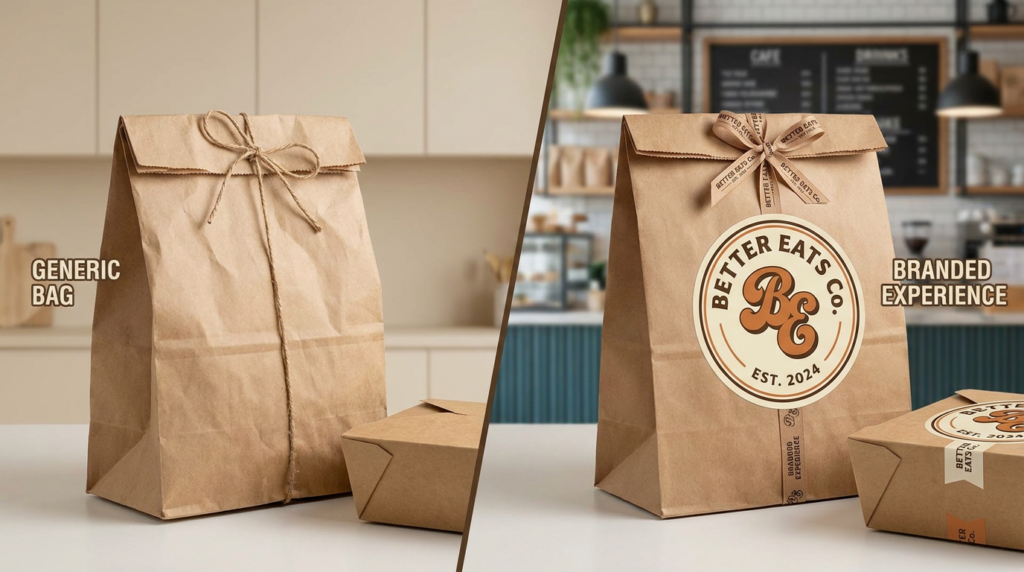
If that packaging is generic — a plain brown bag with no branding, no logo, no identity — then the restaurant has just spent money acquiring a customer and failed to leave any impression at the moment of greatest emotional engagement. The food arrives. The customer eats it. The restaurant evaporates from memory by morning.
Custom branding through stickers is how restaurants reclaim that moment. A logo sticker on a delivery bag doesn’t just look good. It does something far more important: it reintroduces the restaurant’s identity at the exact moment the customer is most engaged with it — hungry, anticipating, present. That’s not just aesthetics. That’s strategic brand placement at the highest-value touchpoint in the entire delivery transaction.
The opportunity is real, the market is growing at pace, and the cost of entry is lower than almost any other marketing channel. Now let’s look at exactly why custom logo stickers are the tool of choice.
There’s no shortage of ways a restaurant could theoretically improve its delivery packaging. Full custom-printed boxes. Pre-branded bags with screen-printed logos. Bespoke compostable containers with embossed branding. The possibilities are endless — and so are the costs and lead times associated with them.
Custom logo stickers occupy a uniquely powerful position in this landscape. They deliver professional, high-impact branding on any existing packaging — without requiring a restaurant to overhaul its entire packaging supply chain. That’s not a compromise. That’s a strategic advantage.
“A single well-placed logo sticker transforms a plain brown bag into a branded customer experience — without a packaging redesign.”
Consider what a restaurant typically already has on hand: kraft paper bags from a wholesale supplier, cardboard boxes sourced from a local distributor, pizza boxes, sushi trays, noodle containers, drink cups. All of it is generic. All of it is already paid for. A custom logo sticker turns every single one of those items into a branded touchpoint — instantly, affordably, and without the commitment of a bulk pre-printed packaging order.
The cost-effectiveness of stickers is perhaps their most compelling advantage for independent restaurants and small chains. Rather than investing thousands of dollars in minimum-order quantities of custom-printed packaging, a restaurant can order a run of logo stickers and brand their existing stock. The entry point is dramatically lower, and the results are immediately visible.
Flexibility is equally important. Seasonal promotions, menu relaunches, new brand identities — in the food industry, things change quickly. With pre-printed boxes, you’re locked in. With stickers, you can update your design, run a limited-edition seasonal variant, or switch up your look for a special event without any waste. A Halloween sticker run, a Christmas edition, a “we’ve moved” version — the creative freedom is enormous and the operational friction is minimal.
Then there’s the tamper-evident function — a benefit that many restaurant owners don’t initially consider but customers genuinely value. A logo sticker placed across the seal of a delivery bag or over the flap of a cardboard box serves two purposes simultaneously: it brands the packaging and it acts as a visible tamper seal. If a sticker is intact when the delivery arrives, the customer knows the bag hasn’t been opened in transit. That peace of mind is a direct trust-builder — and trust is the foundation of repeat business.
FastStickers’ die-cut stickers are particularly well-suited to this dual-purpose role. Custom-shaped to follow the exact outline of a restaurant logo, they create a premium, intentional impression that round or rectangular stickers simply can’t match. For restaurants that go through high volumes of seal stickers each week, paper sticker rolls offer the same branded impact in a format designed for speed — easy to peel, fast to apply, and cost-effective at scale.
Speed to market is another critical factor. With FastStickers’ 2–3 business day turnaround and free express shipping across Australia, a restaurant can go from concept to fully branded packaging in less than a week. Launching a new menu next Thursday? The stickers can be on your counter by Tuesday. That’s an agility that no pre-printed packaging solution can match.
Now that the case for stickers is firmly made, let’s get tactical — because knowing what to use is only half the answer. The other half is knowing exactly where to place them for maximum brand impact.
The beauty of custom logo stickers is their versatility. Almost every surface of food delivery packaging is a potential branding touchpoint — and with a thoughtful placement strategy, a restaurant can create a consistent, professional branded experience from the moment the bag is handed to the driver to the moment the customer takes their last bite.
Here’s a practical breakdown of the key placement opportunities, and why each one matters.
Delivery Bags — The Hero Placement
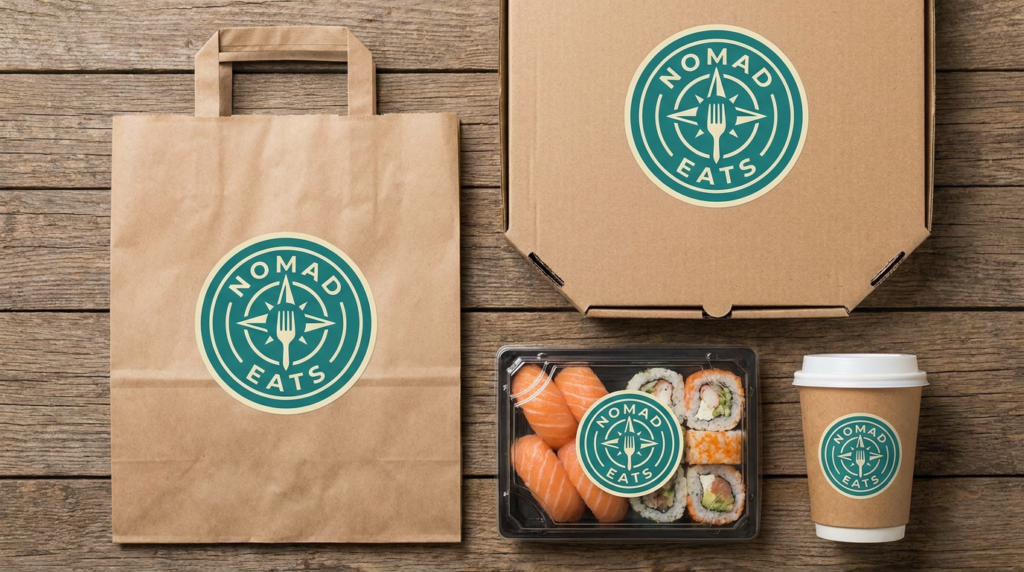
The bag seal is the first thing a customer touches. It’s the first visual impression they receive from the physical packaging. A round or die-cut logo sticker placed across the top seal of a kraft paper delivery bag functions as both a brand statement and a tamper seal — and it does both jobs elegantly. For this application, 50mm–75mm round stickers or die-cut logo stickers work beautifully. They’re large enough to be immediately visible, but not so large that they overwhelm the bag’s surface. This single placement alone transforms a generic bag into a branded customer experience.
Cardboard Boxes — The Lid Moment
Whether it’s a pizza box, a burger box, or a fried chicken container, the lid of a cardboard box is a prime branding real estate. When a box is set down in front of a customer, the top surface is the first thing they see. A logo sticker on the top lid flap — centred, confident, and in brand colours — creates an immediate visual connection between the meal and the restaurant. Rectangular or die-cut stickers in brand colours work particularly well here, as they can be sized to complement the box dimensions without looking lost.
Takeaway Containers — Small But Mighty
Sushi trays, deli containers, noodle boxes, salad containers — these smaller packaging items are easy to overlook from a branding perspective. But they’re often the items that sit on a customer’s desk at lunch, visible to colleagues. A 30–50mm round or oval sticker on the lid keeps the restaurant’s identity present even on the smallest items. For a premium “floating logo” effect on transparent plastic lids, consider clear stickers — the logo appears to sit directly on the surface with no visible background, creating a sophisticated, high-end impression.
Drink Cups and Coffee Cups — The Side Branding Opportunity
Cafés and restaurants that include beverages in their delivery orders have an often-underused canvas: the side of the cup. A 40–60mm round sticker or a narrow band label applied to the cup side keeps the brand visible throughout the drinking experience. For cafés in particular, this is a powerful brand touchpoint — a customer nursing a branded coffee cup at their desk for an hour is being reminded of your restaurant the entire time.
Paper Wrapping and Grease-Proof Paper — Sealing the Item
Burgers wrapped in paper, fish and chips in grease-proof bags, wraps sealed before boxing — each of these can carry a logo sticker as a closure seal. Vinyl sticker rolls are ideal for this application, providing the water and grease resistance needed for food-adjacent surfaces while delivering a clean, professional branded finish.
The Inside Surprise — A “Thank You” Moment
One of the most underrated placement strategies is inside the bag or box. A small “thank you” sticker applied to the inside of the lid or tucked into the bag alongside the food creates a genuine moment of delight. The customer doesn’t expect it. That surprise — that small gesture of thoughtfulness — registers emotionally in a way that exterior branding sometimes doesn’t. It says: we thought about you beyond the transaction. And that’s exactly the kind of micro-moment that builds lasting brand affinity.
QR Code Stickers — Turning Packaging Into Marketing
A small QR code sticker alongside or as part of the branded seal can link customers directly to a loyalty programme, a Google review page, an Instagram profile, or a digital menu. According to restaurant sticker usage research from MustHaveMenus, this kind of functional sticker use is increasingly common among restaurants looking to turn every delivery order into a re-marketing touchpoint. It’s packaging that works as hard as a digital ad — without the ongoing spend.
Understanding where to place stickers is the practical foundation. But the reason these placements work so powerfully goes deeper than aesthetics — it’s rooted in consumer psychology. Let’s explore that next.
There is a moment, brief and charged with anticipation, that every delivery customer experiences: the moment they pick up the bag and begin to open it. Food psychologists and consumer behaviour researchers have studied this moment carefully, and what they’ve found is striking. The packaging experience doesn’t just accompany the meal — in many cases, it shapes the perception of it.
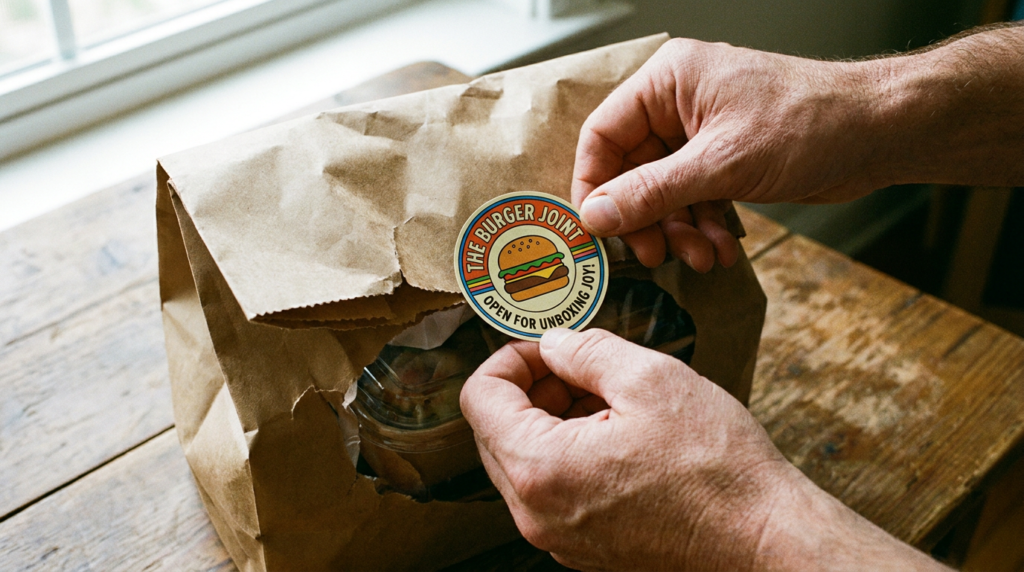
Anticipation and the First Impression Effect
Before a single bite is taken, the customer has already formed an impression of the meal. The psychology of unboxing and how packaging influences consumer behaviour shows that tactile and visual cues from packaging directly prime the consumer’s experience of what’s inside. A well-presented, branded bag signals quality, care, and professionalism — all before the food is tasted. Conversely, generic, unbranded packaging flattens that anticipation. It communicates nothing — and in a competitive market, communicating nothing is a strategic loss.
When a customer peels back a branded logo sticker to open their delivery, they are not just opening a bag. They are completing a brand interaction. The act of breaking the seal — of removing the sticker — is tactile, deliberate, and memorable. It is, in miniature, the same psychology that drives the massive cultural phenomenon of unboxing videos on YouTube and social media.
Perceived Value and the Halo Effect
There is a well-documented phenomenon in consumer psychology known as the “halo effect” — the tendency for one positive attribute to colour our perception of an entire experience. Attractive, branded packaging creates a halo around the food itself. Customers who receive a well-packaged delivery perceive the food as higher quality, even before they taste it. Research into the psychology behind a memorable unboxing experience confirms that tactile quality and visual consistency in packaging directly influence customer satisfaction scores and the likelihood of reordering.
For restaurants, this means a logo sticker is not merely decorative. It is a quality signal — a cue that communicates “this restaurant takes pride in everything, including the way the meal arrives at your door.” That signal has real commercial value.
The “Branded vs. Forgotten” Effect
One of the most practically significant findings in unboxing psychology is how quickly unbranded packaging disappears from memory. As noted in research on why customers remember delivery more than the product, unbranded packaging leaves no distinctive memory trace — the experience is pleasurable in the moment but creates no lasting brand association. The customer enjoyed the food, but couldn’t tell you where it came from a week later.
“Branded, custom printed packaging stands out in a sea of identical brown cardboard. Unbranded boxes disappear from memory within hours.”
Branded packaging, by contrast, creates a mental bookmark. The customer associates the positive experience of the meal with a specific visual identity — and that identity becomes the anchor for their next craving. This is the mechanism behind repeat ordering: not just that the food was good, but that the customer remembers who made it. A logo sticker on the bag is one of the most direct, low-cost ways to create that association.
Social Sharing and the Ripple Effect
We live in a world where food is photographed before it is eaten, and packaging is part of the frame. Visually appealing branded packaging is inherently more shareable than generic packaging. A beautifully sealed bag with a bold custom logo sticker is far more likely to appear in an Instagram story or a TikTok “what I ordered” video than a plain brown bag — because it adds something aesthetically interesting to the shot. Every organic social share of branded packaging is free word-of-mouth marketing. The restaurant’s logo appears in someone else’s feed, associated with a positive dining moment, reaching an audience the restaurant didn’t pay to access.
Trust Through Tamper Evidence
Food safety anxiety is a genuine, documented concern for delivery customers. The question of whether a bag has been opened or interfered with in transit is something that crosses many customers’ minds, even if they don’t voice it. A logo sticker acting as a tamper-evident seal provides visible, immediate reassurance that the packaging is intact. This is not just a functional benefit — it is an emotional one. Trust, once established, becomes loyalty. And loyalty, in the restaurant industry, is revenue.
Every one of these psychological mechanisms is activated by branded packaging — and specifically by a well-designed, well-placed custom logo sticker. But all of this depends on the sticker being designed correctly. Let’s look at how to get that right.
A poorly designed sticker is worse than no sticker at all. A cluttered, low-resolution, off-brand sticker doesn’t build trust — it undermines it. Getting the design right is the difference between a packaging moment that elevates the brand and one that quietly damages it. The good news is that with the right guidance, great sticker design is genuinely accessible — even for restaurants without a graphic designer on staff.
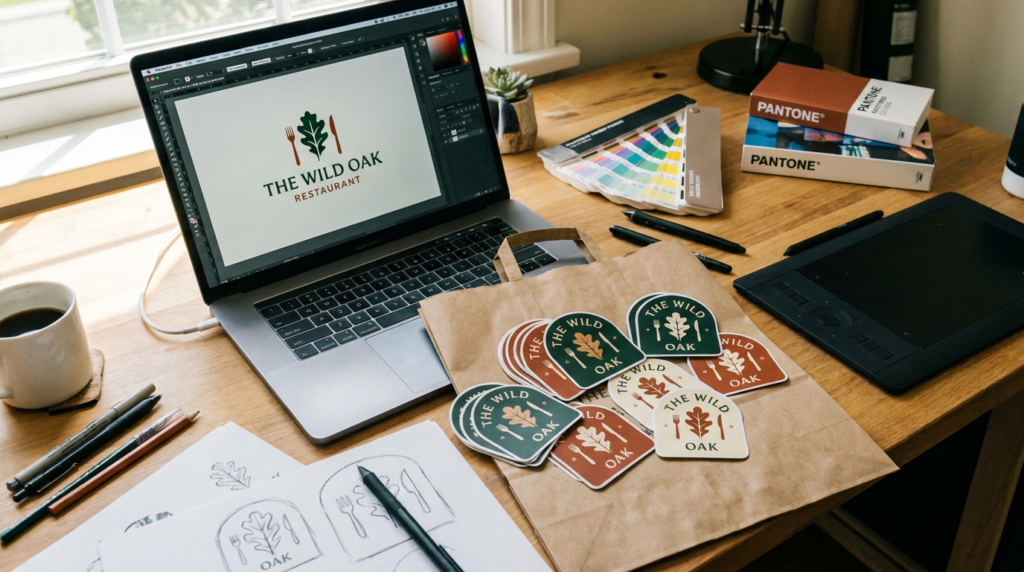
Keep It Simple and Bold
The first principle of sticker design for food delivery packaging is simplicity. A sticker on a delivery bag will be viewed quickly, often in low light, and frequently at an angle. Intricate, fine-detail designs that look beautiful on a screen can become muddy and illegible when printed at 50mm. The goal is instant recognition — a bold logo mark, a clear brand name, and a clean composition with room to breathe. Less is consistently more on sticker design.
Think of the world’s most recognisable fast food brands. Their logos are simple, bold, and unmistakable at any size. Your restaurant’s sticker doesn’t need to tell the whole brand story — it just needs to say, clearly and confidently: this is who made your meal.
Colour Consistency Is Non-Negotiable
The colours on your sticker should match your brand’s exact colour values — ideally specified as CMYK values for print accuracy. Colour consistency across all touchpoints (signage, menus, uniforms, social media, packaging) is one of the most powerful mechanisms of subconscious brand recognition. When a customer sees your brand colour on a sticker, it should resonate immediately with every other brand experience they’ve had with you. This is not a detail to approximate — it’s a standard to hold precisely.
Shape Matters More Than You Think
Sticker shape is a design decision with real strategic implications. Round stickers feel approachable and are the classic choice for seal applications — they sit naturally over a bag’s fold or a box’s flap. Die-cut stickers that follow the exact outline of a logo create a premium, bespoke impression — the sticker looks like it was made for this brand, not just printed and applied. Rectangular stickers work well when there’s additional information to convey, such as a QR code, a website, or a tagline alongside the logo.
For most restaurants, a die-cut logo sticker for the primary seal placement and a round sticker for secondary placements (container lids, cup sides) is an excellent combination.
File Format and Resolution — Get It Right First Time
For the sharpest, most professional print results, sticker artwork should be submitted as a vector file — typically .AI, .EPS, or .PDF format. Vector files are resolution-independent, meaning the design will be perfectly crisp whether the sticker is 30mm or 300mm. Raster files like JPGs or PNGs can work at smaller sizes but risk pixelation and soft edges, particularly on die-cut stickers where the cut line follows the design’s outline. FastStickers’ artwork and print quality guide covers everything you need to know about file preparation.
Size Recommendations for Common Food Packaging
Getting the size right ensures the sticker looks proportionate and intentional rather than undersized or overwhelming:
Finish Options — From Everyday to Premium
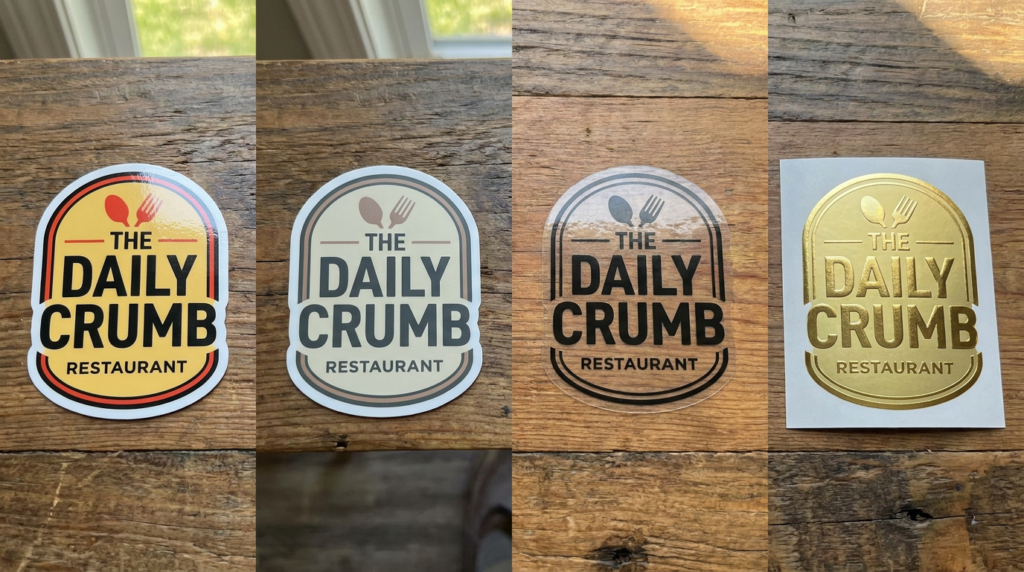
FastStickers offers gloss and matte finish options, each with a distinct brand personality. Gloss finish delivers vibrant, eye-catching colours that pop against kraft paper and cardboard — ideal for casual dining, colourful brands, and restaurants wanting to project energy and warmth. Matte finish conveys sophistication and restraint — perfect for premium or fine-dining establishments aiming for an understated, considered aesthetic.
For restaurants at the premium end of the market, shiny gold stickers or silver foil options add a genuinely luxurious touch to packaging. On a dark kraft paper bag, a gold die-cut logo sticker signals quality in an unmistakable, immediate way. It’s the kind of detail that customers notice, photograph, and remember.
FastStickers’ Free Design Service
For restaurant owners who don’t have a designer — which, frankly, is most of them — FastStickers offers a free artwork and design service included with every order. The FastStickers design team will create or refine your sticker artwork, with unlimited revisions until you’re happy with the result. You don’t need to arrive with a perfect file. You can arrive with a logo on a business card and leave with a professionally designed sticker ready for print.
Great design is the foundation. But even the best design is only as good as the material it’s printed on — which is where the next decision becomes critical.
Not all stickers are created equal — and in the food industry, material choice matters. Delivery packaging is handled, carried, potentially exposed to moisture, grease, and condensation, and needs to hold together through the journey from kitchen to doorstep. Choosing the wrong material can mean stickers that peel, smudge, or fail to adhere to certain surfaces. Choosing the right one means a sticker that stays put, looks sharp, and represents the brand exactly as intended.
Standard Vinyl Stickers — The Reliable All-Rounder
For most restaurant delivery packaging applications, standard vinyl stickers are the go-to choice. They are durable, water-resistant, and produce vibrant, true-to-colour printing. With 3–7 year outdoor durability built into the material, they will easily withstand the moisture, handling, and environmental exposure involved in a typical food delivery. They adhere reliably to kraft paper bags, cardboard boxes, pizza boxes, and most standard food packaging surfaces.
High Tack Stickers — For Textured and Recycled Surfaces
Recycled cardboard and kraft paper are increasingly popular in the food industry, both for sustainability reasons and aesthetics. But these surfaces can be rough, textured, or coated in ways that challenge standard adhesive stickers. High tack stickers feature a stronger, more aggressive adhesive specifically designed for difficult or irregular surfaces. If your packaging includes recycled kraft bags, corrugated board, or any rough-textured material, high tack stickers ensure your logo stays exactly where you put it — throughout the entire delivery journey.
Clear Stickers — The Premium No-Label Look
For restaurants serving in clear or light-coloured containers — think acai bowls, clear drink cups, premium salad containers, or transparent dessert packaging — clear stickers create a stunning “no-label” presentation. The logo appears to float directly on the surface with no visible sticker background. This effect reads as genuinely premium — the kind of detail typically associated with high-end retail products rather than food delivery. It’s a simple material choice that communicates quality loudly and quietly at the same time.
Paper Sticker Rolls — Speed and Volume for Busy Services
For a restaurant doing significant delivery volumes — say, a busy Friday night service with 80+ orders going out the door — the efficiency of application matters as much as the quality of the sticker. Paper sticker rolls are designed for exactly this environment. The roll format allows stickers to be peeled and applied rapidly, without fumbling with individual backing sheets. The cost per sticker is lower, making them ideal for high-volume seal applications where hundreds of stickers are needed each week.
Vinyl Sticker Rolls — Water Resistance at Volume
Where paper sticker rolls are used in environments where moisture is a factor — cold food containers, drink packaging, frozen meal kits — vinyl sticker rolls offer the same roll-format efficiency with the added benefit of water and condensation resistance. This is the material of choice for restaurants and cafés that include beverages, cold dishes, or chilled items in their delivery offering.
Die-Cut Stickers — The Premium Branding Choice
For the primary brand touchpoint — the logo sticker on the delivery bag seal or the box lid — die-cut stickers are the premium choice. Precision-cut to follow the exact outline of the restaurant’s logo, they create the most professional, most memorable brand impression available in sticker format. When a customer peels back a die-cut logo sticker that perfectly follows every curve and angle of the brand mark, they’re experiencing a level of craft and attention to detail that communicates brand quality in an entirely non-verbal way.
A Note on Food Safety
All FastStickers products are applied to the outside of packaging — never in direct contact with food. FastStickers uses premium UV-resistant inks and professional vinyl materials that are stable, non-toxic, and appropriate for use on food packaging exteriors. For restaurants that also manage frozen meal kits or refrigerated meal prep products, it’s worth reading FastStickers’ complete guide to freezer stickers, which covers the specific adhesive and material requirements for cold-chain packaging applications.
With design and material knowledge in hand, the final piece of the puzzle is finding the right printing partner — one that understands the restaurant industry’s pace, the importance of quality, and the need for speed.
Every insight in this guide — the psychology, the placement strategies, the design principles, the material choices — lands at the same practical question: where do you actually get these stickers made, and how quickly can you have them in your kitchen?
For Australian restaurants, the answer is FastStickers.
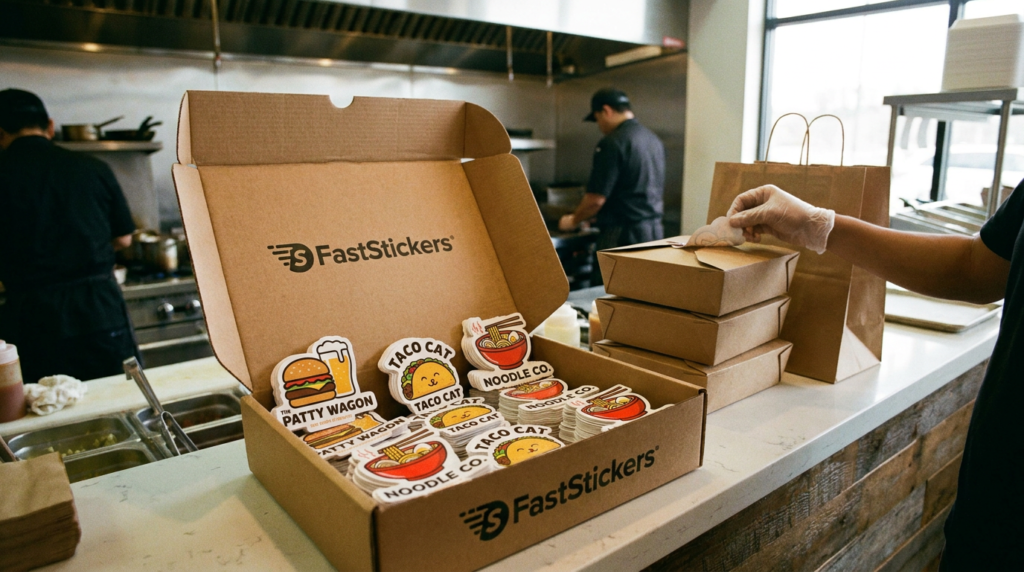
Lightning-Fast Turnaround
In the restaurant industry, speed is currency. A menu launch, a promotional campaign, a catering event — the timeline is always tight, and “we’re waiting on the printer” is not an answer that works. FastStickers prints and dispatches most orders within 2–3 business days, with free express shipping included as standard. For genuinely urgent situations — a last-minute event, an unexpected opportunity — FastStickers offers urgent production options. Simply call and mention “URGENT,” and the team will do everything possible to prioritise the order.
Free Design Service — No Designer Required
The number one barrier most independent restaurant owners cite when it comes to branded stickers is this: “I don’t have anyone to design it.” FastStickers removes that barrier entirely. Every order includes access to FastStickers’ free artwork and design service. The team will work with whatever you can provide — a photo of your logo, a file from your previous printer, a business card — and turn it into print-ready sticker artwork. Unlimited revisions are included, so the final result is exactly what you want before a single sticker is printed.
This service alone is a genuine differentiator. It means any restaurant — whether it’s a first-year independent with a handmade logo or an established chain with a full brand guidelines document — can access professional sticker design without the cost or delay of briefing an external designer.
Free Express Shipping Australia-Wide
There are no hidden delivery costs. Whether a restaurant is ordering from Melbourne’s inner suburbs, the Gold Coast hinterland, or regional Western Australia, FastStickers’ free express shipping covers the whole country. The stickers arrive fast, professionally packaged, and ready to use.
15+ Years of Sticker Expertise
FastStickers is not a generalist printer that also happens to make stickers. They are sticker specialists — a family-run, Australian-owned business based in Gippsland, Victoria, with over 15 years of expertise in materials, adhesives, finishes, and print quality. That depth of knowledge means they understand the nuances: which adhesive works on recycled kraft, how a die-cut should be structured for a complex logo, what finish best suits a fine dining presentation. When a restaurant owner orders from FastStickers, they’re not dealing with an algorithm and a dispatch warehouse — they’re dealing with people who genuinely know their craft.
A Full Product Range for Every Restaurant Need
From die-cut logo stickers for premium bag seals to paper sticker rolls for high-volume service, clear stickers for transparent containers, high tack stickers for textured packaging, vinyl rolls for moisture-exposed applications, and shiny gold stickers for premium brand moments — every product a restaurant needs is available in one place, from one trusted Australian supplier.
FastStickers also supports restaurant window graphics for in-store and shopfront branding — making them a genuine one-stop partner for restaurants looking to create a cohesive brand experience across both their physical location and their delivery operation.
A Simple, Stress-Free Process
Getting started couldn’t be more straightforward:
No minimum order commitments that make the numbers impossible for small restaurants. No long lead times. No design fees. Just professional, Australian-made stickers delivered fast, every time.
Let’s return to those two versions of a Friday night doorstep. The plain brown bag that communicates nothing. And the branded bag, sealed with a bold custom logo sticker, that says: this meal was made with care, and it came from someone worth remembering.
The food delivery market in Australia is on an extraordinary growth trajectory — from $20.92 billion today toward more than $43 billion within a decade. Every week, nearly half of all Australians are ordering delivery at least once. The opportunity to reach customers at home, build brand recognition outside the four walls of the restaurant, and create a delivery experience that generates loyalty and repeat business has never been more accessible — or more important.
Custom logo stickers are not a small detail. They are a strategic branding tool. They transform generic packaging into branded touchpoints. They create tamper-evident seals that build food safety trust. They trigger the psychology of a memorable unboxing experience that keeps customers coming back. They turn every delivered meal into a marketing impression. And they do all of this at a cost that is accessible to restaurants of every size, from a single-location café to a growing multi-site chain.
The restaurants that understand this — and act on it — will be the ones their customers remember. The ones they reorder from. The ones they recommend.
Your food is already worth ordering again. Make sure your packaging makes it worth remembering.
Get custom restaurant logo stickers printed in Australia — fast, affordable, and designed to impress.
Get a Free Quote from FastStickers →
Browse the full range of stickers and labels for restaurants:
Need help with your design? FastStickers’ free artwork service means you don’t need a designer — just bring your logo and let the team do the rest.
Custom Stickers Melbourne: The Complete 2026 Guide for Victorian Businesses Picture this: it’s a Thursday afternoon in a Brunswick café. The new logo finally landed
Picture this: it’s 9pm on a Tuesday in a spare room in Bendigo, and you’re sitting cross-legged on the floor because the table ran out
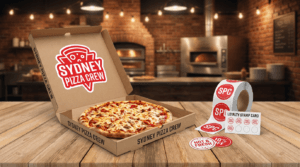
Picture this. It’s Friday night in a suburban Australian street — the kind where the smell of melted cheese and wood-fired dough drifts through open
The Complete Australian Guide for Beekeepers and Honey Producers Picture this: it’s a warm December morning in the Yarra Valley. The flow has been extraordinary

Picture this: it’s 6am on the Saturday before Mother’s Day, and a florist in Melbourne’s inner north is already three hours deep into the morning.