

Custom Stickers Melbourne
Custom Stickers Melbourne: The Complete 2026 Guide for Victorian Businesses Picture this: it’s a Thursday afternoon in a Brunswick café. The new logo finally landed
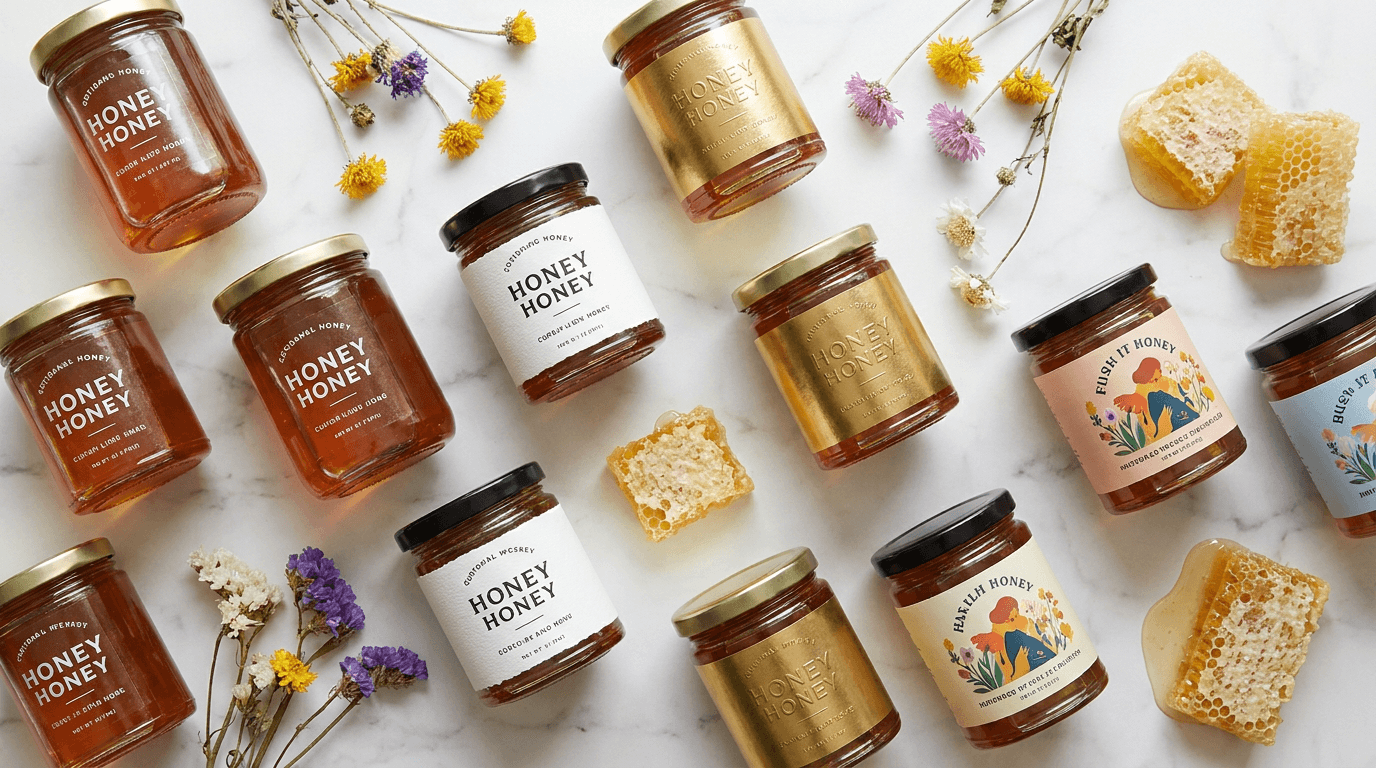
Picture this: it’s a warm December morning in the Yarra Valley. The flow has been extraordinary — a long, generous season that rewarded every early rise and every careful hive inspection. Now the frames are pulled, the extractor has done its work, and the bench is lined with gleaming glass jars, each one filled with honey so golden it almost glows. The beekeeper stands back and looks at the row of jars with quiet satisfaction.
Then comes the question that stops every honey producer at least once: what goes on the label?
A handwritten tag with a rubber band? A generic sticky label printed from the home office? Something that actually reflects the extraordinary natural effort poured into every single jar? The honey is exceptional. The label, at this moment, is an afterthought — and that gap between product quality and presentation is where real commercial opportunity is lost.
This guide exists to close that gap. It’s written for two types of honey producer: the backyard beekeeper bottling their first fifty-jar run for a weekend farmers’ market, and the growing cottage brand producing hundreds of jars per season for deli shelves, online orders, and wholesale accounts. Both need the same things — the right label material, a design that communicates trust and provenance, sizing that actually fits their jars, and full compliance with Australian food labelling law. And both deserve fast, professional printing without being forced into a minimum order of ten thousand units.
This guide covers everything. Sticker materials and when to use each one. Sizing references for every standard Australian honey jar. Design principles that translate beautifully to print. A plain-language breakdown of FSANZ compliance requirements. And a look at how fast-turnaround custom honey jar label printing from Fast Stickers makes all of it genuinely achievable for producers of any size, anywhere in Australia — from the Huon Valley to the Kimberley.
Your honey is extraordinary. Your label should say so.
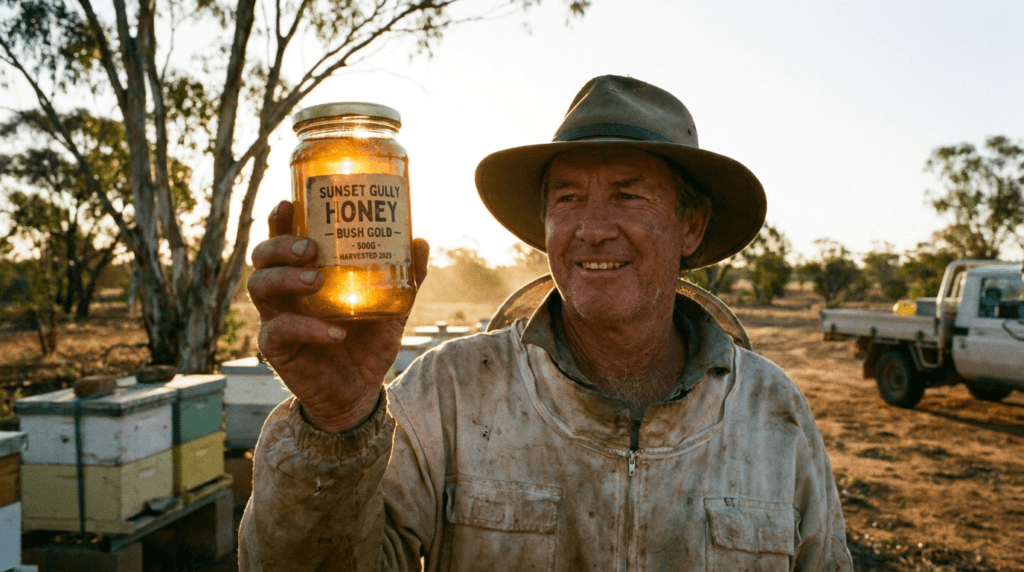
There is a moment that every honey producer needs to understand deeply — the moment a stranger picks up your jar for the first time. It happens at a farmers’ market stall on a Saturday morning. It happens when a café owner is scanning a deli shelf looking for something to stock. It happens when an online shopper is scrolling through product images at eleven o’clock on a Tuesday night. In each of these moments, the honey inside the jar is completely invisible. The only thing doing the selling is the label.
This is the foundational truth of honey marketing that experienced producers understand and new producers learn the hard way: the label is not an afterthought. It is the primary sales mechanism. It is the first conversation your brand ever has with a customer — and it happens without you in the room.
Honey is, visually speaking, a commodity. Two glass jars sitting side by side on a market table hold what looks like the same product. The honey inside might be worlds apart — one is a monofloral leatherwood from old-growth Tasmanian rainforest, and the other is a blended supermarket blend from three countries. But to the uninformed eye, both jars contain amber liquid. The label is the only thing that tells the difference. A beautifully designed label signals quality, provenance, and care before the lid is even touched. It communicates that the person behind the product takes their craft seriously — which is exactly what the customer wants to believe when they’re choosing to pay a premium for artisanal honey over the supermarket alternative.
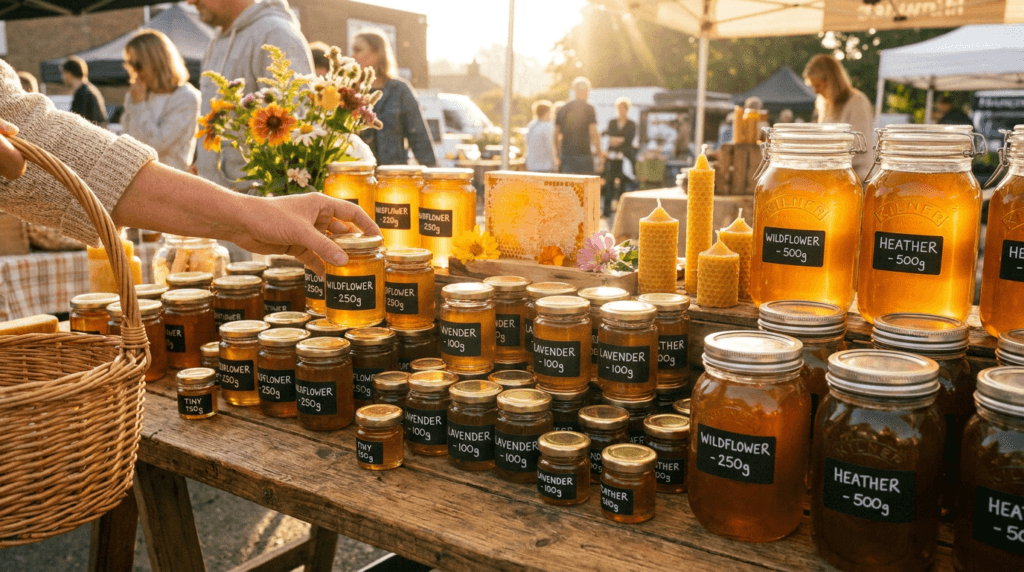
At a farmers’ market stall, research consistently shows that customers engage with a product physically before they engage verbally. They pick it up. They turn it around. They read the label — or at least they attempt to — while the producer is busy with another customer or the label has six seconds of their attention before they move on. In that window, the label must communicate brand name, honey variety, origin, and a sense of identity. That’s an enormous amount of work for a 62mm × 42mm rectangle, and it only gets done well when the label has been designed with genuine intention.
For online and wholesale channels, the stakes are even higher in a different way. The label photograph is the product. When a wholesaler views your product listing or a customer adds your jar to their cart, they’re making a purchasing decision based entirely on how the label looks in a photograph. A label that photographs poorly — low contrast, illegible text at digital thumbnail scale, cheap-looking material — translates directly to lost sales, regardless of how extraordinary the honey inside actually is.
“At a farmers’ market, a customer picks up a jar before they ask a single question. Your label is the first conversation your honey brand ever has.”
The long-term commercial argument for investing in proper labels is equally compelling. Honey producers who build recognisable branded labels create repeat purchase behaviour. Customers who remember a brand name — who can pick your specific jar off a shelf because they know the design, the colours, the feel of it — come back. Unnamed, unbranded honey is interchangeable. Branded honey builds loyalty, word-of-mouth referrals, and the kind of quiet reputation that sustains a small producer through lean seasons.
Just as custom stickers help food businesses turn packaging into a brand experience, honey producers who invest in label design are doing something strategically important: they’re turning a functional glass container into a branded product. And the research on branded packaging confirms it — when customers feel an emotional connection to a product’s identity, they come back, they recommend it, and they choose it again when they could just as easily choose something cheaper.
Before any of that can happen, though, you need to make the right choices about material, sizing, and design. And the first decision — the one that determines how your label survives everything from cold storage to summer market heat — is the choice of sticker material.
The wrong label material is an expensive mistake that most producers only make once. A paper label that bubbles and peels after a single afternoon in a cool room, or a cheap adhesive that lifts off a curved glass surface after two days on a market shelf, does real damage — not just aesthetically, but commercially. Customers notice a label that looks tired. And once a label fails, you’re reprinting. This section exists so that doesn’t happen.
The choice of sticker material for honey jar labels is driven by four factors: the environment the jars will live in, the surface they’ll be applied to, the aesthetic the producer wants to project, and the volume they’re producing at any given time. Get those four factors right and the material choice becomes straightforward.
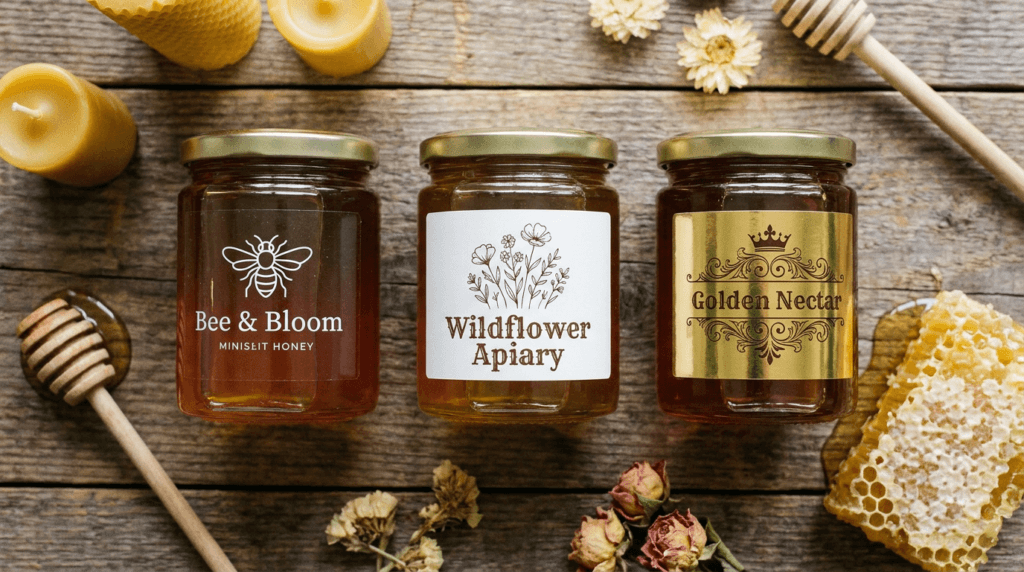
Vinyl stickers are the gold standard for most honey producers in most situations. Waterproof, oil-resistant, and moisture-resistant, vinyl holds its adhesion on cold glass pulled from a cool room and maintains its integrity through a full day at an outdoor market in Australian summer conditions. The permanent adhesive is strong enough to hold on curved glass surfaces, and the print quality is sharp and vibrant — colours stay true, text stays legible. Vinyl stickers are the all-rounder: if you’re not sure which material to choose, vinyl is almost always the right answer. For commercial honey producers selling through retail, wholesale, or markets in any Australian climate, vinyl should be the baseline material.
Clear stickers offer something that no other material does: they let the honey itself become part of the label design. A clear label on a glass honey jar creates a premium “no-label” look where the amber gold of the honey glows through any areas of the design that aren’t printed. For boutique and gift honey ranges — the kind of jar that gets purchased as a present, placed in a hamper, or displayed in a specialty food store — clear stickers are visually stunning. One important technical note: if your design includes any white elements (white text, white borders, white backgrounds to design elements), you’ll need clear stickers with white ink, which prints an opaque white layer beneath those elements so they don’t disappear against the glass.
Paper sticker rolls bring something that vinyl can’t quite replicate: the warm, organic, handcrafted feel that many artisanal honey brands actively want. A matte paper label in natural tones signals “cottage producer,” “raw honey,” and “made with care” — which is exactly the right message for wildflower honey, bush honey, and backyard hive brands that lead with authenticity over polish. The honest caveat is that paper labels are less moisture resistant than vinyl. They’re best suited to jars that will be stored indoors in dry conditions and aren’t going to sit in a cool room or face the unpredictable humidity of an outdoor market. For producers who control their storage environment and prioritise aesthetic, paper sticker rolls deliver a look that is genuinely beautiful and immediately communicates artisanal positioning.
Vinyl sticker rolls are the operational choice for producers labelling at volume. When you’re running off 200 jars on a Tuesday afternoon before market weekend, individual stickers applied one by one from a sheet are not the workflow you want. Vinyl rolls are dispenser-ready, consistent in application, and carry all the durability benefits of individual vinyl stickers. Vinyl sticker rolls make batch labelling efficient and professional — the labels feed smoothly, apply consistently, and look identical from the first jar to the last.
High tack stickers solve a specific problem that producers with particular jar shapes know well: the standard adhesive that holds perfectly on a flat or gently curved surface can lift at the edges when applied to a highly curved or textured glass jar. Squeeze honey bottles, rounded barrel jars, and embossed glass surfaces all present adhesion challenges that standard vinyl sometimes can’t fully address. High tack stickers use a stronger, more aggressive adhesive formulated for difficult surfaces — they stay put where standard labels might eventually lift.
Shiny gold stickers belong in a category of their own. They are not the everyday workhorse label — they are the premium statement piece. For gift honey ranges, Christmas hamper jars, wedding favour honey pots, and any product that is meant to communicate luxury from across the room, shiny gold stickers are the material that turns a glass jar into something genuinely gift-worthy. Tarnish-resistant and waterproof, they hold their metallic lustre in storage and on shelf.
Here’s how to match your situation to the right material at a glance:
One environmental reality that all honey producers should account for: honey is inherently sticky. Jars accumulate residue on their surfaces. In warm conditions, even minimal honey contact with a label edge can compromise a weaker adhesive. In cool storage, condensation is a constant challenge. Paper labels are beautiful but fragile in these conditions. Vinyl is the minimum recommended material standard for any producer selling commercially, and the custom vinyl sticker guide offers deeper context on why vinyl has become the industry standard for food product labelling in Australia.
Material chosen. Next comes the decision that trips up even experienced producers: getting the label size exactly right for each jar format.
Nothing is more frustrating than receiving a print run of beautifully designed labels and discovering they don’t fit the jars correctly. A label that’s too wide buckles and wrinkles. One that’s too tall runs into the shoulder taper or the jar’s base. One that’s too small looks lost on a large jar and misses the visual impact the design was intended to have. Getting sizing right before you order is the difference between a professional result and a costly reprint.
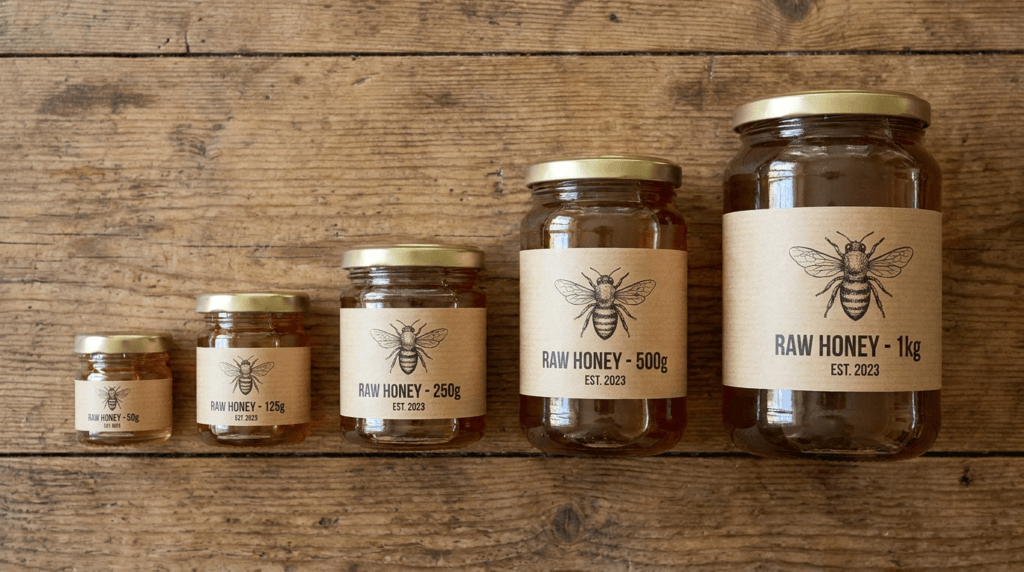
Australian honey is commercially bottled in five primary jar sizes: 50g, 250g, 350g, 500g, and 1kg. Each size demands different label dimensions — and within each size, producers choose between different label positions depending on how much information they need to carry and the visual effect they want to create.
Before diving into measurements, it’s worth understanding the four label positions commonly used on honey jars:
50g jars — the miniature format, popular for gifts, tastings, and favour packs. Labels need to be correspondingly small: a 61mm × 22mm rectangular front label works well, with a 40mm round lid label adding a branding touchpoint visible from above.
250g jars — the standard retail and farmers’ market format. The most common size in the Australian honey market, and the one for which most producers need to make the most deliberate sizing choices. Options include: 62mm × 42mm rectangular (front label — the most popular choice), 196mm × 51mm wraparound, 50mm round (lid), 62mm × 41mm oval, or 45mm × 45mm square for a contemporary feel.
350g jars — a mid-size format that suits producers who want to offer a step up from the 250g without committing to the larger 500g. Recommended sizes: 80mm × 45mm rectangular (front), 196mm × 51mm wraparound, 62mm × 41mm oval, 50mm × 50mm square, or 50mm round (lid).
500g jars — the workhorse of commercial honey production. Labels need to scale up to fill the larger surface without looking stretched or sparse. Options: 80mm × 45mm or 95.5mm × 65mm rectangular (front), 60mm × 52mm hexagonal (particularly effective on hexagonal-sided jars), 62mm × 41mm oval, or 50mm round (lid label).
1kg jars — the bulk format, popular with families, restaurants, and regular buyers. Labels need to carry significant information without looking cluttered. Recommended: 75mm × 110mm rectangular (front — tall format to fill the larger jar face), 200mm × 60mm wraparound, or 50mm round (lid).
For producers who want a complementary independent sizing reference, Avery Australia’s honey label guide provides useful cross-check measurements that align with these standard Australian jar formats.
One practical tip that saves many producers an expensive reprinting exercise: always measure the usable label area of your specific jar, not just its stated size. Glass jar manufacturers vary. Embossing, shoulder taper, base curve, and mould lines all reduce the flat usable surface. A label that fits perfectly on one brand of 500g jar may need to be trimmed for another. Measure your actual jar with a tape measure before finalising your label dimensions — account for the shoulder curve at the top and any embossing patterns on the sides.
For producers with hexagonal jars — a format with obvious and beautiful visual resonance for honey — die cut stickers in a custom hexagonal shape are available and deliver a label that works in harmony with the jar’s geometry rather than fighting it. Honeycomb-shaped labels on hexagonal jars are one of the most effective visual moves in honey product design. And if your jar dimensions fall outside standard sizes, a free custom quote covers bespoke dimensions with no minimum order pressure.
With material confirmed and sizing sorted, the real creative work begins. This is where a honey label goes from functional to genuinely unforgettable.
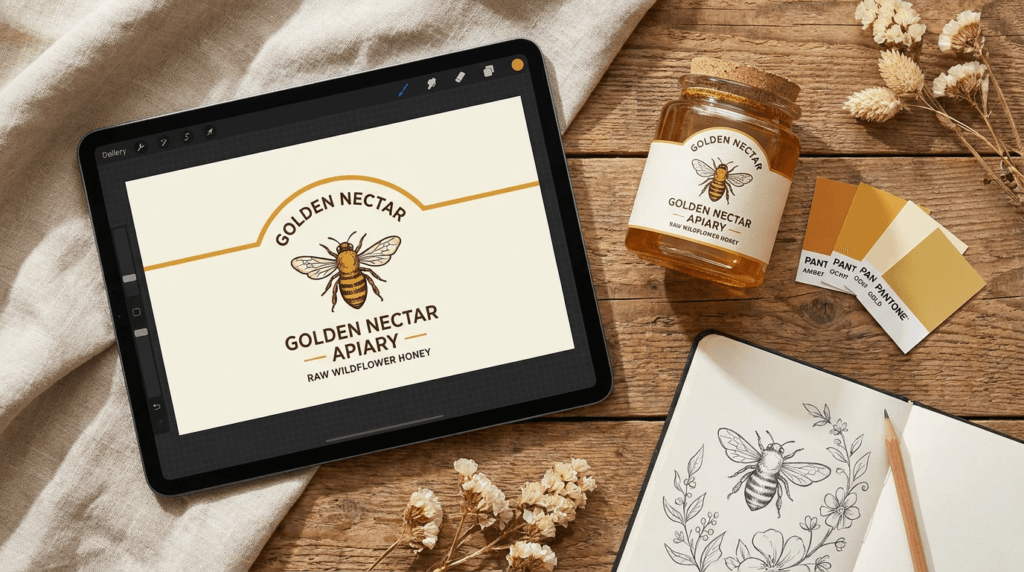
Good honey label design is a balance between tradition and intention. The honey category has a rich and immediately recognisable visual language — golden tones, botanical illustration, bees and honeycombs, warm textures, earthy warmth. This tradition exists because it works: it communicates authenticity, naturalness, and quality in a way that customers read instinctively. The question for every producer is not whether to acknowledge this visual tradition, but how to work within it — or how deliberately to step outside it.
Producers who work within the tradition are signalling: I am part of something established and trustworthy. This honey is real, natural, and made the old way. Producers who step outside it — choosing crisp white backgrounds, minimalist sans-serif typography, and no bees in sight — are signalling something different: I am a modern food brand. I am premium. I am for a certain kind of buyer. Neither choice is wrong. Both can be commercially brilliant. The critical thing is that the choice is made, not defaulted to.
Colour palettes and what they communicate:
The colours on your honey label are doing emotional work before the customer reads a single word. Warm amber, deep gold, cream, and beeswax tones are the classic palette — immediately trustworthy, visually harmonious with the honey itself, and deeply familiar in the honey category. They say natural, genuine, and carefully made. Forest green combined with natural brown speaks to raw honey, bush honey, and wilderness provenance — it says this honey came from somewhere specific and unspoiled. A crisp white-and-black label, by contrast, projects modern retail confidence and premium positioning; it works brilliantly for producers targeting contemporary food retail buyers who respond to clean, uncluttered design. Deep navy or slate blue communicates boutique sophistication — it’s a label designed for the gift shop, the hamper company, or the artisan food market.
Typography that reads at label scale:
Typography is the element most commonly underestimated in honey label design. The font choices that look beautiful on screen at full resolution may become illegible at actual label printing scale. Script and handwritten fonts project a warm, personal, artisanal feel — perfect for cottage producers who want their label to feel like it came from a person, not a factory. Classic serif fonts communicate tradition and reliability — they read as established brands. Clean sans-serif fonts project modernity and minimal premium positioning. The non-negotiable rule, regardless of which direction you choose: all text must be legible at the actual printed dimensions of your label. Test your design at true scale — print it out at 100% and read it at arm’s length — before approving any artwork.
Shape as brand signal:
The physical shape of your label is itself a piece of communication. Hexagonal labels carry an immediate and powerful visual reference to honeycombs — they’re so thematically appropriate for honey that they feel both clever and natural. Oval labels have a classic, elegant quality that suits traditional and artisanal brands; there’s something timeless about an oval jar label that feels like it belongs in a Victorian-era pantry. Round lid labels add a branding element visible from above — essential at market stalls where customers look down at a table full of jars. Rectangular labels offer maximum real estate for brand storytelling and compliance information, which makes them a practical choice for producers who need to carry a lot of content on a front label.
What your design should include:
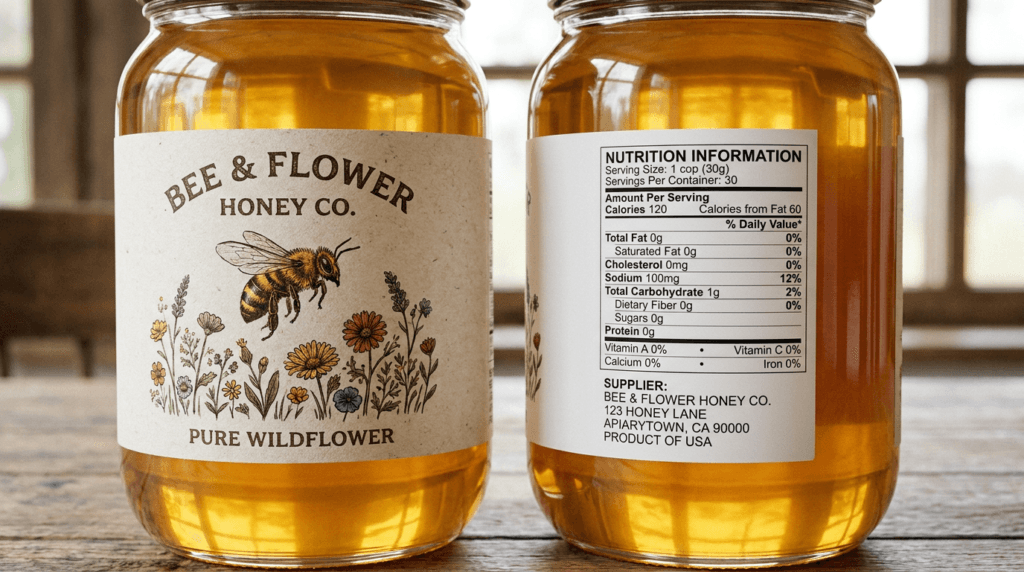
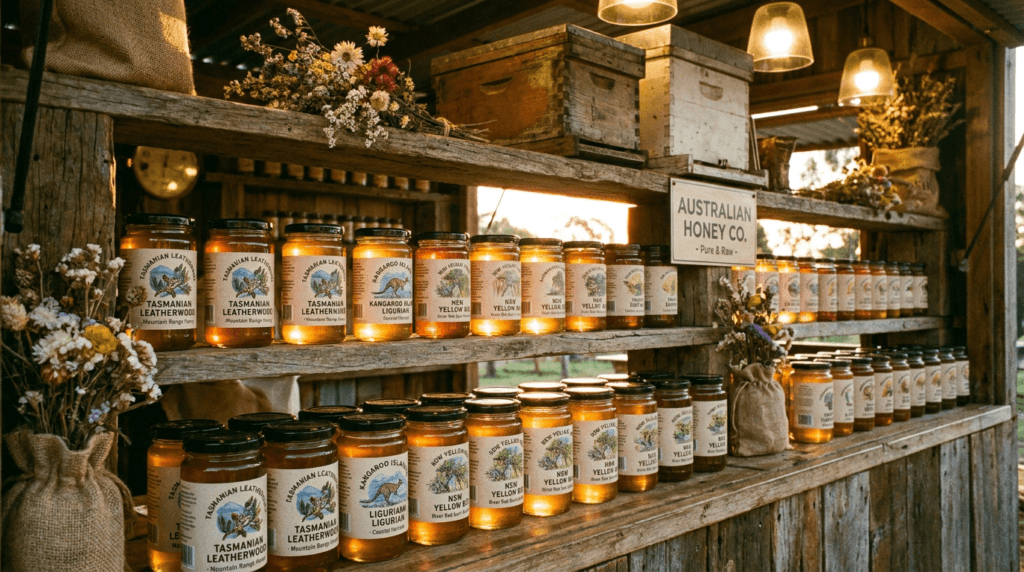
Think of your honey jar label as carrying two categories of content — brand elements and compliance elements. The brand elements are: your producer name or brand name (the primary identity anchor), the honey variety or classification (leatherwood, ironbark, manuka-style, wildflower, infused), a provenance statement that tells the jar’s story (Gippsland Bushland Honey, Sunshine Coast Hinterland Wildflower, Margaret River Raw), and your logo or brand mark — whether that’s a bee illustration, a botanical element, a hand-lettered wordmark, or an abstract design. The compliance elements — NIP, best before date, batch code, full supplier address, infant warning — can be carried either on an integrated back label or designed into the front label, depending on your jar size and information volume.
Designing for two contexts simultaneously:
A honey label has to work in two very different contexts: the physical retail environment (held in a hand, viewed at arm’s length, competing with jars on either side) and the digital environment (photographed for product listings, social media, and online stores, viewed at thumbnail scale on a phone screen). Designs that work in both contexts tend to share certain characteristics: strong contrast between text and background, a clear visual hierarchy that leads the eye to the brand name first, and a design that reads clearly even when the image is reduced to a small square on a website.
“Your honey jar label is not just a legal requirement — it’s your most compact piece of brand storytelling. In the space of a 62mm × 42mm rectangle, it has to earn trust, communicate provenance, and make someone reach for your jar instead of the one next to it.”
For producers using premium or gift-market positioning, shiny gold stickers and shiny silver stickers offer a metallic material finish that communicates luxury before the design even registers. For modern minimal brands, clear stickers with white ink deliver a premium transparency effect that makes the honey itself part of the visual. And for hexagonal or bespoke shapes, die cut stickers let the label’s shape itself become a brand element.
For producers who don’t have a graphic designer — which is most beekeepers, honestly — the free artwork service at Fast Stickers turns a rough idea, a sketch, or even a verbal description into a print-ready label design with unlimited revisions included. No design background needed.
A quick pre-order design checklist:
A beautifully designed label that doesn’t meet FSANZ requirements isn’t finished — it’s a liability. The next section covers what the law actually requires, in plain language that any producer can act on.
Compliance is the part of honey production that doesn’t come with the beekeeping kit. It arrives quietly — a question from a café owner, a query from a market organiser about food safety requirements, or the moment a producer starts looking at commercial retail and discovers that their current label is missing mandatory elements. Getting compliance right from the beginning is not bureaucratic overhead; it is the foundation of a trustworthy honey brand and a business that can scale without having to reprint everything mid-season.
Honey labelling in Australia is governed by the Food Standards Australia New Zealand (FSANZ) Food Standards Code. This is the national framework that applies to all food products sold commercially in Australia, and honey is specifically addressed within it. Non-compliance can result in product recalls, regulatory action, and loss of access to retail channels — outcomes that are entirely avoidable with a thorough label review before printing.
Here are the mandatory elements that must appear on every honey jar label sold commercially in Australia:
Product name — “Honey” is the required declaration for standard honeybee honey. If you produce honey from Australian native stingless bees, the required name is “Native Bee Honey” under Standard 2.8.3, introduced via FSANZ Amendment No. 229 on 22 July 2024.
Metric net weight — the quantity of honey in the jar, expressed in grams (e.g., “250g net”). This must be displayed in a standardised and legible format.
Country of origin — “Product of Australia” or equivalent Australian-origin statement. This is particularly important in the Australian honey market, where consumers actively seek local production as a quality and authenticity marker.
Business name and street address — the full street address (not a PO Box) of the supplier, manufacturer, or packer in Australia or New Zealand. This is a point that catches many small producers off guard — a post office box is not a compliant address for food labelling purposes.
Best before date — honey has a remarkably long shelf life, but a best before date is still legally required. It must be displayed in a clear and standardised format.
Batch or lot identification code — a traceability code that allows a specific production run to be identified in the event of a product recall or quality issue. This can be printed directly on the label, stamped separately on the jar, or applied as a small additional sticker.
Nutrition Information Panel (NIP) — this is the panel that declares average energy, protein, fat, saturated fat, carbohydrates, sugars, and sodium per serving and per 100g. The NIP is a significant piece of label real estate — it requires clear formatting and legible font size, and it genuinely cannot be squeezed into a small front label without compromising the design.
Infant warning statement — “Not suitable for infants under 12 months” is mandatory on all honey products sold in Australia, without exception. This warning must appear on every jar and must be legible.
Ingredients list — only required if the product contains anything beyond pure honey. If you produce pure, single-ingredient honey, no ingredients list is needed. If your honey contains flavourings, additives, or anything beyond pure honey, a full ingredients list in descending order of proportion is required.
Allergen declaration — required if any added ingredient contains a declared allergen under the FSANZ allergen framework. For pure honey with no additions, this is generally not applicable — but any infused or blended honey product may trigger allergen labelling obligations.
For native bee honey producers specifically, the introduction of Standard 2.8.3 via FSANZ Amendment No. 229 on 22 July 2024 established formal compositional and labelling requirements for honey produced by Australian stingless bee species. If you produce native bee honey, a thorough review of that specific standard is essential, as the compositional requirements differ from those for conventional honeybee honey.
The practical label design solution for compliance:
The NIP alone takes up enough space that fitting all mandatory elements onto a single small front label — while maintaining a legible, well-designed brand presentation — is genuinely difficult for jars smaller than 500g. The solution used by most professional honey producers is straightforward and fully FSANZ-compliant: a two-label system.
The front label carries the brand identity — name, logo, honey variety, provenance, and any mandatory statements that fit naturally within the design (product name, country of origin, best before date, infant warning). The back label — which can be a simple, clean, undesigned label — carries the NIP, batch code, full supplier address, and any remaining mandatory elements. Paper sticker rolls work well for clean, affordable back labels in controlled environments. Vinyl sticker rolls are the waterproof choice for back labels that need to survive cool storage and outdoor market conditions.
This system allows the front label to be as beautiful and brand-forward as the producer wants, while the back label handles all regulatory obligations cleanly, professionally, and compliantly. Compliance and design are not in opposition — they just need to be planned for from the beginning, not retrofitted to a design that was made without them in mind.
For the most current and detailed compliance guidance, foodstandards.gov.au/business/labelling is the authoritative source. Requirements can and do change — staying current with FSANZ updates is part of operating a responsible honey business.
With material, sizing, design, and compliance all understood, one practical question remains: how do you get labels printed fast enough to actually keep up with your bees?
Beekeeping operates on nature’s schedule, not the calendar’s. A strong honey flow in regional Victoria can arrive and close inside a two-week window. A beekeeper who extracts on a Monday and wants to be at market by the following Saturday doesn’t have three weeks to wait for a print run. They have five days. And that operational reality — the urgency of seasonal production, the unpredictability of flow timing, the need to move product quickly — is precisely why print lead times matter so much to honey producers in a way they don’t matter to some other industries.
This is the problem that Fast Stickers was built to solve. Not just for honey producers, but for every small Australian producer who operates on real timelines rather than theoretical ones.
2–3 business day turnaround: Most orders are produced and dispatched within two to three business days of artwork approval. For a producer who pulls a surprise early flow and needs labels in hand before the weekend, this turnaround is not a nice-to-have — it is what makes the whole commercial operation viable. Slow printing doesn’t just mean late labels. It means honey sitting in jars on a bench while a market weekend passes without it.
Rush orders for genuine emergencies: When the timeline is even tighter — an unexpected flow, a wholesale order that arrived without warning, a special event on Friday that needs product by Thursday — rush sticker orders are available. For urgent situations, calling Fast Stickers directly and marking an order as “URGENT” triggers the fastest available turnaround. This is the printing equivalent of a fast lane — it exists precisely because seasonal producers face real, time-critical situations.
Free express shipping, Australia-wide: A beekeeper in the Snowy Mountains receives exactly the same fast delivery as a producer in inner Melbourne. One in the Kimberley or the Huon Valley or rural South Australia is not penalised with freight surcharges or slower delivery tiers for being outside a metropolitan area. Free express shipping, nationwide, means that geography is not a barrier to professional label printing — which matters in a country as large and as regionally distributed as Australia.
“The bees don’t wait for your label printer. Your printing partner should be fast enough to keep up with them.”
No minimum order pressure: This is one of the most meaningful practical benefits for cottage producers and backyard beekeepers. A producer bottling fifty jars for a farmers’ market debut does not need five thousand labels. They need fifty — or a hundred if they want a buffer. Fast Stickers’ flexible ordering means small producers can order what they need, when they need it, without being forced into a minimum that locks capital into label stock they won’t use for months. Scale up when the operation scales up. Order what you need now.
Free design service with unlimited revisions: Most honey producers are extraordinary at beekeeping. Most are not graphic designers — and they shouldn’t need to be. The free artwork service at Fast Stickers means that a producer can arrive with a rough sketch, a brand name, a colour direction, and a general sense of what they want their label to feel like — and the design team will translate that into a print-ready, professionally designed honey jar label. Unlimited revisions means the process continues until the producer is genuinely happy with the result. Get a free quote to start the process with no commitment required.
Multiple varieties, multiple labels: Honey producers frequently manage several varieties simultaneously — wildflower and leatherwood running alongside a macadamia-blossom infused range and a creamed honey line. Each variety needs its own label. Fast Stickers can produce different label designs for different batch varieties in the same order, giving cottage brands the product range differentiation that lets a market stall feel like a full product line rather than a single SKU with variations.
The ordering process, step by step:
Australian-owned and locally operated: Fast Stickers is a Gippsland-based family business with more than fifteen years of experience serving Australian small businesses and producers. This is not a multinational platform with an Australian shipping address and an offshore production facility. It is a real Australian business that understands what it means to run a small food operation in this country — the seasonal pressures, the tight margins, the importance of getting it right the first time. For honey producers who position around local, Australian, and community values — which many do, given the profound ecological role of bees in Australian agriculture — working with a locally-operated supplier is itself an expression of those values.
For producers interested in understanding sheet-format options for small-batch labelling, kiss cut stickers offer a flexible format where multiple labels sit on a single backing sheet — a practical option for producers managing several label variants in small quantities.
Go back to that beekeeper in the Yarra Valley. The bench. The jars. The honey that took a full season to produce — the inspections, the splits, the careful extraction, the filtering and settling. Everything that went into those jars was done with extraordinary care. Thousands of kilometres flown by tens of thousands of bees. Weeks of flower bloom. Hours of hive management. And then the final step: the label.
The label is not separate from the craft. It is the completion of it. It is the moment where private effort becomes a public product — where something made in a shed or a backyard or a paddock becomes something that a stranger picks up, reads, considers, and chooses to spend their money on. A honey producer who has put that level of care into their product and then puts a handwritten tag on it is not finishing the work. They’re leaving it incomplete.
The key takeaways from this guide come back to a simple framework: right material, right size, right design, right compliance.
Right material means choosing vinyl for durability in commercial and outdoor settings, clear film for premium and boutique ranges that want honey’s natural colour to speak, shiny gold for gift occasions that demand luxury, and paper for artisanal brands operating in controlled indoor environments.
Right size means measuring your actual jar and matching your label dimensions to its usable surface — front label, back label, lid label, and wraparound each serving a different purpose and requiring different dimensions for each jar size from 50g to 1kg.
Right design means understanding the visual traditions of the honey category and making a deliberate choice about how to work within them or step beyond them — with colour, typography, shape, and imagery all working together to tell your brand’s story in the few seconds a customer gives you.
Right compliance means knowing the ten mandatory FSANZ elements that every honey jar label must carry, understanding the two-label system that lets beautiful design and legal compliance coexist, and staying current with standards like the 2024 native bee honey amendment.
And behind all of it: a printing partner who is fast enough to keep up with your season, close enough to understand your context, and flexible enough to serve a producer bottling fifty jars with the same professionalism as one producing five thousand.
Your honey is extraordinary. It is the product of seasons and effort and ecological wonder that most people will never fully appreciate. It deserves a label that matches what’s inside the jar.
Your honey is ready. Your label should be too.
Get custom honey jar stickers and labels printed fast — with free design, free express shipping, and a 2–3 business day turnaround. Fast Stickers is Australia’s specialist sticker and label printer, built for producers who take their product seriously.
Get Your Free Quote from Fast Stickers →
Browse the full range of sticker and label options for honey jars — vinyl, clear, die-cut, gold, sticker rolls, high tack, and more:
No designer? No problem. The free artwork service turns your brand idea into a print-ready honey jar label — included with every order, with unlimited revisions.
Custom Stickers Melbourne: The Complete 2026 Guide for Victorian Businesses Picture this: it’s a Thursday afternoon in a Brunswick café. The new logo finally landed
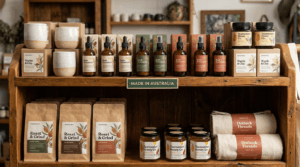
Picture this: it’s 9pm on a Tuesday in a spare room in Bendigo, and you’re sitting cross-legged on the floor because the table ran out
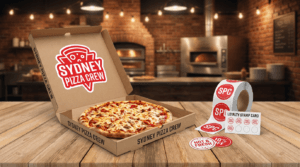
Picture this. It’s Friday night in a suburban Australian street — the kind where the smell of melted cheese and wood-fired dough drifts through open

Picture this: it’s 6am on the Saturday before Mother’s Day, and a florist in Melbourne’s inner north is already three hours deep into the morning.

Picture this: it’s a Tuesday night in a sticky-floored pub somewhere in Fitzroy or Fortitude Valley. The lights are low, the monitors are buzzing, and