
Custom Stickers Melbourne
Custom Stickers Melbourne: The Complete 2026 Guide for Victorian Businesses Picture this: it’s a Thursday afternoon in a Brunswick café. The new logo finally landed
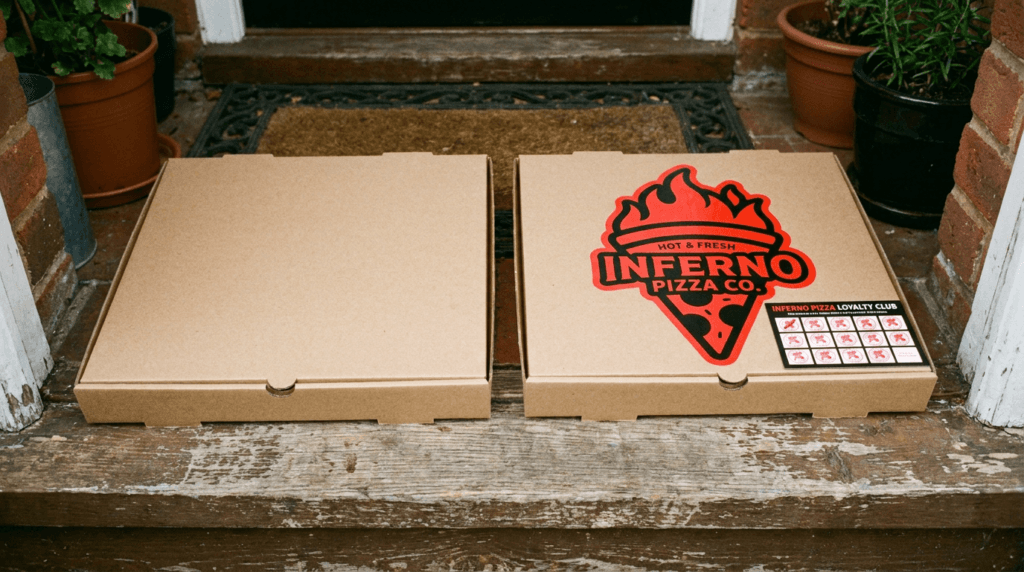
Picture this. It’s Friday night in a suburban Australian street — the kind where the smell of melted cheese and wood-fired dough drifts through open car windows. Two pizzerias sit side by side, both pumping out orders, both with a queue building at the counter. A delivery driver drops two boxes on a doorstep: one sealed with a strip of generic packing tape, its plain brown cardboard carrying no story and no soul. The other arrives differently — a bold die-cut logo sticker seals the lid, the brand colours pop even under a porch light, and tucked inside is a loyalty card with two stamps already on it and a seasonal promo sticker winking from the inside lid. The customer doesn’t just notice the difference. They feel it.
That feeling — the warmth of a brand that thought about you — is not accidental. It is the result of a deliberate, affordable, and surprisingly powerful decision: to invest in custom pizza shop stickers.
In Australia’s increasingly competitive pizza market, the difference between a customer who orders once and one who orders every Friday night is often not the pizza. Most pizza is good. What separates the shops that build genuine customer loyalty from the ones that quietly churn through one-time orders is the brand experience built around the pizza itself. And custom stickers are one of the most accessible, fast-turnaround, and high-impact ways to build that experience — from the box that leaves your kitchen to the window that faces the street to the loyalty card sitting in your customer’s wallet.
In this guide, we’ll cover everything an Australian pizza shop owner needs to know about using custom stickers strategically:
Let’s start with the market you’re operating in — because the opportunity is bigger than most pizza shop owners realise.
There has never been a better time to own a pizza shop in Australia. And there has never been a more competitive time, either.
According to industry research from IMARC Group, the Australian pizza market was valued at USD $3,237.5 million in 2025 and is projected to reach USD $4,659.2 million by 2034 — growing at a compound annual growth rate of 4.13%. That’s a market adding well over a billion dollars in value over the next decade, driven by digital ordering platforms, changing consumer lifestyles, and a genuine Australian love affair with pizza as a convenient, shareable, and endlessly customisable meal.
The growth is real. The opportunity is significant. And the competition is intensifying at exactly the same pace.
What makes the current landscape particularly challenging for independent pizza operators is the rise of food delivery platforms. Uber Eats, DoorDash, and their competitors have fundamentally changed how Australians discover and order pizza. On those platforms, every pizzeria looks roughly the same: a logo thumbnail, a star rating, a price point, and a delivery time estimate. The browsing experience offers almost no opportunity for brand differentiation. A customer scrolling through options at 6:30pm on a Friday isn’t lingering on your brand story — they’re deciding in seconds.
This means the physical delivery moment — the box that arrives at the door, the bag that’s handed across the counter, the sticker that seals the lid — has become one of the most important brand impressions an independent pizza shop can make. It’s the moment when your brand moves from a thumbnail on a screen to a real, tangible experience in a customer’s home. And it’s a moment that most independent operators are leaving entirely unbranded.
“40–60% of the global pizzeria market is made up of independents — and in Australia, those shops compete not just on flavour, but on brand.”
That statistic matters enormously. The large chains — your Domino’s, your Pizza Huts — have national marketing budgets, brand recognition built over decades, and the kind of loyalty infrastructure that takes years and millions of dollars to construct. Independent pizza shops can’t compete with that at scale. But they can compete on something the chains consistently struggle to deliver: the feeling of a local brand that actually cares. A brand that feels considered, personal, and specific to your suburb. And that feeling, more often than not, starts with a sticker.
Custom pizza shop stickers are not a marketing luxury reserved for businesses with large budgets. They are one of the most cost-effective branding tools available to any food business. A roll of branded paper sticker seals costs a fraction of what a social media ad campaign costs, lasts an entire service run, and touches every single customer who orders from you. As a companion read, this guide on how restaurants can use custom logo stickers to elevate their food delivery branding explores this principle in broader detail — and much of it applies directly to the pizza shop context.
Australian customers are increasingly loyal to brands that feel considered and local. They’re less impressed by the sheer size of a chain and more drawn to the pizza shop that feels like it knows the neighbourhood. Stickers are how you signal that — quickly, affordably, and with every single order.
Having established why Australia’s pizza market makes branding more urgent than ever, let’s move into the most visible and impactful branding opportunity available to you: the pizza box itself.
The pizza box is not just packaging. It is a branding surface unlike almost anything else in food service.
Think about it from your customer’s perspective. A coffee cup is held, sipped from, and discarded in minutes. A burger wrapper is unwrapped and scrunched up before the first bite. But a pizza box? It is carried through the front door, placed on the kitchen bench or coffee table, and sits in the centre of the meal for the entire duration — sometimes for hours, if there are leftovers in the fridge. It’s photographed for social media. It travels in the back seats of cars. It ends up on office tables at lunch. The pizza box is, square for square, one of the most sustained branding surfaces in all of food service. And most pizza shops in Australia are sending theirs out completely blank.
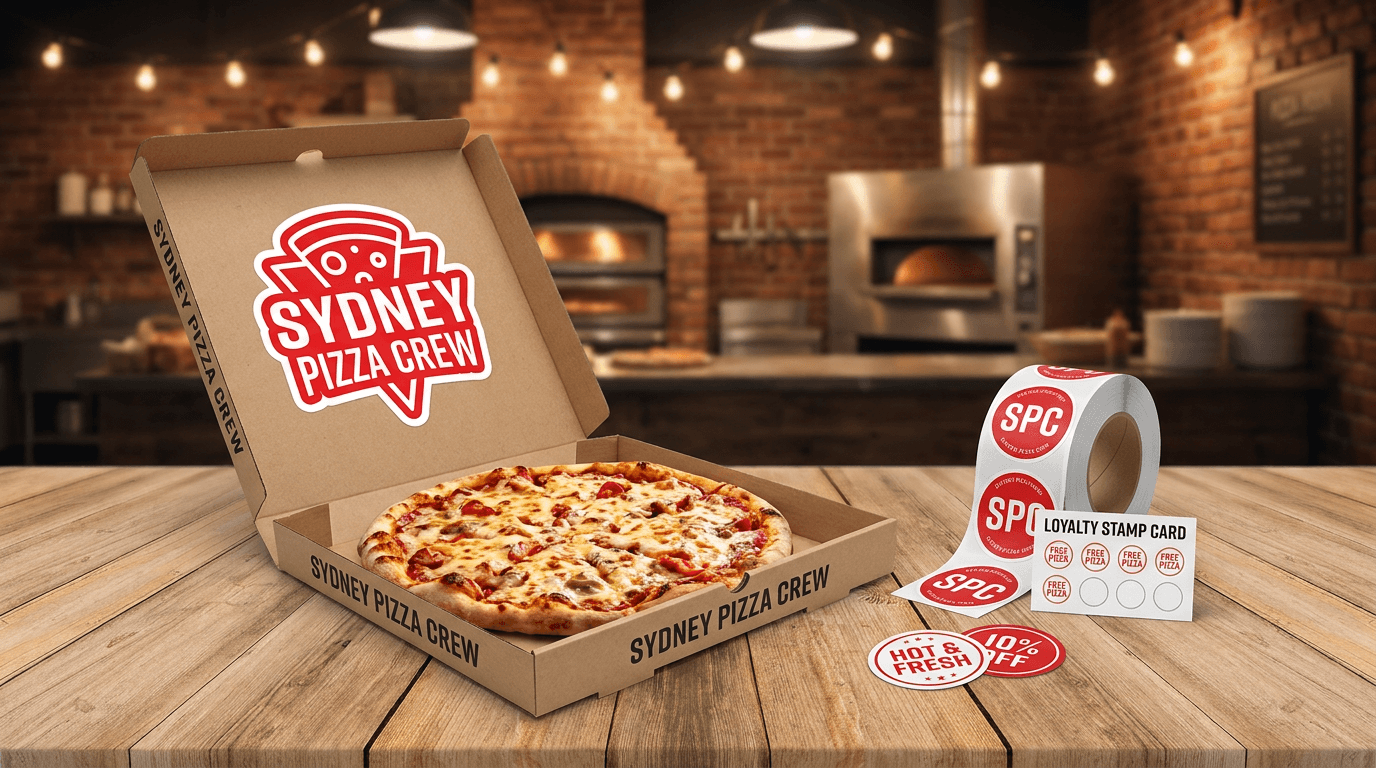
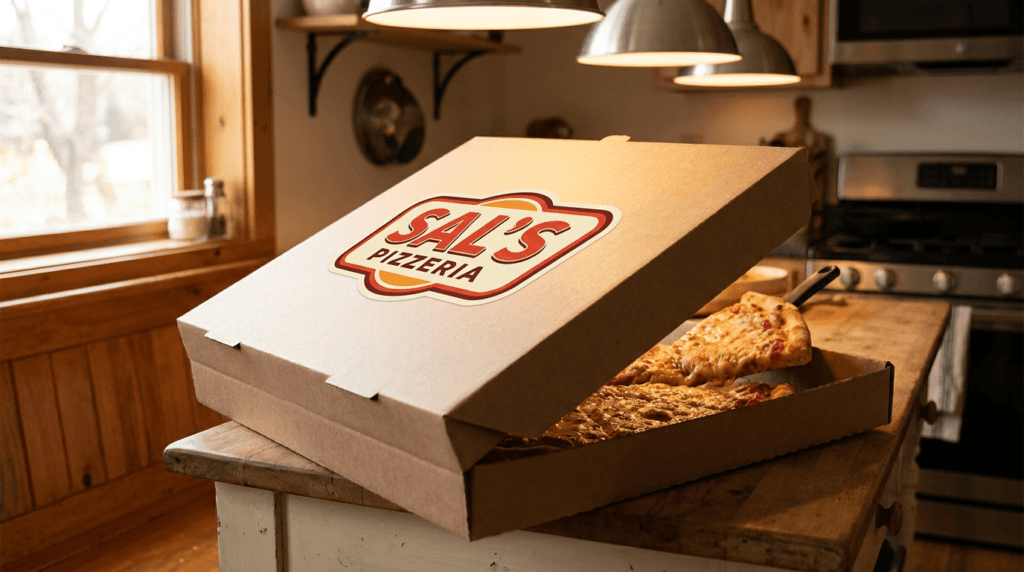
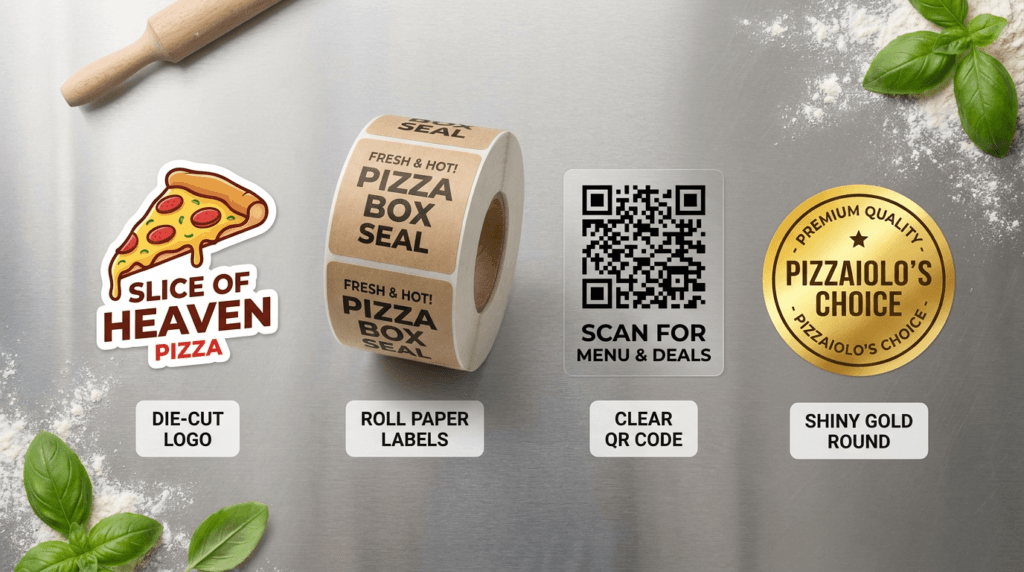
The most impactful placement on any pizza box is the top lid centre. A 75–100mm die-cut sticker — shaped precisely to follow the outline of your logo, not stuck inside a square or circle border — creates an immediate and unmistakeable brand statement the moment the box is placed in front of your customer. There’s something psychologically compelling about a die-cut logo: it looks intentional. It looks like it was designed for this box, for this brand, for this specific moment. Because it was.
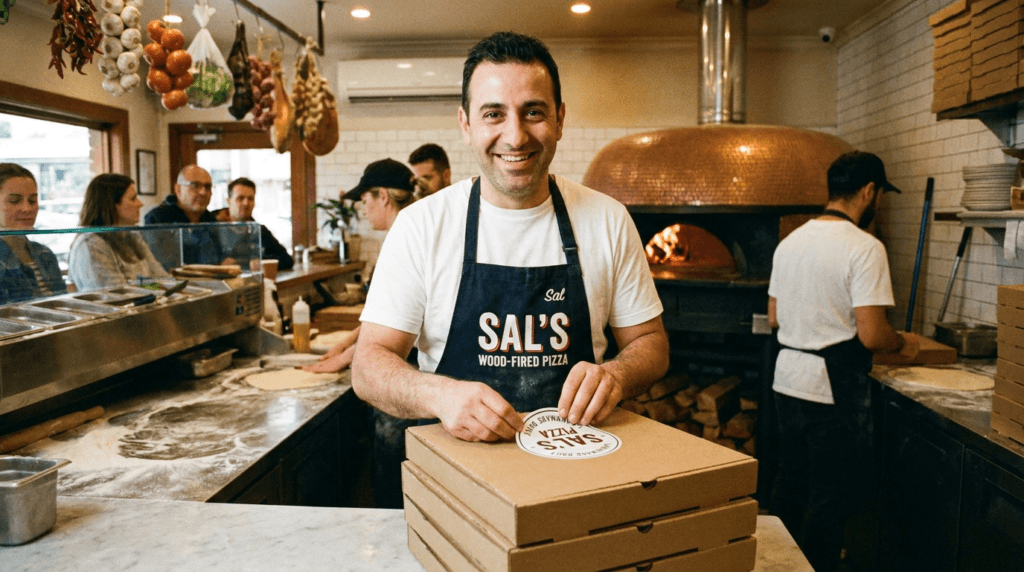
The box seal is a second placement worth your attention, and it serves a dual purpose that is easy to overlook. A sticker applied across the join between the lid and the base of the pizza box does two things simultaneously: it brands the box and it acts as a tamper-evident seal. For delivery orders especially, a sealed box communicates food safety and care — something that matters to customers who aren’t watching their order being prepared. A torn or missing seal is immediately noticed. An intact branded seal, on the other hand, is a quiet signal of professionalism that builds trust before the box is even opened.
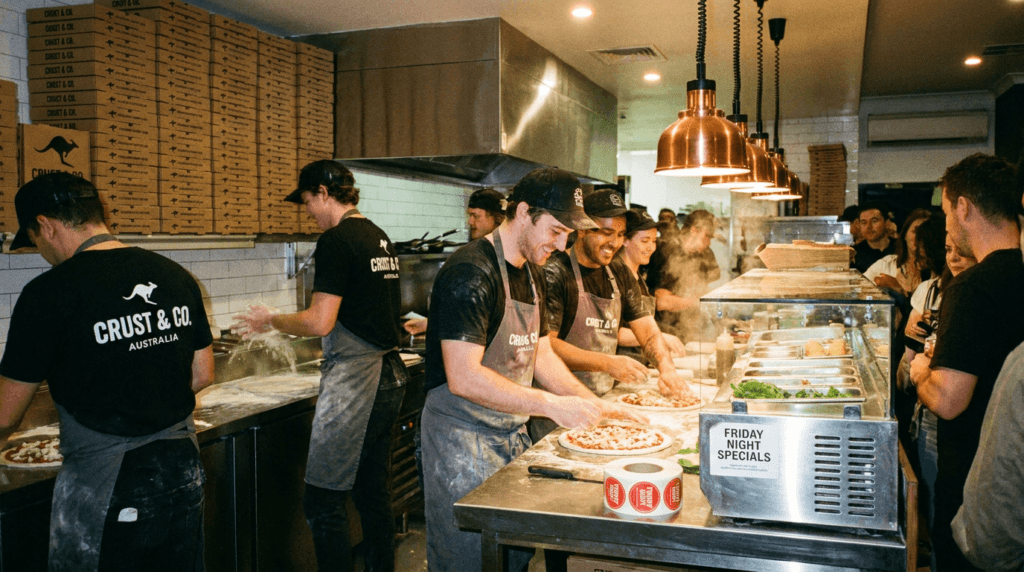
For high-volume services — if you’re sending out 50, 100, 150 boxes on a busy Friday night — paper sticker rolls are the format that makes this practical. They peel fast, apply consistently, and are cost-effective at volume. A team member can seal a box in under two seconds with a well-placed roll on the prep bench. Speed matters in a pizza kitchen, and the right sticker format makes branded sealing as fast as reaching for the tape dispenser.
Plain box vs. branded box — the contrast is stark:
A plain box arrives at the door communicating nothing except that a pizza is inside. A branded box — die-cut logo sticker centred on the lid, tamper seal across the join, and a small “thank you” or promo sticker on the inside lid — arrives communicating that this pizza shop is professional, that it thinks about its customers, and that it is a brand worth remembering. That is not a small difference in the mind of the customer. That is the difference between a one-time order and a saved favourite.
The inside of the box lid is a branding canvas that almost no pizza shop is using. A small branded sticker placed on the inside of the lid — a warm “thanks for ordering”, a QR code linking to your loyalty sign-up, or a limited-time promotional offer — creates a genuine moment of surprise and delight when the customer lifts the lid. It’s an unexpected touch in an expected moment. And unexpected touches are exactly what get customers talking. Boosting brand loyalty with custom stickers explores this “surprise and delight” principle in depth, and it applies powerfully to the inside-the-box moment.
The pizza box doesn’t stop travelling when it reaches your customer’s home, either. Every branded box that goes out in a delivery driver’s car is a mobile brand impression for every house on the route. Every box left on an office table is a brand impression for every colleague in the room. Every box photographed and shared on social media is a brand impression for every follower. The box is your ambassador — and a branded box is a far better ambassador than a plain one.
Branding the box is the most visible sticker strategy — but the most powerful loyalty tool a pizza shop can deploy goes inside the box: the loyalty sticker card.
Here is a number worth sitting with for a moment: it costs 5 to 7 times more to acquire a new customer than to retain an existing one.
That single statistic reframes the entire economics of running a pizza shop. Every dollar you spend on social media ads, Google listings, or delivery platform promotions to attract someone who’s never ordered from you before is worth five to seven times what it would cost to simply keep a customer you already have. And yet most independent pizza shops invest far more in acquisition than they do in retention. Loyalty programs are the most direct and proven tool for closing that gap.
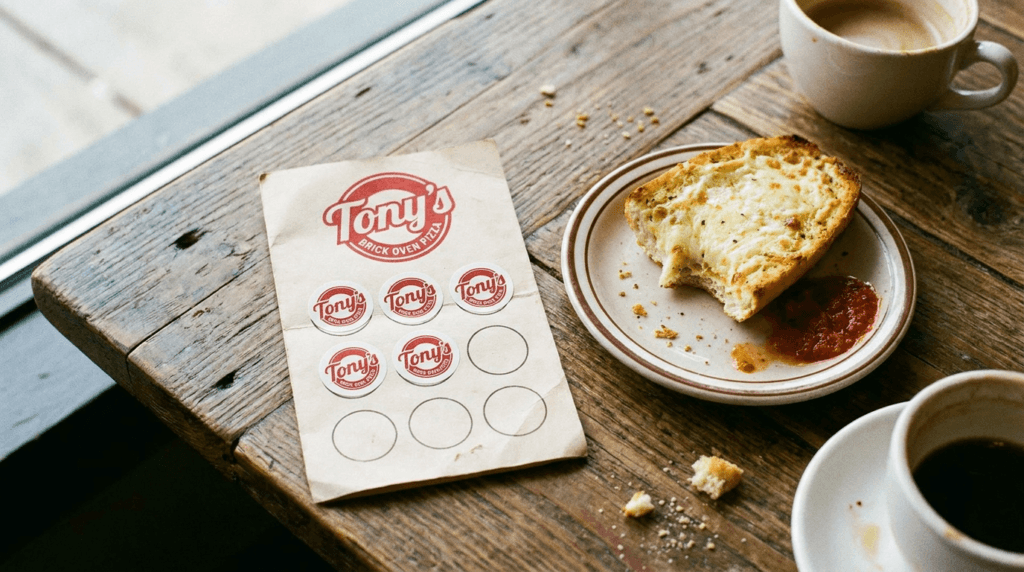
The classic “buy 10, get 1 free” loyalty stamp card has been a staple of independent food businesses for decades — and it still works, because the psychology behind it is rock solid. Behavioural scientists call it the Endowed Progress Effect: when customers receive a card with 2 stamps already on it (instead of starting from zero), they feel measurably more motivated to complete the card than customers who start from scratch. The perception of progress creates momentum. A customer who already has 2 of 10 stamps feels invested. They have something to lose if they don’t come back. That’s not manipulation — it’s just understanding how people think.
Pizza shop loyalty programs specifically drive measurable increases in visit frequency and average order value, and the mechanism is intuitive: a customer who is three stamps away from a free pizza has a reason to choose your shop over the other one down the street, even if the other shop is marginally cheaper on that particular night. Loyalty programs shift the decision-making frame from price comparison to progress completion. That is a profound change in customer behaviour, and it’s achievable with a printed card and a roll of stickers.
How does it work in practice? A small card — business card size or slightly larger — printed with your pizza shop’s logo, brand colours, and 8 to 10 clearly marked stamp or sticker spots. At each order, a small round logo sticker or branded stamp is applied to the card. On completion, the customer redeems for a free pizza, a garlic bread, a discount off their next order — whatever reward works for your margin. Simple. Tangible. Effective.
“When budgets are tight, people choose businesses that make them feel valued.” — Stamp Me, How Loyalty Programs Help Australian Small Businesses
The power of the physical loyalty card is something that gets underestimated in an era of app-based loyalty schemes. Unlike a digital loyalty program that lives in an app customers rarely open, a physical loyalty card lives in the wallet. Every time your customer opens their wallet — at the servo, at the supermarket, at the bottle shop — they see your pizza shop’s brand. It’s a passive, daily brand touchpoint that costs you nothing after the card is printed. No app subscription, no digital infrastructure, no push notification strategy. Just a beautifully branded card doing its quiet, persistent work.
Here’s a creative twist that takes the physical card to the next level: instead of a rubber stamp, give customers a small sheet of branded mini stickers — tiny pizza icons, logo marks in your brand colours, or custom seasonal designs — to collect and stick onto their card themselves. This gamifies the experience. It makes the loyalty card something customers interact with actively rather than passively. And it makes it shareable — a loyalty card covered in custom-designed mini stickers is far more likely to end up in an Instagram story than a card with generic ink stamps.
Australian small businesses are increasingly turning to loyalty programs as a direct response to cost-of-living pressures affecting their customers. In a market where households are more cautious about discretionary spending, a loyalty card signals genuine value. It tells your customer: we know you come back, and we reward you for it. That’s not a small thing when people are watching every dollar.
FastStickers can print both components of a complete loyalty card system: the cards themselves (via branded business card printing with custom sticker spots) and the small branded sticker stamps that go on them — a complete solution from one Australian supplier, delivered in 2–3 business days.
A simple implementation timeline for any pizza shop ready to launch:
Loyalty programs keep existing customers coming back — but attracting new customers and promoting specials requires a different kind of sticker strategy entirely. That’s where promotional stickers and menu labels come in.
Every pizza shop has a story to tell beyond its standard menu. A winter special. A footy finals deal. A new gourmet topping. A limited-time collaboration with a local supplier. The challenge is communicating those stories quickly, affordably, and without reprinting your entire menu every time something changes. That’s exactly what promotional stickers are built for.
Think of promotional stickers not as decoration but as active selling tools — physical communications that direct your customer’s eye, communicate urgency, and make it easy for someone to say yes to something they might otherwise have missed.
Seasonal and limited-time offer stickers are one of the highest-impact applications. A run of removable stickers printed with your footy finals deal, your Christmas special, or your “New on the Menu” announcement can be applied over existing menus, on counter cards, on window displays, and on packaging — without a single full reprint. When the promotion ends, they peel off cleanly. FastStickers’ 2–3 business day turnaround means a promotion can go from idea to in-store in under a week — fast enough to respond to a trending moment, a local event, or a competitor move. In the fast-moving food service environment, that kind of agility is a genuine competitive advantage.
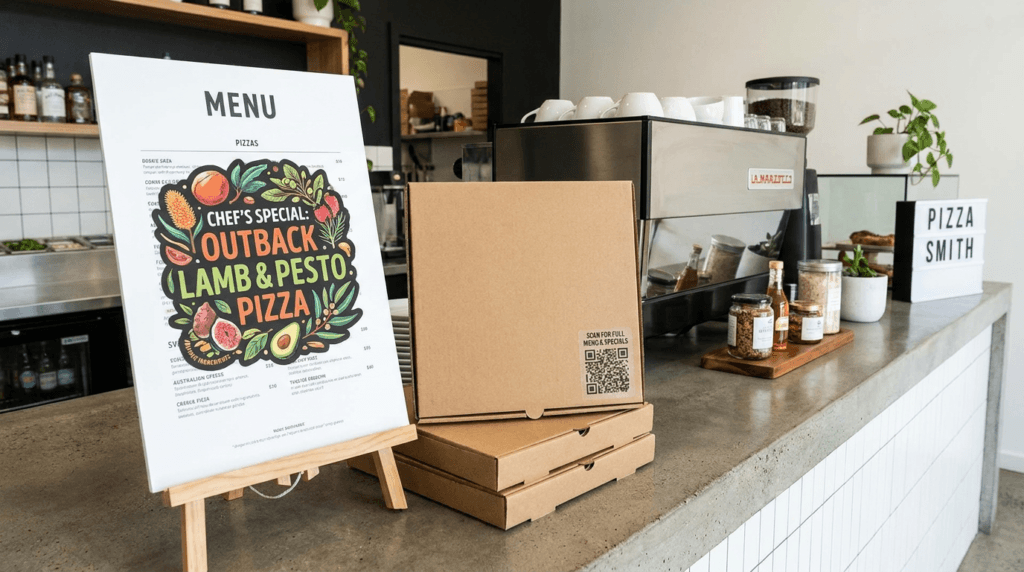
“Chef’s Special” and “New Item” stickers deserve their own mention, because they do something specific that menus often can’t: they draw the eye to the items you most want to sell. This is a technique borrowed directly from retail merchandising — the brightly coloured badge that says “New” or “Recommended” next to a product on a shelf. Applied to a printed menu, a menu board insert, or a counter display card, a well-designed special sticker can meaningfully increase orders on high-margin items. Your regulars know your standard menu. A sticker tells them there’s something worth trying that they haven’t had before.
Ingredient and allergen labels are a practical application that pizza shops selling packaged products cannot overlook. If your shop sells frozen pizzas, fresh dough balls, house-made sauces, or any packaged food product for retail sale, Australian food labelling requirements apply — and they apply rigorously. Country of origin and allergen labelling requirements from business.gov.au are worth reviewing if your shop moves into retail products. Paper sticker rolls with food-safe adhesive options are the practical format for this application — printable with ingredient lists, allergen warnings, best-before dates, and country of origin information.
QR code stickers are one of the most underused tools in the independent pizza shop marketing toolkit. A small QR code sticker — ideally printed on clear stickers for a premium, intentional look on any packaging surface — applied to a pizza box lid, a delivery bag, or a counter card can link your customer directly to:
Every delivery becomes a re-marketing moment. Every box lid becomes a digital touchpoint. The QR code sticker is tiny, inexpensive, and quietly working every time a customer’s phone camera hovers over it.
Event and occasion stickers give your packaging a seasonal energy that customers notice and appreciate. Footy finals packaging. An Australia Day special. A Valentine’s Day heart-shaped pizza in a box sealed with a gold foil sticker. A Christmas pizza with festive seasonal messaging. These small moments of seasonal relevance make customers feel like your shop is present and alive — not just churning out orders. Removable stickers are ideal for these short-run campaigns, applying cleanly to existing packaging and menus for the duration of the occasion, then peeling off without residue when the season passes.
“Order Online” and platform signage stickers are the simplest sticker application of all — and one of the most commonly overlooked. A small sticker on your shopfront window or counter surface that says “Order on Uber Eats” or “Order Online at [yourwebsite.com.au]” is a professional, functional signal that tells walk-in customers how to engage with your shop beyond the counter. It increases delivery ordering discoverability for customers who might not have searched for you on the platform. And if you’re running a rush promotion — FastStickers’ rush sticker orders can have these in your hands even faster when timing is critical.
Inside the shop and on the box, stickers are working hard — but the brand opportunity doesn’t stop at the front door. Window stickers, delivery vehicle decals, and in-store signage extend your pizza shop’s brand presence into the street, the suburb, and the neighbourhood.
A pizza shop’s physical presence in the street is one of its most undervalued marketing assets. Before a customer ever opens the app, they may have driven past your shopfront a dozen times. They may have seen your delivery driver’s car parked two streets away. They may have glanced at your window while walking past. Every one of those moments is a brand impression — and a sticker-based branding strategy can make every single one of them count.
Your shopfront window is prime real estate. Static cling stickers are ideally suited to this application for one simple reason: they apply without adhesive, come off without residue, and can be repositioned or swapped out for seasonal campaigns as easily as you change your specials board. Opening hours, delivery platform logos, “Now Open” announcements, seasonal promotions — all of these can live on your window in a professional, clean format that changes as your business changes. There’s no commitment, no damage to the glass, and no removal headache when the campaign is done.
For a more permanent brand statement — the kind that tells every person who walks past your shop exactly who you are — vinyl stickers applied to the shopfront door, front window, or awning create a professional first impression that holds up through Australian sun, rain, and the UV intensity that fades lesser materials. Premium vinyl with UV-resistant inks doesn’t yellow, peel, or crack. It looks the same six months later as it did on the day it was applied. For a branded shopfront that projects confidence and permanence, vinyl is the material of choice.
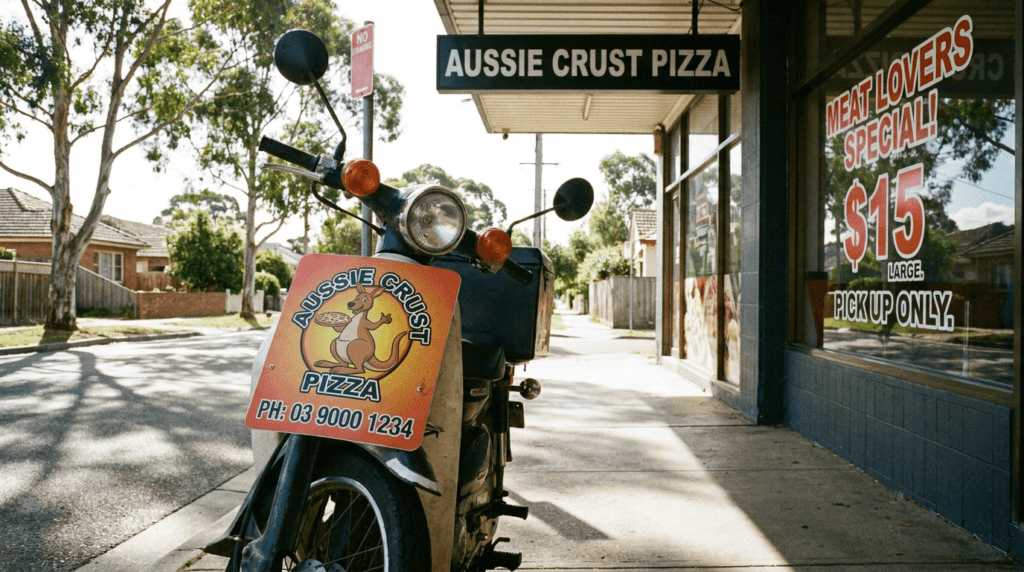
Delivery vehicle stickers are perhaps the most overlooked brand touchpoint in the independent pizza shop’s arsenal. If your shop runs its own deliveries — whether by car, scooter, or bike — every delivery run is a moving brand impression through your local neighbourhood. A bumper sticker or vehicle panel sticker on your delivery vehicles, featuring your logo and phone number or website, turns every delivery route into hyperlocal marketing. The houses on that route see your brand. The cars that pull up behind your driver at the lights see your brand. The pedestrians who step aside as your scooter pulls into the driveway see your brand. No ad spend required. No targeting algorithm needed. Just your logo, moving through the neighbourhood that is your actual customer base.
This is marketing at its most literal and its most effective: reaching the exact people — in the exact streets — that you want as customers.
In-store branding is another layer that stickers handle efficiently and affordably. A fridge door sticker highlighting cold drink specials. A counter sticker with a QR code prompting loyalty program sign-up. A menu board flag sticker calling out a new item. A “Customer Favourite” callout beside your most popular pizza. These layered, in-store brand details create an environment that feels considered and professional — a significant upgrade from the generic takeaway shop aesthetic that many independents default to, without requiring a shopfit or a signage company.
For textured surfaces — brick walls, rough plaster, uneven counter faces — standard adhesive stickers may struggle to bond properly. High tack stickers are specifically formulated for irregular and challenging surfaces, with an adhesive strength that grips where standard stickers won’t. If you want to brand the brick wall behind your counter, the textured exterior of your shopfront, or a rough-plaster internal feature wall, high tack is the specification you need.
The coherence principle is worth naming explicitly here, because it’s what makes a sticker branding strategy more than a collection of individual tactics. When a customer sees the same logo on your shopfront window, on your delivery vehicle, on the pizza box that arrives at their door, and on the loyalty card in their wallet — they have experienced a cohesive brand. Not just a logo, but a presence. Not just a pizza shop, but a brand identity that shows up consistently wherever they encounter you. Cohesive brands are the ones customers remember. They are the ones customers recommend to a friend when asked: “do you know a good local pizza spot?”
“A brand is not what you say it is. It’s what they say it is — and they say it because of every touchpoint they’ve experienced.”
The custom vinyl stickers for business and product labelling guide goes deeper into how businesses use vinyl across multiple touchpoints to build cohesive, professional brand identities. For pizza shops specifically, the opportunity is as wide as your imagination and as achievable as a single order placed today.
A quick brand touchpoint map for your pizza shop:
With a clear picture of every place your brand can appear, the final practical question is which sticker material is right for each application — because in a pizza shop environment, heat, grease, moisture, and high volume all place real demands on the products you choose.
Not all stickers are created equal. And in the pizza shop environment — where surfaces are hot, hands are greasy, boxes are corrugated, windows are glass, and the pace is relentless — material selection is the difference between a sticker that performs all service and one that peels off before the delivery reaches the door.
Here’s a practical, application-specific guide to the sticker materials that matter most for pizza shops:
Paper sticker rolls — The workhorse of the pizza kitchen. Ideal for high-volume applications where speed and cost-efficiency matter: pizza box seals, ingredient and allergen labels, loyalty stamp spots, and short-term promotional labels. Paper stickers peel and apply fast, perform reliably on dry cardboard and paper surfaces, and are the most cost-effective option at volume. Not recommended for surfaces exposed to moisture or condensation — use vinyl in those environments.
Vinyl sticker rolls — The right call anywhere moisture or grease is a factor. Cold drink cup labelling, cold food container branding, sauce bottle labels, and any packaging that might encounter condensation should use vinyl rather than paper. Vinyl’s water resistance keeps the label intact and legible where paper would bubble, peel, or smear.
Die-cut stickers — The premium choice for hero brand placements. The pizza box lid, loyalty card inserts, and branded giveaway stickers — anywhere the first impression matters most and you want the sticker to look like it was purpose-built for your brand. Die-cut stickers are cut to follow the exact outline of your logo, with no background border, creating a professional and intentional look that generic square or round stickers simply cannot match.
High tack stickers — Essential for textured and challenging surfaces. Corrugated pizza boxes with textured surfaces, brick walls, rough internal plaster, and uneven counter faces all require a stronger adhesive bond than standard stickers provide. High tack is also the right specification for kraft and recycled packaging, which is increasingly popular in the pizza industry as sustainability-conscious operators switch away from standard bleached board. Recycled and kraft surfaces can be notoriously difficult for standard adhesives — high tack resolves this reliably.
Clear stickers — The invisible premium. For QR codes on packaging where you want the code to appear printed directly on the surface, for transparent container labelling where the product should be visible through the label, and for branding on glass shopfront surfaces where a “no-label” look is the goal. Clear stickers communicate premium intent — they look expensive without costing more than standard vinyl.
Removable stickers — Precision tools for temporary applications. Seasonal menu overlays, limited-time promotional flags on menu boards, window displays for short-run campaigns. Removable stickers apply cleanly, look professional during the campaign, and peel off without leaving residue or damaging the surface beneath. They’re the responsible choice when you want flexibility without the permanence.
Shiny gold stickers — The special occasion upgrade. A gold die-cut logo sticker on a black pizza box for a Valentine’s Day special, a grand opening, or a premium “chef’s tasting” edition is a social-media-worthy packaging moment. It signals occasion, quality, and thoughtfulness in a way that standard sticker finishes simply don’t. Reserve these for the moments when you want packaging to feel like a gift rather than a delivery.
Static cling — The flexible shopfront solution. No adhesive, no residue, easily repositioned or removed. Perfect for shopfront window displays, inside-the-shop glass partitions, and fridge door promotional messaging. Static cling lets your window work as a changing promotional canvas without any permanent commitment.
A note on heat: pizza boxes are warm by nature, and the question of whether stickers can handle that temperature is one that comes up regularly. The answer, for exterior-applied stickers, is straightforward: FastStickers’ standard vinyl materials are formulated for durability well beyond the ambient surface temperature of a pizza box lid. The sticker is applied to the outside of the box, not inside where direct heat exposure is possible — and at those surface temperatures, premium vinyl performs without issue through delivery and beyond. Always apply stickers to external surfaces only.
Quick reference — matching sticker to application:
Before sending your artwork to print, it’s worth reviewing FastStickers’ artwork and print quality guide — a practical resource for ensuring your design files are set up correctly and your stickers come out looking exactly as intended. Getting the file right before printing saves time, cost, and the frustration of reprints.
Return, for a moment, to that Friday night doorstep. Two pizza boxes. Two very different experiences. One is forgotten by Saturday morning — a functional delivery, adequate and anonymous. The other is remembered. Not because the pizza was necessarily better, but because the experience of receiving it was better. The brand was present. Someone thought about the customer.
That is what custom pizza shop stickers do. They take the moments your product is in front of your customer — the box on the table, the loyalty card in the wallet, the shopfront window in the neighbourhood — and fill them with brand intent. They transform packaging from a container into a communication. They turn a delivery into a relationship.
Australia’s pizza market is growing. The opportunity is real and it is expanding. But so is the competition — and in a market where 40–60% of operators are independents competing for the same Friday night orders, the brands that invest in their physical presence are the ones that get remembered, recommended, and reordered from. Custom stickers are not a finishing touch. They are a fundamental part of building a pizza shop brand that stands out in an increasingly crowded field.
The investment is minimal. The impact is sustained. And with FastStickers’ 2–3 business day turnaround, free express shipping Australia-wide, free artwork design service, and over 15 years of experience helping Australian businesses look professional and stand out, getting started has never been more straightforward.
Your pizza is already worth ordering again. Make sure your brand makes it worth remembering.
Ready to brand your pizza shop with custom stickers that arrive fast?
Get a Free Quote from FastStickers →
Browse the full range of stickers and labels for pizza shops and food businesses:
Shop FastStickers →
Don’t have a designer? FastStickers’ free artwork service means you don’t need one. Bring your logo and let the team handle the rest.
Learn More About FastStickers →
Custom Stickers Melbourne: The Complete 2026 Guide for Victorian Businesses Picture this: it’s a Thursday afternoon in a Brunswick café. The new logo finally landed
Picture this: it’s 9pm on a Tuesday in a spare room in Bendigo, and you’re sitting cross-legged on the floor because the table ran out
The Complete Australian Guide for Beekeepers and Honey Producers Picture this: it’s a warm December morning in the Yarra Valley. The flow has been extraordinary

Picture this: it’s 6am on the Saturday before Mother’s Day, and a florist in Melbourne’s inner north is already three hours deep into the morning.
Picture this: it’s a Tuesday night in a sticky-floored pub somewhere in Fitzroy or Fortitude Valley. The lights are low, the monitors are buzzing, and